Roberts Tamalee, Ling Clare L, Watthanaworawit Wanitda, Cheav Chanvoleak, Sengduangphachanh Amphonesavanh, Silisouk Joy, Hopkins Jill, Phommasone Koukeo, Batty Elizabeth M, Turner Paul, Ashley Elizabeth A
Lao-Oxford-Mahosot Hospital-Wellcome Trust Research Unit, Microbiology Laboratory, Mahosot Hospital, Mahosot Road, Vientiane, Lao PDR.
Centre for Tropical Medicine and Global Health, Nuffield Department of Medicine, University of Oxford, Oxford, UK.
JAC Antimicrob Resist. 2024 Nov 28;6(6):dlae195. doi: 10.1093/jacamr/dlae195. eCollection 2024 Dec.
AmpC β-lactamases are neglected compared with ESBL as a cause of third-generation cephalosporin (3GC) resistance in Enterobacterales in low- and middle-income countries and the burden is unknown. The aim of this study was to investigate the presence of AmpC β-lactamase-producing and in clinical specimens from three clinical research laboratories in Southeast Asia.
Stored clinical isolates of and resistant to ceftriaxone or ceftazidime or cefpodoxime and ESBL confirmation test negative were screened using MASTDISCS AmpC, ESBL and Carbapenemase Detection Set-D72C. Short-read WGS was performed to identify genes.
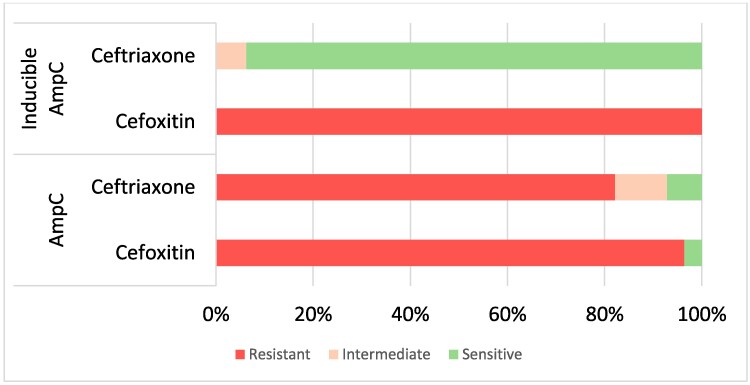
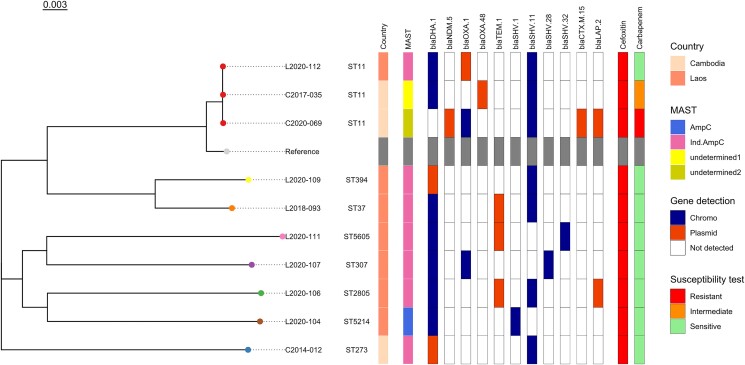
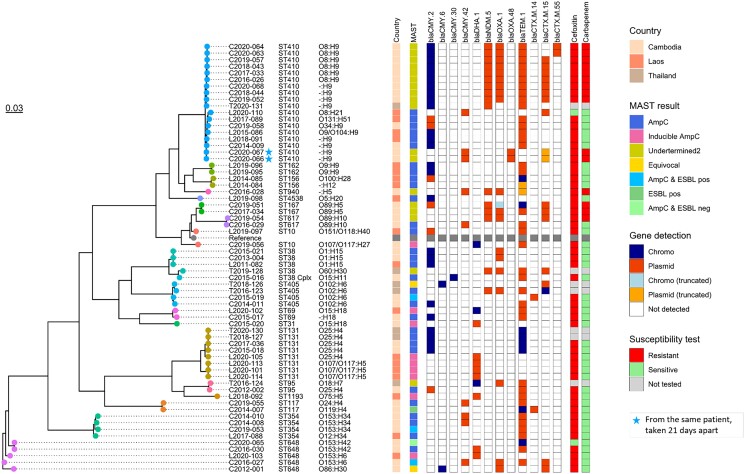
Of 126 isolates collected between 2010 and 2020, 31 (24.6%) and 16 (12.7%) were phenotypically AmpC and inducible AmpC positive by MASTDISCS testing, respectively. All inducible AmpC isolates were ceftriaxone susceptible and 97.7% of AmpC/inducible AmpC isolates tested against cefoxitin were resistant. Through WGS, 17 and eight different STs were detected for the AmpC/inducible AmpC and isolates, respectively. Twelve different β-lactamase resistance genes were detected, with most commonly in AmpC-positive isolates (20/31; 64.5%; 15 chromosomal, five plasmid). All inducible AmpC-positive isolates had the gene (seven chromosomal, nine plasmid).
Though uncommon, AmpC and inducible AmpC β-lactamases in and are an important cause of infection in Southeast Asia. With current testing methods, these infections may be going undetected, resulting in patients receiving suboptimal treatment.
在低收入和中等收入国家,与超广谱β-内酰胺酶(ESBL)相比,AmpCβ-内酰胺酶作为肠杆菌科细菌对第三代头孢菌素(3GC)耐药的原因被忽视,其负担尚不清楚。本研究的目的是调查东南亚三个临床研究实验室临床标本中产生AmpCβ-内酰胺酶的肠杆菌科细菌和大肠埃希菌的存在情况。
使用MASTDISCS AmpC、ESBL和碳青霉烯酶检测试剂盒-D72C对储存的对头孢曲松、头孢他啶或头孢泊肟耐药且ESBL确认试验阴性的肠杆菌科细菌和大肠埃希菌临床分离株进行筛选。进行短读长全基因组测序(WGS)以鉴定ampC基因。
在2010年至2020年收集的126株分离株中,分别有31株(24.6%)和16株(12.7%)经MASTDISCS检测表型为AmpC阳性和诱导型AmpC阳性。所有诱导型AmpC分离株对头孢曲松敏感,97.7%的AmpC/诱导型AmpC分离株对头孢西丁耐药。通过WGS,分别在AmpC/诱导型AmpC肠杆菌科细菌和大肠埃希菌分离株中检测到17种和8种不同的序列型(ST)。检测到12种不同的β-内酰胺酶耐药基因,ampC最常见于AmpC阳性分离株中(20/31;64.5%;15个染色体型,5个质粒型)。所有诱导型AmpC阳性分离株均有blaDHA基因(7个染色体型,9个质粒型)。
虽然不常见,但肠杆菌科细菌和大肠埃希菌中的AmpC和诱导型AmpCβ-内酰胺酶是东南亚感染的重要原因。采用目前的检测方法,这些感染可能未被发现,导致患者接受的治疗效果欠佳。