Shrestha Lok Bahadur, Tungatt Katie, Aggarwal Anupriya, Stubis Aija, Fewings Nicole L, Fichter Christina, Akerman Anouschka, Rodrigo Chaturaka, Tedla Nicodemus, Lee Sharon, Lloyd Andrew R, Brilot Fabienne, Britton Warwick J, Kelleher Anthony, Caterson Ian D, Douglas Mark W, Rockett Rebecca, Tangye Stuart G, Triccas James A, Turville Stuart G, Sandgren Kerrie J, Bull Rowena A, Cunningham Anthony L
The Kirby Institute, University of New South Wales, Sydney, NSW, Australia; School of Biomedical Sciences, Faculty of Medicine & Health, University of New South Wales, Sydney, NSW, Australia.
Centre for Virus Research, The Westmead Institute for Medical Research, Westmead, NSW, Australia.
EBioMedicine. 2024 Dec;110:105461. doi: 10.1016/j.ebiom.2024.105461. Epub 2024 Nov 28.
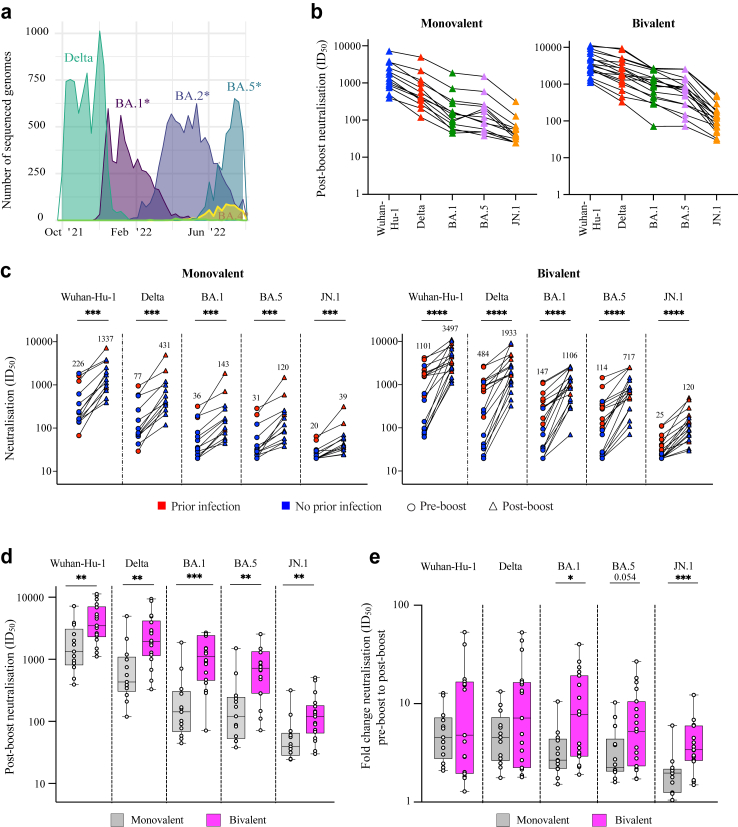
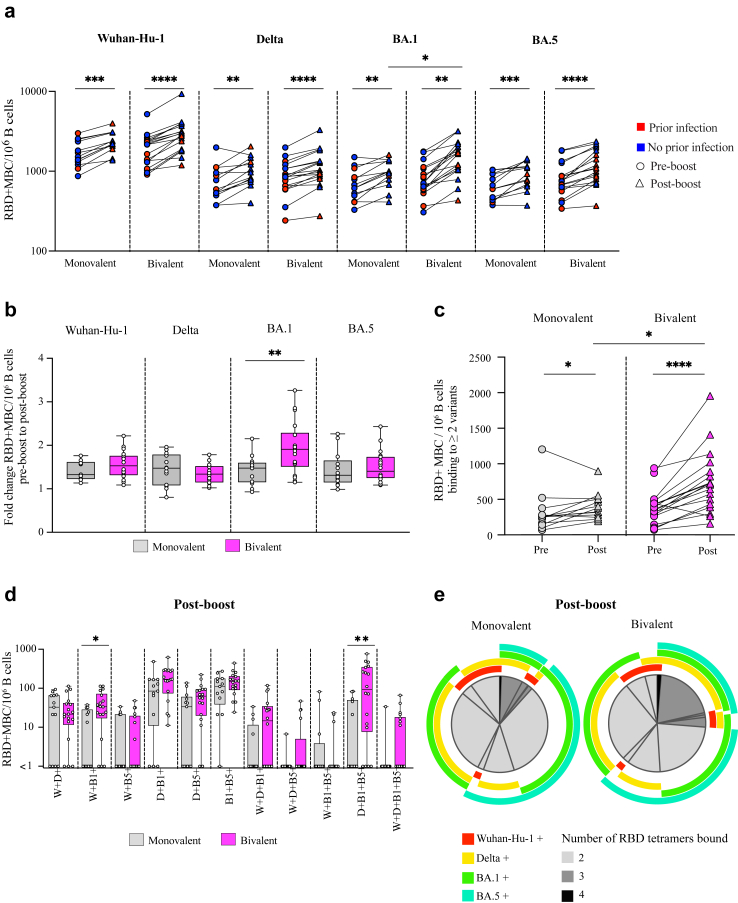
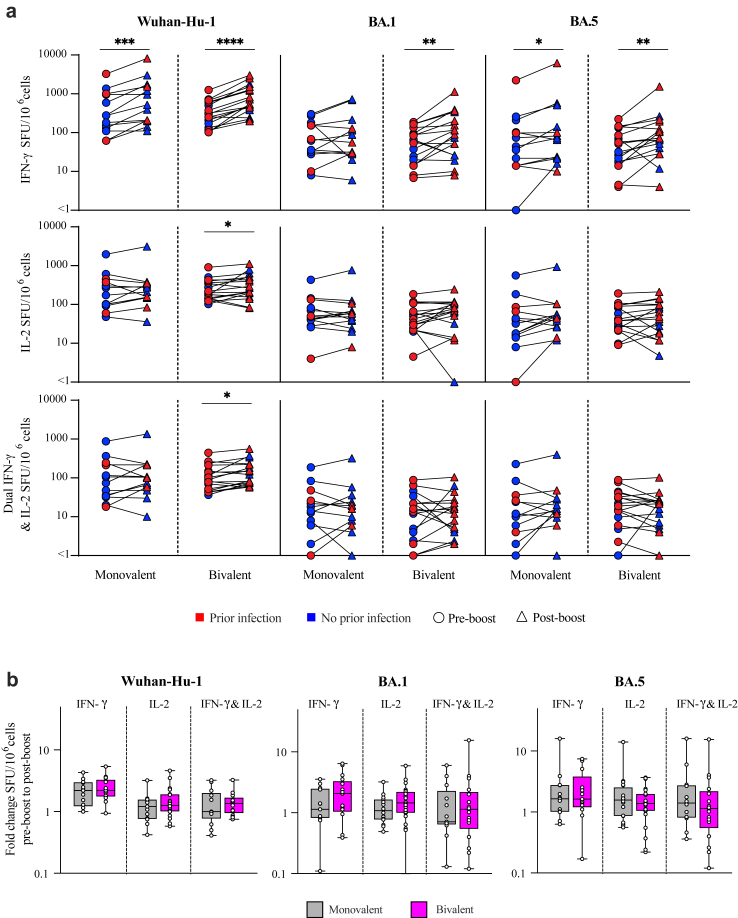
Current literature informs us that bivalent vaccines will generate a broader serum neutralizing antibody response to multiple SARS-CoV-2 variants, but studies on how this breadth relates to the memory B cell (MBC) and T cell responses are sparse. This study compared breadth of neutralising antibody, and memory B and T cell responses to monovalent or a bivalent ancestral/Omicron BA.1 COVID-19 booster vaccine.
At baseline and 1-month post-booster, neutralisation activity and frequencies of receptor binding domain (RBD)-specific MBCs and Spike-specific memory T cells were measured against a panel of variants.
Both vaccines boosted neutralising antibodies to 5 variants - Wuhan-Hu-1, Delta, BA.1, BA.5 and JN.1, the latter of which had not yet emerged at the time of sample collection. The bivalent vaccine induced a significantly larger increase in nAb against BA.1 and JN.1. Both vaccines boosted RBD-specific MBC responses to Wuhan-Hu-1, Delta, BA.1 and BA.5 variants with a significantly greater increase for BA.1 in the bivalent group. The breadth of MBCs was significantly higher in those who received the bivalent boost and correlated with nAb breadth. Both vaccines significantly boosted Spike-specific T cell responses to the Wuhan-Hu-1 and BA.5 variants, but only the bivalent vaccine boosted BA.1 responses.
These results suggest that the bivalent vaccine confers an advantage against future novel variants due to increased frequency of broadly reactive RBD-specific B cells.
Work supported by NSW Health for the NSW Vaccine, Infection and Immunology Collaborative (VIIM).
当前文献表明,二价疫苗将对多种严重急性呼吸综合征冠状病毒2(SARS-CoV-2)变体产生更广泛的血清中和抗体反应,但关于这种广度与记忆B细胞(MBC)和T细胞反应之间关系的研究却很少。本研究比较了单价或二价原始毒株/奥密克戎BA.1新冠病毒加强疫苗的中和抗体广度以及记忆B细胞和T细胞反应。
在基线和加强免疫后1个月,针对一组变体测量中和活性以及受体结合域(RBD)特异性MBC和刺突特异性记忆T细胞的频率。
两种疫苗均将针对5种变体(武汉-1株、德尔塔、BA.1、BA.5和JN.1,后者在样本采集时尚未出现)的中和抗体水平提高。二价疫苗诱导针对BA.1和JN.1的中和抗体显著增加。两种疫苗均增强了针对武汉-1株、德尔塔、BA.1和BA.5变体的RBD特异性MBC反应,二价组针对BA.1的增加更为显著。接受二价加强免疫者的MBC广度显著更高,且与中和抗体广度相关。两种疫苗均显著增强了针对武汉-1株和BA.5变体的刺突特异性T细胞反应,但只有二价疫苗增强了针对BA.1的反应。
这些结果表明,由于广泛反应性RBD特异性B细胞频率增加,二价疫苗对未来新型变体具有优势。
由新南威尔士州卫生部为新南威尔士州疫苗、感染与免疫学合作项目(VIIM)提供支持。