Kwon Taeeun, Ahn Byeongchan, Kang Ki Hyuk, Won Wangyun, Ro Insoo
Department of Chemical and Biomolecular Engineering, Seoul National, University of Science and Technology, Seoul, Republic of Korea.
Department of Chemical and Biological Engineering, Korea University, Seoul, Republic of Korea.
Nat Commun. 2024 Nov 29;15(1):10239. doi: 10.1038/s41467-024-54495-5.
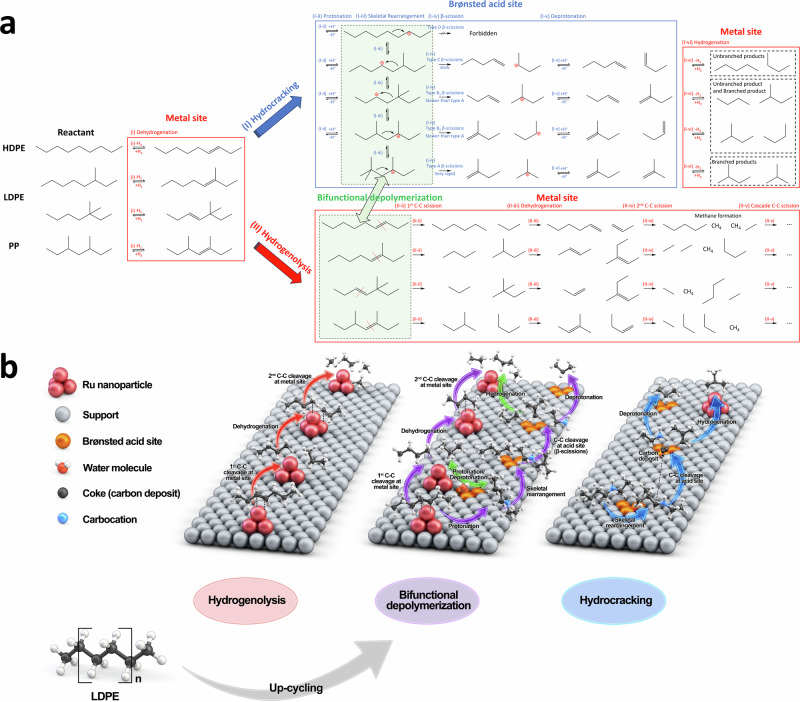
The surge in global plastic production, reaching 400.3 million tons in 2022, has exacerbated environmental pollution, with only 11% of plastic being recycled. Catalytic recycling, particularly through hydrogenolysis and hydrocracking, offers a promising avenue for upcycling polyolefin plastic, comprising 55% of global plastic waste. This study investigates the influence of water on polyolefin depolymerization using Ru catalysts, revealing a promotional effect only when both metal and acid sites, particularly Brønsted acid site, are present. Findings highlight the impact of Ru content, metal-acid balance, and their proximity on this interaction, as well as their role in modulating the isomerization process, affecting product selectivity. Additionally, the interaction facilitates the suppression of coke formation, ultimately enhancing catalyst stability. A comprehensive techno-economic and life cycle assessment underscores the viability and environmental benefits of the process, particularly in the presence of water. These insights advance understanding and offer strategies for optimizing polyolefin plastic recycling processes.
2022年全球塑料产量激增,达到4.003亿吨,加剧了环境污染,仅有11%的塑料被回收利用。催化回收,尤其是通过氢解和加氢裂化,为升级回收占全球塑料垃圾55%的聚烯烃塑料提供了一条很有前景的途径。本研究考察了水对使用钌催化剂的聚烯烃解聚的影响,结果表明只有当金属位点和酸性位点,特别是布朗斯特酸性位点同时存在时才会有促进作用。研究结果突出了钌含量、金属-酸平衡及其邻近性对这种相互作用的影响,以及它们在调节异构化过程、影响产物选择性方面的作用。此外,这种相互作用有助于抑制焦炭形成,最终提高催化剂稳定性。一项全面的技术经济和生命周期评估强调了该工艺的可行性和环境效益,特别是在有水存在的情况下。这些见解增进了人们的理解,并为优化聚烯烃塑料回收工艺提供了策略。