Department of Gastrointestinal Surgery, Weihai Central Hospital, Qingdao University, No. 3, Mishandong Road Xi, Wendeng District, Weihai, 264200, Shandong Province, China.
Department of Anesthesiology, Weihai Central Hospital, Qingdao University, Weihai, Shandong, China.
Sci Rep. 2024 Nov 29;14(1):29693. doi: 10.1038/s41598-024-80983-1.
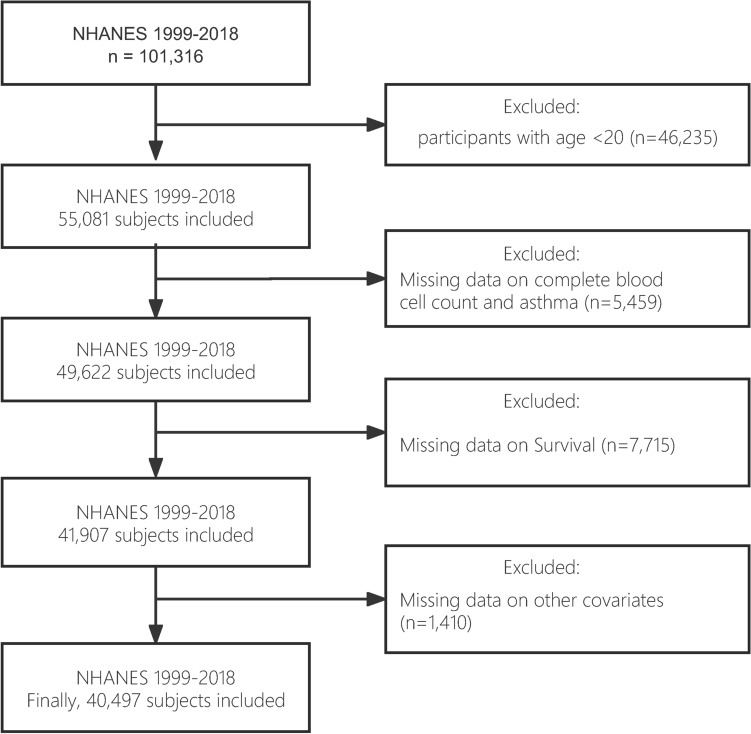
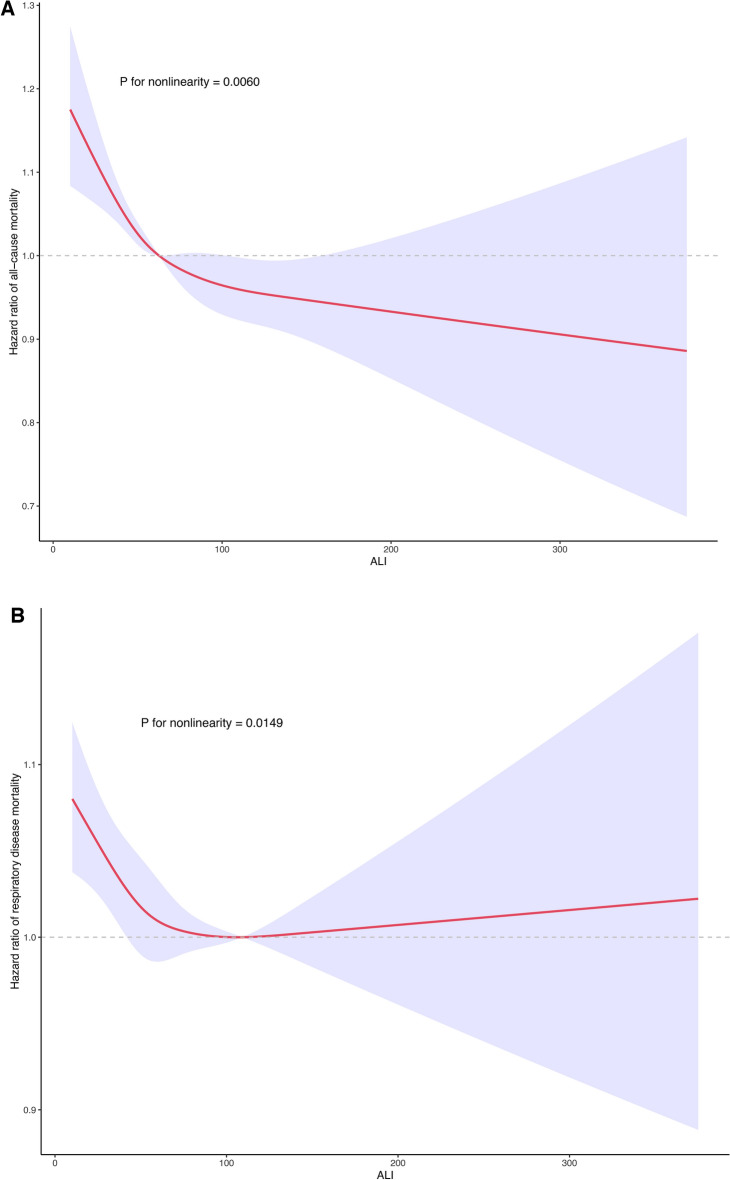
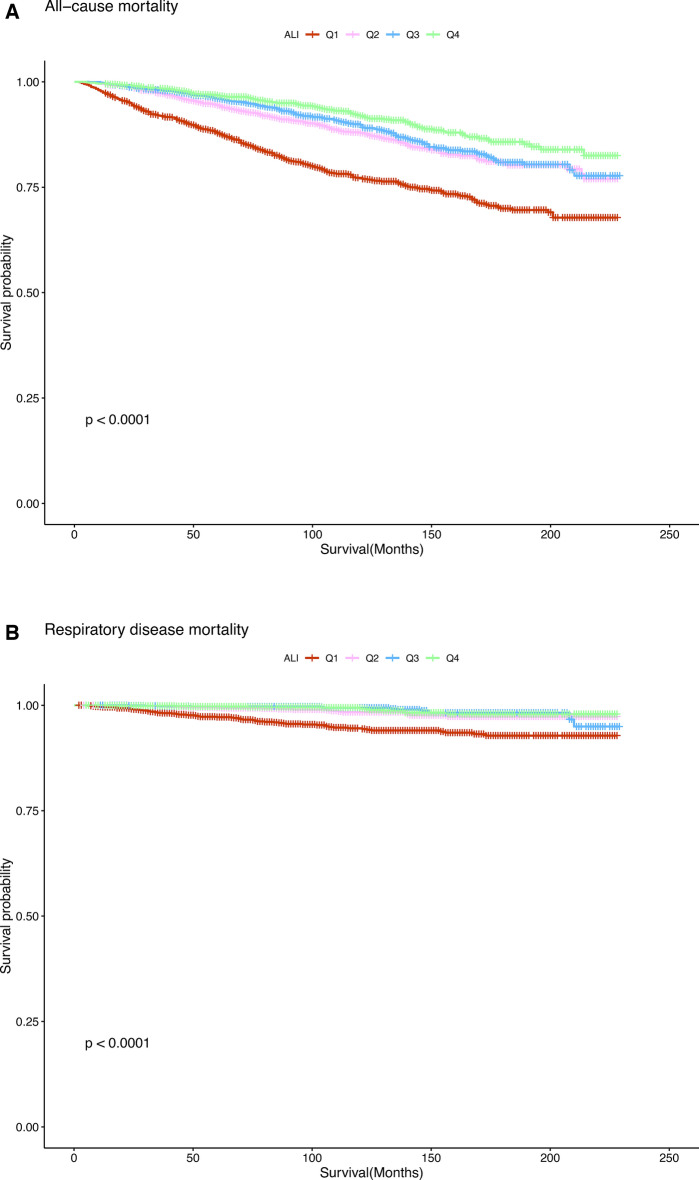
The Advanced Lung Cancer Inflammation Index (ALI) represents both the inflammatory and nutritional status of the host, but its link with mortality in asthma patients is uncertain. The purpose of this study was to look at the relationship between ALI levels and all-cause and respiratory disease mortality in asthmatic patients. We conducted our research using cohort data from the National Health and Nutrition Examination Survey (NHANES) from 1999 to 2018. The National Death Index was used to calculate mortality until December 31, 2019. The study employed multivariate logistic regression to look into the relationship between ALI levels and asthma prevalence. Weighted Kaplan-Meier and multivariate-adjusted Cox analyses were utilized for investigating the relationship between ALI levels and all-cause and respiratory disease mortality in individuals with asthma. A restricted cubic spline (RCS) analysis was used to assess their nonlinear relationship. Subgroup and sensitivity analyses were also performed to evaluate the robustness of the results that were obtained. We enrolled 40,497 people in our study, and 5,469 of them had asthma, representing a 14% prevalence. A median follow-up of 11.19 (9.38, 14.29) years revealed 109 fatalities from respiratory diseases and 724 deaths from all causes. After correcting for several covariates, there was no longer any link (P-trend = 0.2) between ALI levels and the prevalence of asthma. When compared to the lowest quartile, the highest quartile of ALI levels was substantially linked to a lower risk of mortality from respiratory diseases and all causes (all P-trend < 0.001). In the RCS regression model, the relationship between ALI level and both all-cause and respiratory disease mortality in asthmatic participants was nonlinear, with P for nonlinearity of 0.006 and 0.015, respectively. We also discovered that the probability of mortality from respiratory disease decreased progressively to a nadir at an ALI level of 109.13 and then increased as the ALI level increased. Multiple subgroup and sensitivity analyses revealed that ALI was consistently related to lower all-cause and respiratory disease mortality in asthma patients. Our findings suggest that ALI is associated with a reduced risk of all-cause and respiratory disease mortality in asthma patients.
晚期肺癌炎症指数 (ALI) 既代表宿主的炎症状态,也代表其营养状态,但它与哮喘患者死亡率之间的关系尚不确定。本研究旨在探讨 ALI 水平与哮喘患者全因和呼吸疾病死亡率之间的关系。我们使用了 1999 年至 2018 年国家健康和营养检查调查 (NHANES) 的队列数据进行研究。利用国家死亡指数计算截至 2019 年 12 月 31 日的死亡率。研究采用多变量逻辑回归探讨 ALI 水平与哮喘患病率之间的关系。采用加权 Kaplan-Meier 和多变量调整 Cox 分析探讨哮喘患者 ALI 水平与全因和呼吸疾病死亡率之间的关系。采用限制性立方样条 (RCS) 分析评估它们之间的非线性关系。还进行了亚组和敏感性分析,以评估结果的稳健性。我们的研究纳入了 40497 人,其中 5469 人患有哮喘,占 14%。中位随访时间为 11.19 年(9.38 年,14.29 年),共发生 109 例呼吸疾病死亡和 724 例全因死亡。在校正了多个协变量后,ALI 水平与哮喘患病率之间不再存在关联(P 趋势=0.2)。与最低四分位相比,ALI 水平最高四分位与呼吸疾病和全因死亡率较低显著相关(所有 P 趋势<0.001)。在 RCS 回归模型中,ALI 水平与哮喘患者全因和呼吸疾病死亡率之间的关系是非线性的,非线性 P 值分别为 0.006 和 0.015。我们还发现,呼吸疾病死亡率逐渐降低至 ALI 水平为 109.13 时达到最低点,然后随着 ALI 水平的升高而升高。多项亚组和敏感性分析表明,ALI 与哮喘患者全因和呼吸疾病死亡率降低呈一致相关。我们的研究结果表明,ALI 与哮喘患者全因和呼吸疾病死亡率降低风险降低相关。