Qiu Xin, Shen Shuang, Jiang Nizhen, Feng Yifei, Yang Guodong, Lu Donghong
Department of Gastroenterology, The First Affiliated Hospital of Guangxi Medical University, Nanning, 530000, China.
Department of Hepatobiliary Surgery, Guangxi Medical University Cancer Hospital, Nanning, China.
Sci Rep. 2025 Apr 29;15(1):15121. doi: 10.1038/s41598-025-99311-2.
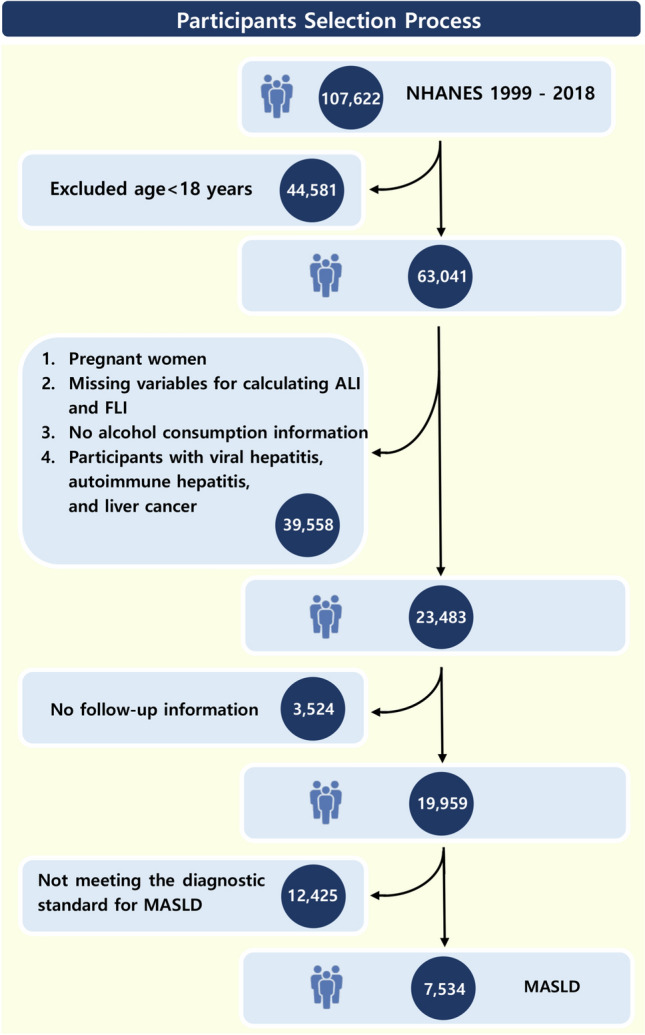
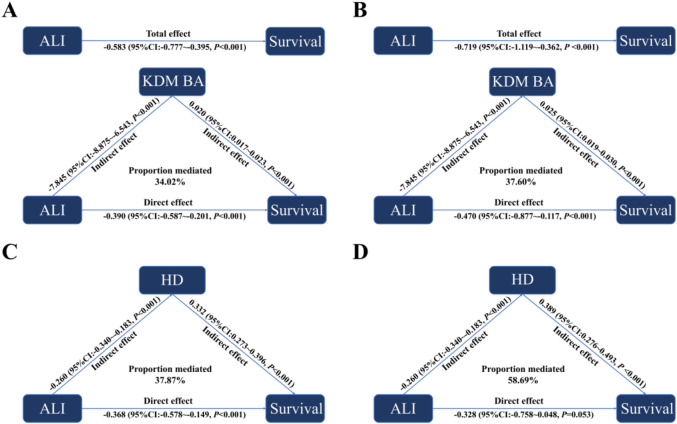
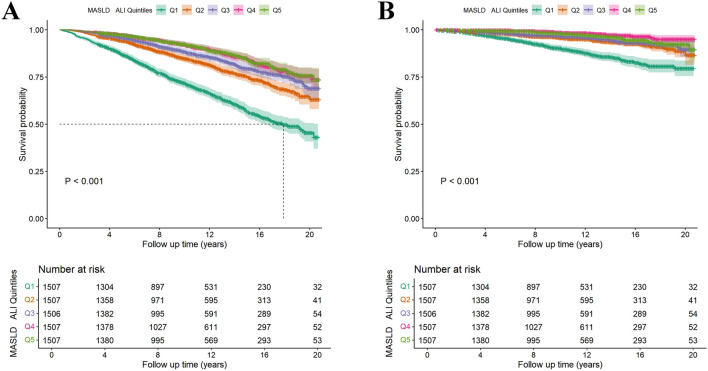
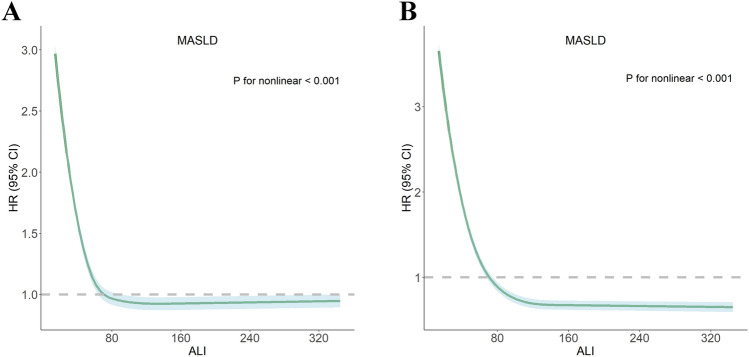
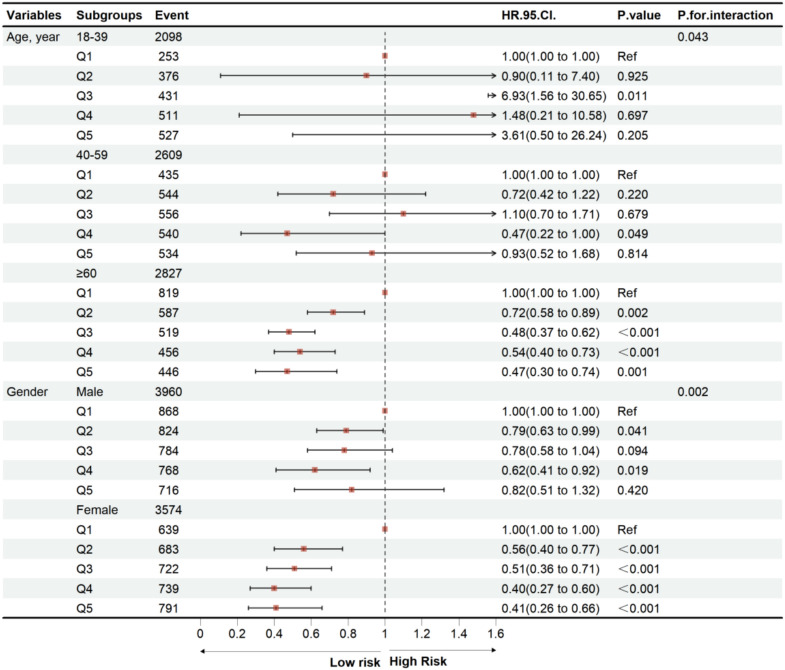
Metabolic dysfunction-associated steatotic liver disease (MASLD), formerly known as non-alcoholic fatty liver disease (NAFLD), is a growing global health concern due to its rising prevalence and association with hepatic and cardiovascular diseases. This study aimed to assess the prognostic value of the Advanced Lung Cancer Inflammation Index (ALI)-a combined indicator of nutritional and inflammatory status-in predicting all-cause and cardiovascular mortality in MASLD patients.Data were drawn from MASLD-diagnosed adults (≥ 18 years) in the National Health and Nutrition Examination Survey (NHANES) from 1999 to 2018, with mortality tracked until December 31, 2019. ALI was calculated for each participant, and its relationship with long-term mortality was analyzed using multivariable Cox regression, restricted cubic spline (RCS) regression, and subgroup analyses. Additionally, the mediating role of biological age, including Klemera-Doubal method biological age (KDM BA) and homeostatic model assessment (HD), was assessed in this relationship through mediation analysis. Among 7,534 MASLD patients, higher ALI quintiles were significantly associated with reduced all-cause (aHR = 0.591, P = 0.004) and cardiovascular mortality (aHR = 0.393, P = 0.026). A nonlinear relationship was observed between ALI and mortality outcomes (P < 0.001). Subgroup analysis indicated ALI's stronger predictive value in older adults (≥ 60), females, and lifelong non-smokers. Mediation analysis showed that KDM BA and HD partially mediated the ALI-mortality relationship (34.02% and 37.87% for all-cause mortality; 37.60% and 58.69% for cardiovascular mortality, respectively). Higher values of the ALI are associated with reduced all-cause and cardiovascular mortality in patients with MASLD, with biological age serving as a partial mediator. Improved nutritional and inflammatory status enhances the prognosis of MASLD patients.
代谢功能障碍相关脂肪性肝病(MASLD),前身为非酒精性脂肪性肝病(NAFLD),由于其患病率不断上升以及与肝脏和心血管疾病的关联,日益成为全球健康关注的焦点。本研究旨在评估晚期肺癌炎症指数(ALI)——一种营养和炎症状态的综合指标——在预测MASLD患者全因死亡率和心血管死亡率方面的预后价值。数据来自1999年至2018年美国国家健康与营养检查调查(NHANES)中诊断为MASLD的成年人(≥18岁),死亡率追踪至2019年12月31日。为每位参与者计算ALI,并使用多变量Cox回归、受限立方样条(RCS)回归和亚组分析来分析其与长期死亡率的关系。此外,通过中介分析评估了生物年龄的中介作用,包括克莱梅拉 - 杜巴尔方法生物年龄(KDM BA)和稳态模型评估(HD)。在7534例MASLD患者中,较高的ALI五分位数与全因死亡率降低(调整后风险比[aHR]=0.591,P=0.004)和心血管死亡率降低(aHR=0.393,P=0.026)显著相关。观察到ALI与死亡率结局之间存在非线性关系(P<0.001)。亚组分析表明,ALI在老年人(≥60岁)、女性和终身不吸烟者中具有更强的预测价值。中介分析表明,KDM BA和HD部分介导了ALI与死亡率的关系(全因死亡率分别为34.02%和37.87%;心血管死亡率分别为37.60%和58.69%)。较高的ALI值与MASLD患者全因死亡率和心血管死亡率降低相关,生物年龄起部分中介作用。改善营养和炎症状态可提高MASLD患者的预后。