Zhai Sijia, Eßinger Till Moritz, Koch Martin, Deng Jianhang, Zahnert Thomas, Neudert Marcus, Bornitz Matthias
Carl Gustav Carus Faculty of Medicine, Department of Otorhinolaryngology, Head and Neck Surgery, Ear Research Center Dresden, Technische Universität Dresden, Fetscherstraße 74, 01307, Dresden, Germany.
Eur Arch Otorhinolaryngol. 2025 May;282(5):2301-2312. doi: 10.1007/s00405-024-09105-x. Epub 2024 Nov 29.
The success of partial ossicular chain reconstructions in cases of conductive hearing loss depends on many factors. One important factor is the coupling between the prosthesis and the stapes head, which has not been explicitly investigated previously. Prostheses with different forms of attachment to the stapes are available, namely clip and bell type PORP. We present a standardized method to assess the quality of the prosthesis-stapes connection. The coupling quality of different prostheses is compared using measurements on a specimen model.
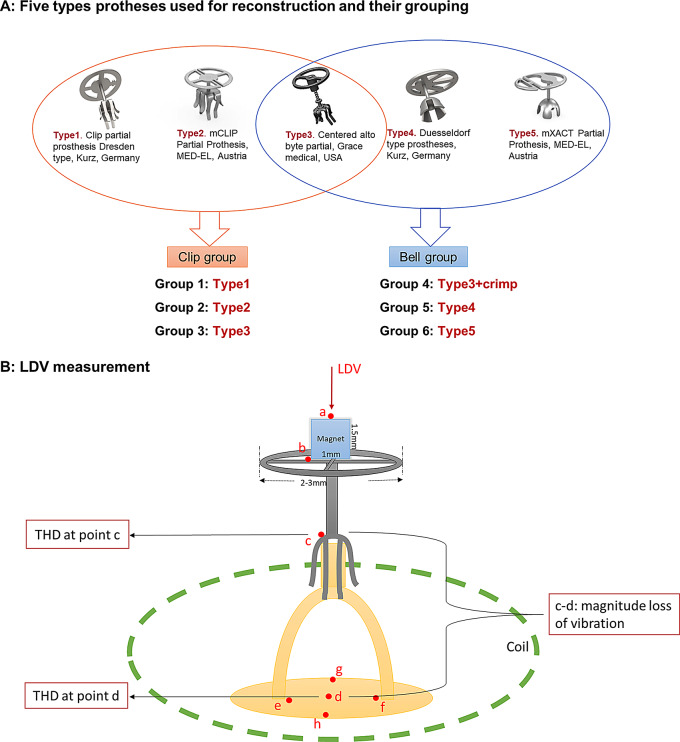
This study delineated six groups categorized by prosthesis types, employing 12 temporal bones to create a reconstructed ossicular chain model. The model comprised stapes and inner ear of the specimen, various prostheses and a standardized mechanical excitation at the prosthesis head. Multiple-points measurements were conducted using laser Doppler vibrometry along the sound transfer direction. This methodology enabled the assessment of vibrational magnitude loss and sound distortion from the prosthesis to the stapes.
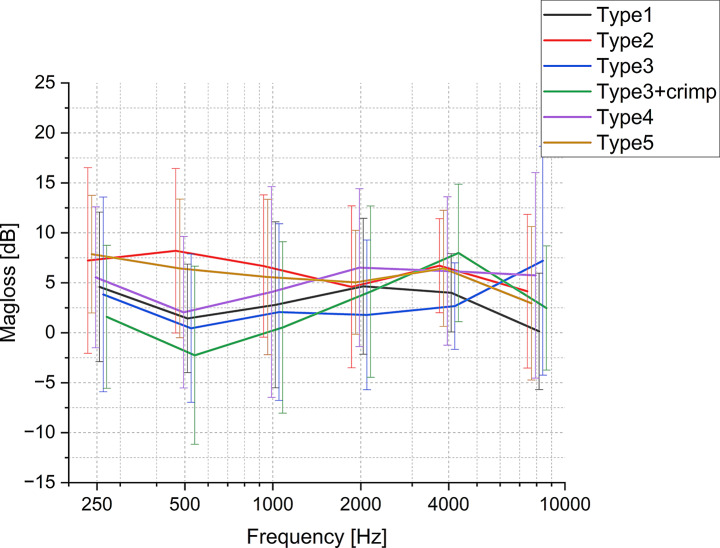
All six groups showed uniformly good sound transmission, with low magnitude loss of < 10 dB and very low total harmonic distortion of < 1%.
The proposed measurement method enables an explicit and comparable examination of the prosthesis coupling to the stapes head. While the coupling mechanism may be important in terms of handling, stability or long-term robustness of the reconstruction, our results show no relevant differences between types in terms of sound transmission.
传导性听力损失病例中部分听骨链重建的成功取决于多种因素。一个重要因素是假体与镫骨头之间的耦合,此前尚未对此进行明确研究。有多种与镫骨连接形式不同的假体,即夹式和钟形PORP。我们提出一种标准化方法来评估假体与镫骨连接的质量。通过在标本模型上进行测量来比较不同假体的耦合质量。
本研究根据假体类型划分了六组,使用12块颞骨创建了重建听骨链模型。该模型包括标本的镫骨和内耳、各种假体以及在假体头部进行的标准化机械激励。沿着声音传播方向使用激光多普勒测振仪进行多点测量。这种方法能够评估从假体到镫骨的振动幅度损失和声音失真。
所有六组均表现出一致良好的声音传输,幅度损失低至<10 dB,总谐波失真极低,<1%。
所提出的测量方法能够对假体与镫骨头的耦合进行明确且可比的检查。虽然耦合机制在重建的操作、稳定性或长期耐用性方面可能很重要,但我们的结果表明,在声音传输方面,不同类型之间没有相关差异。