Ju Dongrun, Modi Vrinda, Khade Rahul L, Zhang Yong
Department of Chemistry and Chemical Biology, Stevens Institute of Technology, 1 Castle Point Terrace, Hoboken, NJ, 07030, USA.
Commun Chem. 2024 Nov 29;7(1):279. doi: 10.1038/s42004-024-01371-4.
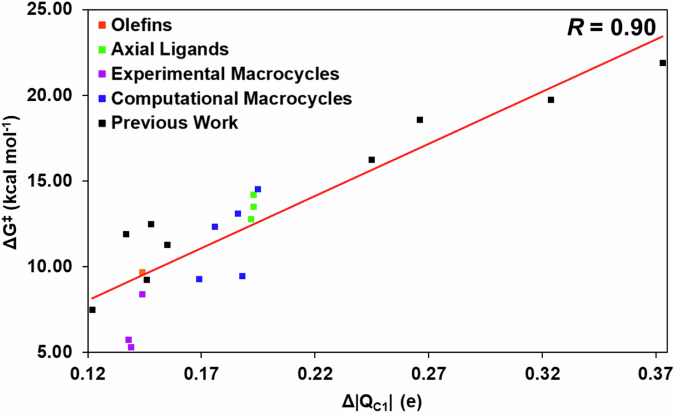
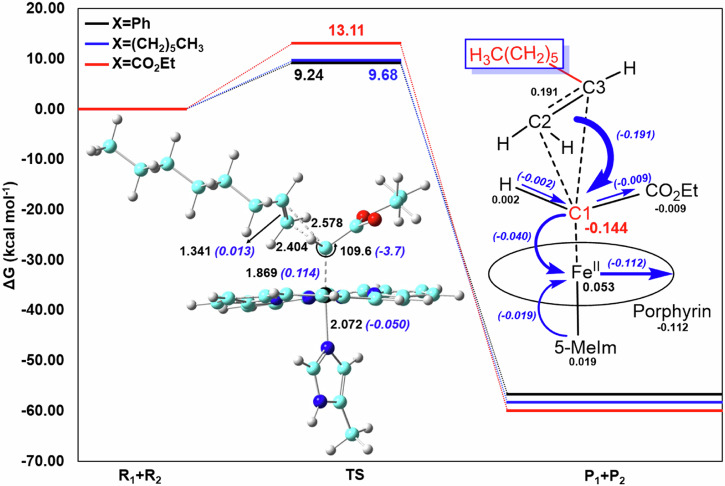
Engineered heme proteins exhibit excellent sustainable catalytic carbene transfer reactivities toward olefins for value-added cyclopropanes. However, unactivated and electron-deficient olefins remain challenging in such reactions. To help design efficient heme-inspired biocatalysts for these difficult situations, a systematic quantum chemical mechanistic study was performed to investigate effects of olefin substituents, non-native amino acid axial ligands, and natural and non-natural macrocycles with the widely used ethyl diazoacetate. Results show that electron-deficient substrate ethyl acrylate has a much higher barrier than the electron-rich styrene. For styrene, the predicted barrier trend is consistent with experimentally used heme analogue cofactors, which can significantly reduce barriers. For ethyl acrylate, while the best non-native axial ligand only marginally improves the reactivity versus the native histidine model, a couple of computationally studied macrocycles can dramatically reduce barriers to the level comparable to styrene. These results will facilitate the development of better biocatalysts in this area.
工程化血红素蛋白对烯烃表现出优异的可持续催化卡宾转移反应活性,可用于制备高附加值的环丙烷。然而,在这类反应中,未活化的缺电子烯烃仍然具有挑战性。为了帮助设计针对这些困难情况的高效血红素启发型生物催化剂,我们进行了一项系统的量子化学机理研究,以研究烯烃取代基、非天然氨基酸轴向配体以及天然和非天然大环与广泛使用的重氮乙酸乙酯之间的相互作用。结果表明,缺电子底物丙烯酸乙酯的势垒比重电子的苯乙烯高得多。对于苯乙烯,预测的势垒趋势与实验中使用的血红素类似物辅因子一致,后者可显著降低势垒。对于丙烯酸乙酯,虽然最佳的非天然轴向配体与天然组氨酸模型相比仅略微提高了反应活性,但一些通过计算研究的大环可以将势垒大幅降低至与苯乙烯相当的水平。这些结果将有助于该领域更好的生物催化剂的开发。