Department of Public Health and Primary Care, Leiden University Medical Center, Postzone V0-P, PO Box 9600, 2300 RC, Leiden, The Netherlands.
National eHealth Living Lab, Leiden University Medical Center, Leiden, The Netherlands.
Orphanet J Rare Dis. 2024 Nov 29;19(1):444. doi: 10.1186/s13023-024-03461-x.
Understanding quality of life (QoL) is important in diseases for which there is no cure to date, such as Huntington's disease (HD). A deeper level of understanding is, however, compromised by the lack of studies examining QoL from the perspectives of HD gene expansion carriers (HDGECs). Only a few qualitative studies on QoL in HD have been performed, yet none investigated how QoL is defined by HDGECs themselves.
This qualitative study explores how premanifest and manifest HDGECs define their QoL.
Online semi-structured interviews were conducted with 6 premanifest and 6 manifest HDGECs in the Netherlands. Qualitative content analysis was used to explore participants' QoL definitions via inductive coding and the subsequent formulation of (sub)categories and (sub)themes.
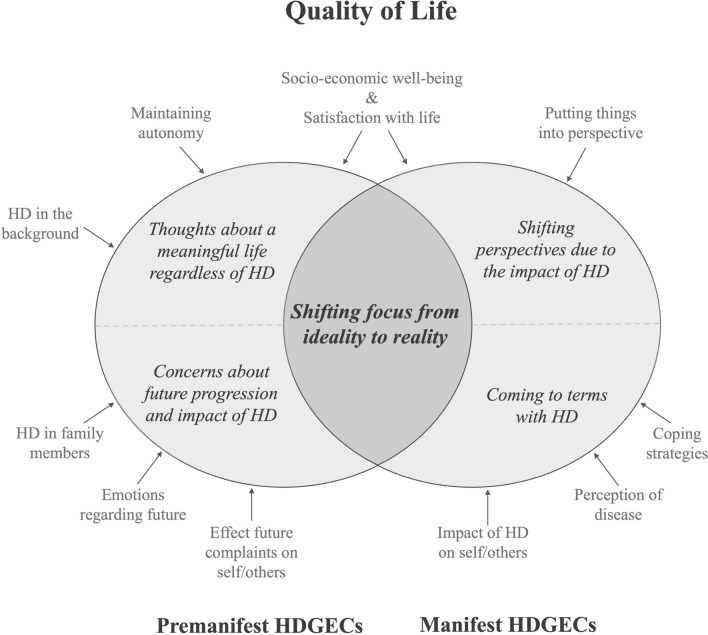
Premanifest and manifest HDGECs had a different focus when defining QoL. Two subthemes were identified for premanifest HDGECs: Thoughts about a meaningful life regardless of HD and Concerns about the future progression and impact of HD. For manifest HDGECs, two other subthemes were identified: Coming to terms with HD and Shifting perspectives due to the impact of HD. One overall theme was generated, reflecting the difference and adaptive shift in focus between premanifest and manifest HDGECs: Shifting focus from ideality to reality.
In providing optimal care, HDGECs should be considered as part of a complex, continuously changing environment, thereby taking into account their individual QoL experiences and tailoring care accordingly. HDGECs might benefit from forming helpful beliefs about future adaptability and resilience and developing adaptive coping strategies.
在目前尚无治愈方法的疾病中,如亨廷顿病(HD),了解生活质量(QoL)很重要。然而,由于缺乏从 HD 基因扩展携带者(HDGEC)的角度研究 QoL 的研究,这种理解的深入程度受到了影响。尽管已经进行了一些关于 HD 患者生活质量的定性研究,但没有研究调查 HDGEC 本身是如何定义 QoL 的。
本定性研究旨在探讨预发性和显性 HDGEC 如何定义自己的 QoL。
在荷兰,对 6 名预发性和 6 名显性 HDGEC 进行了在线半结构化访谈。采用定性内容分析法,通过归纳编码探讨参与者的 QoL 定义,并随后形成(子)类别和(子)主题。
预发性和显性 HDGEC 在定义 QoL 时有不同的侧重点。确定了两个预发性 HDGEC 的子主题:无论 HD 如何,都要思考有意义的生活和对 HD 未来进展和影响的担忧。对于显性 HDGEC,还确定了另外两个子主题:接受 HD 和由于 HD 的影响而改变观点。生成了一个总体主题,反映了预发性和显性 HDGEC 之间关注点的差异和适应性转变:从理想主义到现实主义的转变。
在提供最佳护理时,应将 HDGEC 视为复杂、不断变化的环境的一部分,从而考虑到他们的个体 QoL 体验,并相应地调整护理。HDGEC 可能受益于形成对未来适应性和韧性的有益信念,并发展适应性应对策略。