Lee S-H, Menis J, Kim T M, Kim H R, Zhou C, Kurniawati S A, Prabhash K, Hayashi H, Lee D D-W, Imasa M S, Teh Y L, Yang J C-H, Reungwetwattana T, Sriuranpong V, Wu C-E, Ang Y, Sabando M, Thiagarajan M, Mizugaki H, Noronha V, Yulianti M, Zhang L, Smyth E, Yoshino T, Park J O, Pentheroudakis G, Park S, Peters S, Ahn J B, Popat S
Division of Hematology-Oncology, Department of Medicine, Samsung Medical Center, Sungkyunkwan University School of Medicine, Seoul, South Korea.
Medical Oncology Department, University and Hospital Trust of Verona, Verona, Italy.
ESMO Open. 2024 Dec;9(12):103996. doi: 10.1016/j.esmoop.2024.103996. Epub 2024 Nov 29.
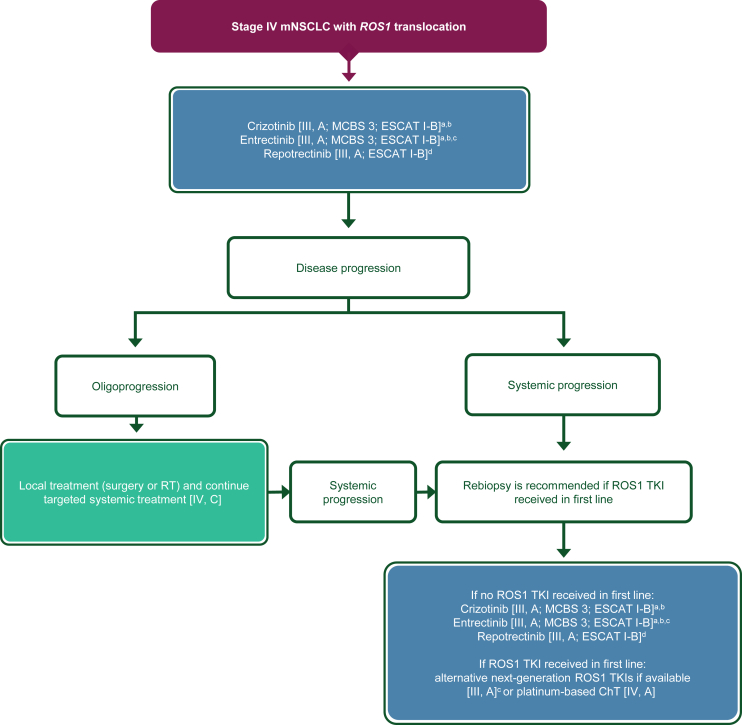
The European Society for Medical Oncology (ESMO) Clinical Practice Guidelines for the diagnosis, treatment and follow-up of patients with oncogene-addicted metastatic non-small-cell lung cancer (mNSCLC), published in January 2023, was modified according to previously established standard methodology, to produce the Pan-Asian adapted (PAGA) ESMO consensus guidelines for the management of Asian patients with oncogene-addicted mNSCLC. The adapted guidelines presented in this manuscript represent the consensus opinions reached by a panel of Asian experts in the treatment of patients with oncogene-addicted mNSCLC representing the oncological societies of China (CSCO), Indonesia (ISHMO), India (ISMPO), Japan (JSMO), Korea (KSMO), Malaysia (MOS), the Philippines (PSMO), Singapore (SSO), Taiwan (TOS) and Thailand (TSCO), co-ordinated by ESMO and the Korean Society for Medical Oncology (KSMO). The voting was based on scientific evidence and was independent of the current treatment practices, drug access restrictions and reimbursement decisions in the different regions of Asia. The latter are discussed separately in the manuscript. The aim is to provide guidance for the optimisation and harmonisation of the management of patients with oncogene-addicted mNSCLC across the different regions of Asia, drawing on the evidence provided by both Western and Asian trials, while respecting the differences in screening practices, molecular profiling and age and stage at presentation. Attention is drawn to the disparity in the drug approvals and reimbursement strategies between the different regions of Asia.
欧洲医学肿瘤学会(ESMO)于2023年1月发布了关于致癌基因成瘾性转移性非小细胞肺癌(mNSCLC)患者诊断、治疗及随访的临床实践指南,并根据先前既定的标准方法进行了修订,以制定针对亚洲致癌基因成瘾性mNSCLC患者管理的泛亚适应性(PAGA)ESMO共识指南。本稿件中呈现的适应性指南代表了由来自中国(CSCO)、印度尼西亚(ISHMO)、印度(ISMPO)、日本(JSMO)、韩国(KSMO)、马来西亚(MOS)、菲律宾(PSMO)、新加坡(SSO)、台湾(TOS)和泰国(TSCO)肿瘤学会的亚洲专家组成的小组,在ESMO和韩国医学肿瘤学会(KSMO)的协调下,就致癌基因成瘾性mNSCLC患者治疗达成的共识意见。投票基于科学证据,且独立于亚洲不同地区当前的治疗实践、药物获取限制和报销决定。稿件中对后者进行了单独讨论。目的是借鉴西方和亚洲试验提供的证据,在尊重筛查实践、分子谱分析以及就诊时年龄和分期差异的同时,为优化和统一亚洲不同地区致癌基因成瘾性mNSCLC患者的管理提供指导。需注意亚洲不同地区在药物批准和报销策略方面存在差异。