Patil Tejas, Gao Dexiang, Watson Alexander, Sakamoto Mandy, Nie Yunan, Gibson Amanda, Dean Michelle L, Yoder Benjamin A, Miller Eliza, Stalker Margaret, Aisner Dara L, Bunn Paul A, Schenk Erin L, Marmarelis Melina E, Bennati Chiara, Navani Vishal, Zhang Yongchang, Camidge D Ross
Division of Medical Oncology, University of Colorado School of Medicine, Aurora, CO, USA. Electronic address: https://twitter.com/TejasPatilMD.
Department of Biostatistics, University of Colorado School of Medicine, Aurora, CO, USA.
Lung Cancer. 2025 Jan;199:108040. doi: 10.1016/j.lungcan.2024.108040. Epub 2024 Nov 25.
For patients with EGFR mutant NSCLC who progress on osimertinib, the clinical benefit of continuing osimertinib with next line platinum pemetrexed chemotherapy remains unknown.
In this international, multi-center, retrospective cohort study, a total of 159 patients with EGFR mutant NSCLC who progressed on osimertinib and received platinum-pemetrexed therapy on progression from 2013 to 2023 were included. The data cutoff was December 31, 2023. Data analysis was conducted from January 2024 to June 2024. The primary endpoints were progression free survival (PFS) and overall survival (OS), analyzed using Kaplan-Meier methods. Multivariable Cox regression adjusting for patient-specific and cancer-specific factors was performed.
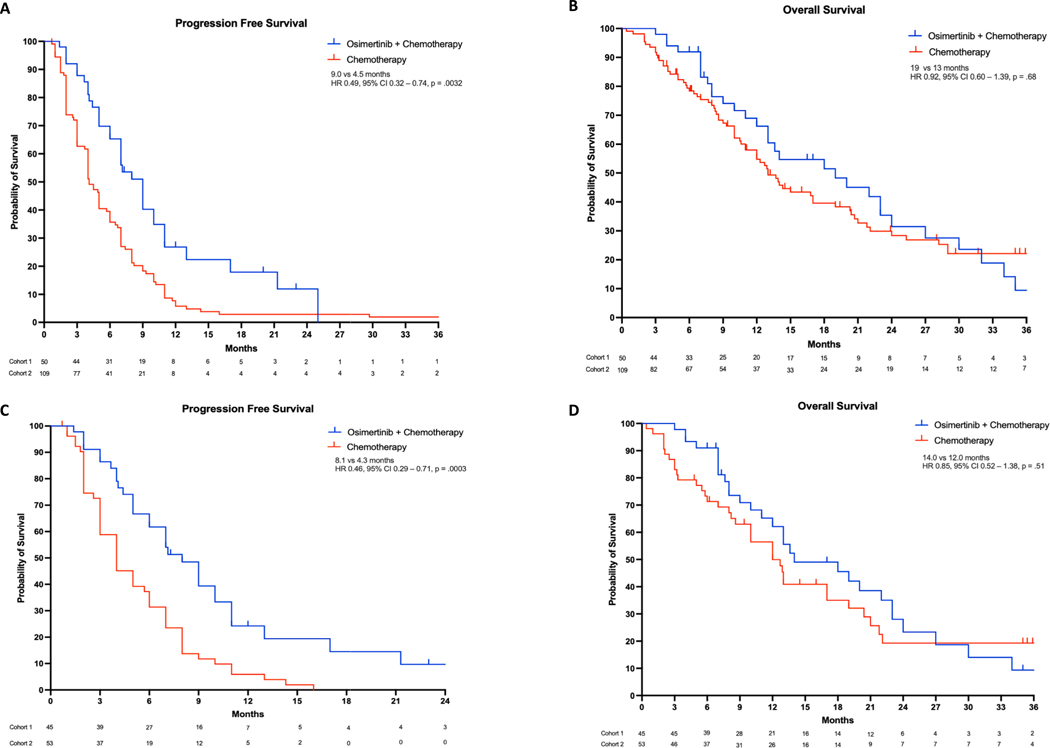
421 patients with EGFR mutant NSCLC with progression on osimertinib were identified, of which159 patients who met pre-specified inclusion criteria were divided into two groups: Cohort 1 (osimertinib + platinum-pemetrexed) included 50 patients (median [IQR] age, 59 [30 - 83] years; 36 [72.0 %] female; 11 [22.4 %] Asian) and Cohort 2 (platinum-pemetrexed alone) included 109 patients (median [IQR] age, 54 [25 - 80] years; 62 [56.9 %] female; 74 [64.9 %] Asian). Most patients were never smokers (Cohort 1, 37 [74.0 %]; Cohort 2, 66 [60.6 %]). One third of patients had baseline brain metastases (Cohort 1, 19 [38.0 %]; Cohort 2, 36 [38.3 %]). Both cohorts had a median of two prior lines of anti-cancer therapy. The addition of bevacizumab or immune checkpoint inhibitors (ICI) to next-line platinum-pemetrexed chemotherapy was more common in Cohort 2 (bevacizumab use, 30.3 % vs 8.0 %, p = 0.002; ICI use, 33.0 % vs 2.0 %, p = 0.001). With a median duration of follow up of 30 months, there was a significant PFS benefit to continuing osimertinib with next line platinum pemetrexed chemotherapy (9.0 vs 4.5 months; HR 0.49, 95 % CI 0.32 - 0.74, p = 0.0032), also seen in subset analyses of patients who received first line osimertinib (n = 55, 11.0 vs 6.2 months; HR 0.41, 95 % CI 0.25 - 0.73, p = 0.002). Among patients with EGFR mutant NSCLC without brain metastases after progression on osimertinib, we found that continuing osimertinib with next line platinum pemetrexed significantly reduced the median time to CNS progression (n = 38; 7.0 vs 4.1 months; HR 0.47, 95 % CI 0.48 - 0.98, p = 0.01). After adjusted analysis, there was no significant OS difference between Cohorts 1 and 2 (19 months vs 13 months; HR 0.92, 95 % CI 0.60 - 1.39, p = 0.68).
For patients with EGFR mutant NSCLC who progress on osimertinib, there is a significant PFS, but not OS, benefit to continuing osimertinib with next line platinum pemetrexed chemotherapy. The continuation of osimertinib with next line platinum pemetrexed chemotherapy appears to reduce the risk of CNS progression.
对于在奥希替尼治疗期间病情进展的表皮生长因子受体(EGFR)突变的非小细胞肺癌(NSCLC)患者,继续使用奥希替尼联合铂类培美曲塞进行二线化疗的临床获益尚不清楚。
在这项国际多中心回顾性队列研究中,纳入了2013年至2023年间在奥希替尼治疗期间病情进展且在病情进展时接受铂类培美曲塞治疗的159例EGFR突变的NSCLC患者。数据截止日期为2023年12月31日。数据分析于2024年1月至2024年6月进行。主要终点为无进展生存期(PFS)和总生存期(OS),采用Kaplan-Meier方法进行分析。进行了针对患者特异性和癌症特异性因素的多变量Cox回归分析。
共识别出421例在奥希替尼治疗期间病情进展的EGFR突变的NSCLC患者,其中159例符合预先设定的纳入标准,分为两组:队列1(奥希替尼+铂类培美曲塞)包括50例患者(年龄中位数[四分位间距]为59[30-83]岁;女性36例[72.0%];亚洲人11例[22.4%]),队列2(单纯铂类培美曲塞)包括109例患者(年龄中位数[四分位间距]为54[25-80]岁;女性62例[56.9%];亚洲人74例[64.9%])。大多数患者从不吸烟(队列1,37例[74.0%];队列2,66例[60.6%])。三分之一的患者有基线脑转移(队列1,19例[38.0%];队列2,36例[38.3%])。两个队列的患者既往均接受过中位数为两线的抗癌治疗。在二线铂类培美曲塞化疗中加用贝伐单抗或免疫检查点抑制剂(ICI)在队列2中更为常见(贝伐单抗使用情况:30.3%对8.0%,p=0.002;ICI使用情况:33.0%对2.0%,p=0.001)。中位随访时间为30个月,继续使用奥希替尼联合铂类培美曲塞进行二线化疗有显著的PFS获益(9.0个月对4.5个月;风险比[HR]0.49,95%置信区间[CI]0.32-0.74,p=0.0032),在接受一线奥希替尼治疗的患者亚组分析中也可见(n=55,11.0个月对6.2个月;HR0.41,95%CI0.25-0.73,p=0.002)。在奥希替尼治疗期间病情进展后无脑转移的EGFR突变的NSCLC患者中,我们发现继续使用奥希替尼联合铂类培美曲塞显著缩短了至中枢神经系统进展的中位时间(n=38;7.0个月对4.1个月;HR0.47,95%CI0.48-0.98,p=0.01)。经校正分析后,队列1和队列2之间的OS无显著差异(19个月对13个月;HR0.92,95%CI0.60-1.39,p=0.68)。
对于在奥希替尼治疗期间病情进展的EGFR突变的NSCLC患者,继续使用奥希替尼联合铂类培美曲塞进行二线化疗有显著的PFS获益,但无OS获益。继续使用奥希替尼联合铂类培美曲塞进行二线化疗似乎可降低中枢神经系统进展风险。