Obstetric and Gynaecology ST7, Princess Royal Hospital, Haywards Heath, UK.
Obstetric and Gynaecology Consultant, Conquest Hospital, Hastings, UK.
J Med Case Rep. 2024 Dec 1;18(1):580. doi: 10.1186/s13256-024-04740-8.
Ovarian torsion is a surgical emergency whereby the ovary twists, or torts, on its ligamentous support and potentially compromises vascular supply to both the ovary and Fallopian tube. It accounts for 2-3% of all acute gynecological emergencies, yet is a condition that is rarely reported to occur after hysterectomy. While it is well established that ovarian torsion can occur after laparoscopic hysterectomy, we report on the rare occurrence of ovarian torsion occurring post the supposedly preventative ovarian transposition suspension procedure or ovariopexy. This highlights that further evaluation of laparoscopic surgical techniques are required to prevent this exquisitely painful gynecological condition occurring postoperatively.
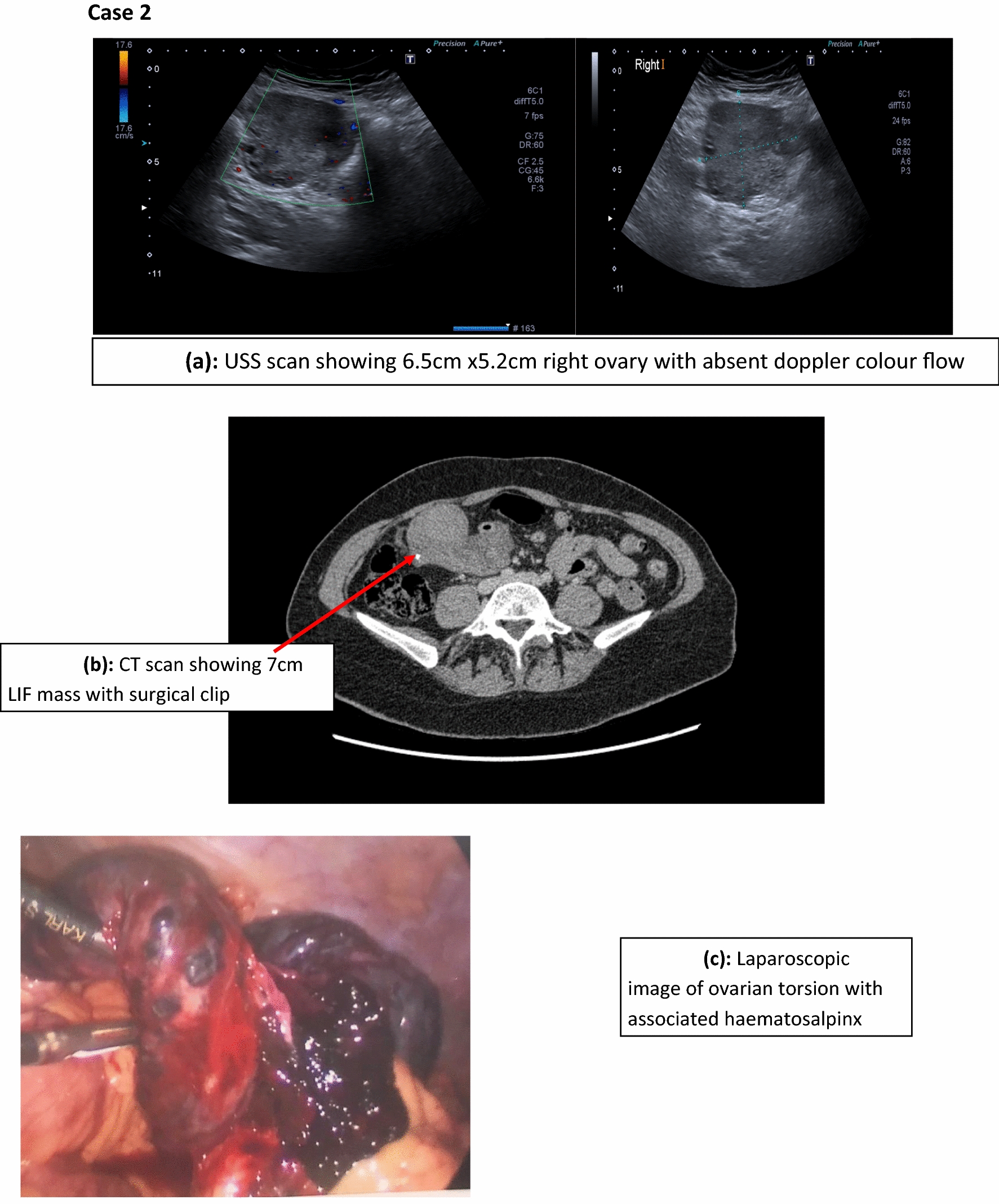
We report two cases of ovarian torsion post-primary laparoscopic radical hysterectomy performed for cervical malignancy. Both patients were Caucasian, multiparous, premenopausal female patients, aged 37 and 39 years old. Ovarian transposition suspension was performed at the primary procedure to allow ovarian function to be preserved if the patient's required postoperative pelvic irradiation if surgically upstaged. Both patients underwent emergency laparoscopic detorsion, with one torsion due to reoccurrence of her cervical cancer.
Adnexal torsion is estimated to occur between 1% and 8% in post-hysterectomy cases. It can be a difficult to diagnose condition, with prudent history-taking, relevant investigations, and a low threshold to consider laparoscopy forming essential clinical acumen. Unfortunately, the suspension of the ovaries post-hysterectomy does not exclude future ovarian torsion. With rising rates of cervical cancer in premenopausal women, reportedly increasing by 37% in the 25-34 age range in the United Kingdom (National Cancer Registration and Analysis Service, Public Health England. 2021), further research is needed to improve techniques to allow for safe ovarian conservation for these patients while undergoing operative treatment of cervical cancer.
卵巢扭转是一种外科急症,卵巢在其韧带支撑上扭曲或扭转,可能会损害卵巢和输卵管的血管供应。它占所有急性妇科急症的 2-3%,但很少有报道称在子宫切除术后发生这种情况。虽然腹腔镜子宫切除术后卵巢扭转的情况已经得到证实,但我们报告了一种罕见的情况,即卵巢扭转发生在所谓的预防性卵巢移位悬吊术或卵巢固定术后。这表明需要进一步评估腹腔镜手术技术,以防止这种术后发生的极其疼痛的妇科疾病。
我们报告了两例宫颈癌行腹腔镜根治性子宫切除术术后卵巢扭转的病例。两名患者均为白人,多产,绝经前女性,年龄分别为 37 岁和 39 岁。为了保留患者如果需要术后盆腔放疗的卵巢功能,在初次手术中进行了卵巢移位悬吊术。两名患者均行紧急腹腔镜复位术,其中一名患者因宫颈癌复发而发生扭转。
子宫切除术后附件扭转的发生率估计在 1%至 8%之间。它是一种难以诊断的疾病,谨慎的病史采集、相关检查以及考虑腹腔镜检查的低门槛对于形成基本的临床敏锐性至关重要。不幸的是,子宫切除术后卵巢的悬吊并不能排除未来发生卵巢扭转的可能性。由于英国 25-34 岁年龄段宫颈癌的发病率上升(37%)(国家癌症登记和分析服务处,英格兰公共卫生署,2021 年),对于这些患者在接受宫颈癌手术治疗时需要进一步研究以改善技术,以安全地保留卵巢。