Yuan Zhiyong, Liu Ying, Wang Fuhua, Han Xiaoning, Dong Zhenhui, Xing Jinyan, Chang Xiaotian
Department of Critical Medicine, The Affiliated Hospital of Qingdao University, 266000 Qingdao, Shandong, China.
Medical Research Center of the Affiliated Hospital of Qingdao University, 266000 Qingdao, Shandong, China.
Rev Cardiovasc Med. 2024 Nov 19;25(11):405. doi: 10.31083/j.rcm2511405. eCollection 2024 Nov.
Both acute myocardial infarction (AMI) and its salvage treatment, venoarterial-extracorporeal membrane oxygenation (VA-ECMO), may lead to the production of proinflammatory cytokines and further aggravate tissue damage. Xuebijing (XBJ) may modulate cytokine production involved in the inflammatory response. We aimed to determine the efficacy of XBJ in cardiogenic shock patients on VA-ECMO.
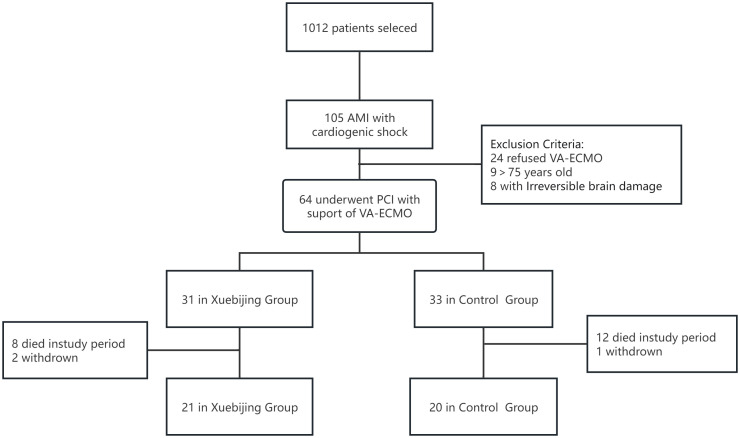
This was a prospective, randomized trial carried out in an intensive care unit of a tertiary teaching hospital. Patients with cardiogenic shock after acute myocardial infarction undergoing percutaneous coronary intervention (PCI) with VA-ECMO support were randomly divided into a Xuebijing group and a control group. Cytokines, inflammatory factors and left ventricular ejection fraction (LVEF) were compared between the groups.
41 patients were enrolled in the study, with 21 in the Xuebijing group and 20 in the control group. 28 (68.3%) were male, and the average age was 64.71 ± 8.18 years old. There was no difference in APACHEII (acute physiology and chronic health evaluation II) score, LVEF, or cytokine and inflammatory factors collected before extracorporeal membrane oxygenation (ECMO) between the two groups. The levels of interleukin-6 (IL-6) and tumor necrosis factor-alpha (TNF-α) in the Xuebijing group were lower than those in the control group in the first 24 hours, 48 hours and 72 hours after ECMO ( < 0.05). The LVEF in the Xuebijing group was higher than that of the control group at 48 hours (31.57 ± 3.43 . 28.35 ± 4.42, = 0.013). This trend persisted at 72 hours. The duration of ECMO support in the Xuebijing group was 5.57 ± 2.11 days, which was shorter than that in the control group ( = 0.033).
Xuebijing injection can reduce the inflammatory response and improve cardiac function in patients with acute myocardial infarction treated with VA-ECMO to a certain extent.
Chinese Clinical Trial Registry (ChiCTR), ChiCTR2100054069, Registered 8, December 2021, https://www.chictr.org.cn/showproj.html?proj=142869.
急性心肌梗死(AMI)及其挽救治疗——静脉-动脉体外膜肺氧合(VA-ECMO),均可能导致促炎细胞因子的产生,并进一步加重组织损伤。血必净(XBJ)可能调节参与炎症反应的细胞因子生成。我们旨在确定血必净对接受VA-ECMO治疗的心源性休克患者的疗效。
这是一项在三级教学医院重症监护病房进行的前瞻性随机试验。急性心肌梗死后接受经皮冠状动脉介入治疗(PCI)并接受VA-ECMO支持的心源性休克患者被随机分为血必净组和对照组。比较两组之间的细胞因子、炎症因子及左心室射血分数(LVEF)。
41例患者纳入研究,血必净组21例,对照组20例。男性28例(68.3%),平均年龄64.71±8.18岁。两组在体外膜肺氧合(ECMO)前的急性生理与慢性健康状况评分II(APACHEII)、LVEF或收集的细胞因子及炎症因子方面无差异。血必净组在ECMO后第1个24小时、48小时和72小时的白细胞介素-6(IL-6)和肿瘤坏死因子-α(TNF-α)水平低于对照组(P<0.05)。血必净组在48小时时的LVEF高于对照组(31.57±3.43对28.35±4.42,P=0.013)。这一趋势在72小时时持续存在。血必净组的ECMO支持时间为5.57±2.11天,短于对照组(P=0.033)。
血必净注射液可在一定程度上减轻接受VA-ECMO治疗的急性心肌梗死患者的炎症反应并改善心脏功能。
中国临床试验注册中心(ChiCTR),ChiCTR2100054069,于2021年12月8日注册,https://www.chictr.org.cn/showproj.html?proj=142869 。