Quane Ellen J, Elders Niels, Newman Anna S, van Mourik Sophia, Williams Neal S J, van den Berg Keimpe J, Ryan Anthony J, Mykhaylyk Oleksandr O
School of Mathematical and Physical Sciences, The University of Sheffield, Dainton Building, Brook Hill, Sheffield, South Yorkshire S3 7HF, U.K.
Department of Resin Technology, Akzo Nobel Car Refinishes BV, Rijksstraatweg 31, Sassenheim 2171 AJ, Netherlands.
Macromolecules. 2024 Nov 14;57(22):10623-10634. doi: 10.1021/acs.macromol.4c02046. eCollection 2024 Nov 26.
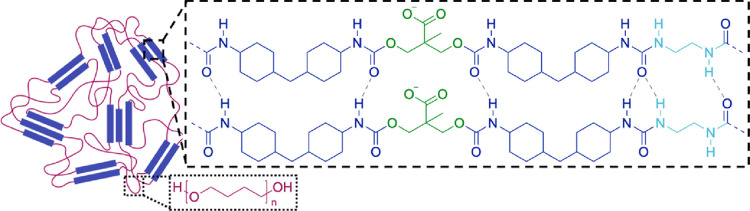
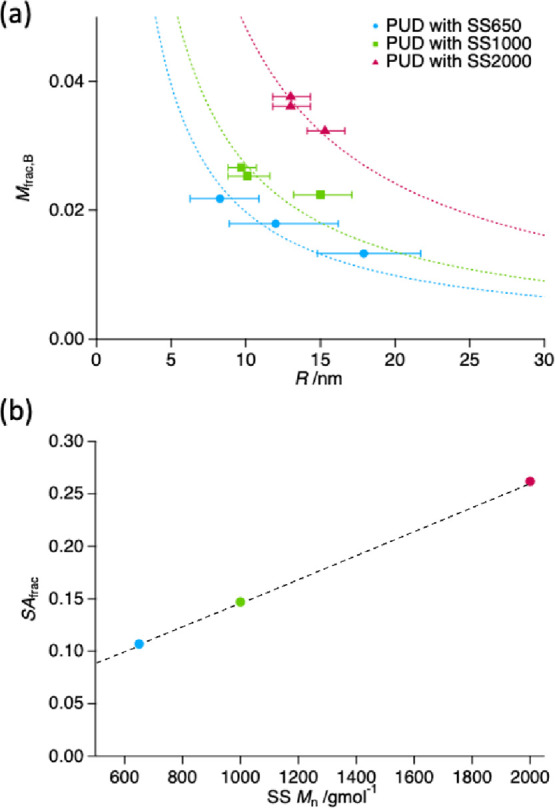
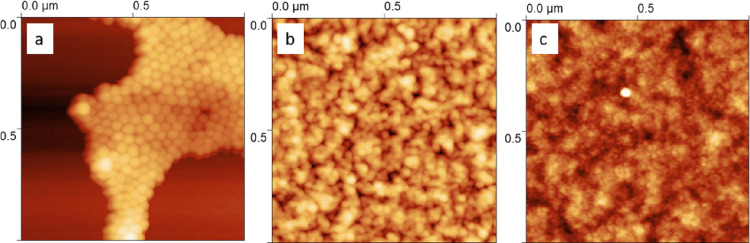
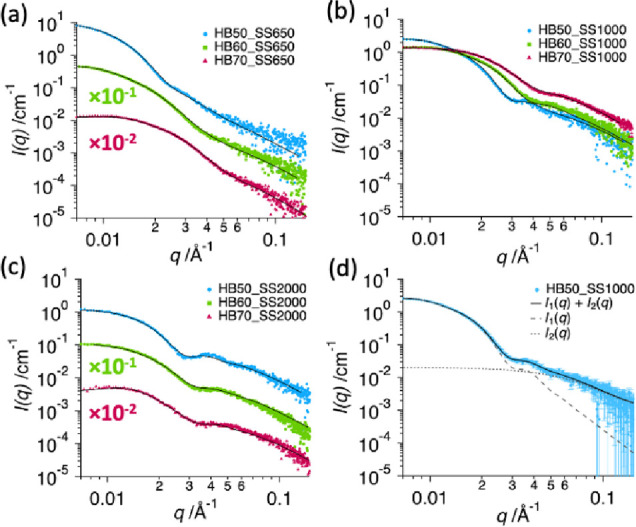
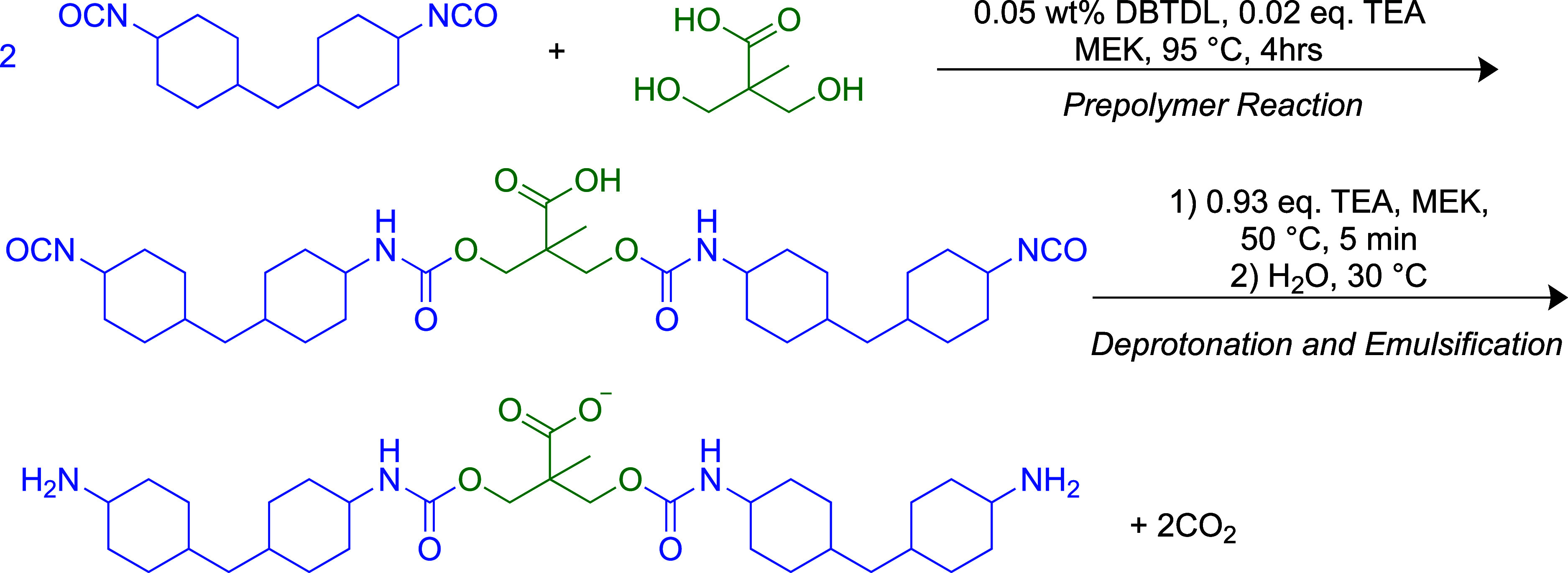
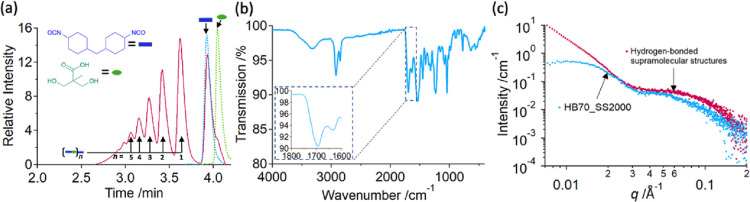
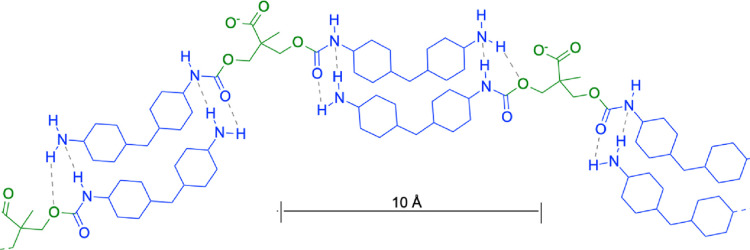
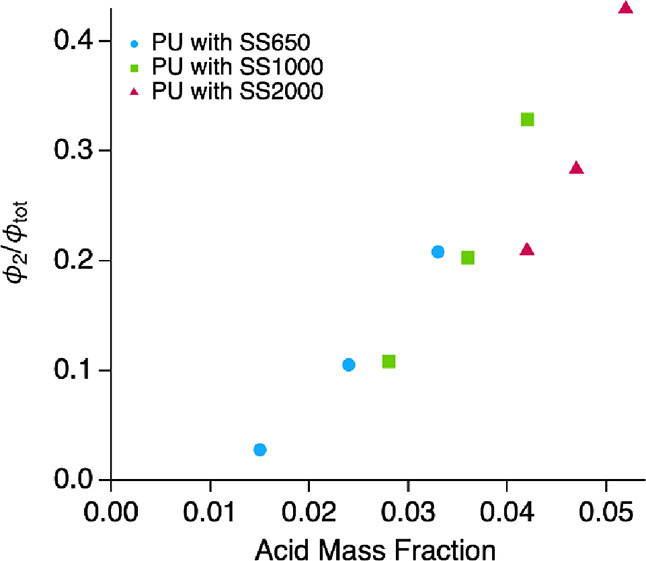
A range of charge-stabilized aqueous polyurethane (PU) dispersions comprising hard segments formed from hydrogenated methylene diphenyl diisocyanate (HMDI) with dimethylolpropionic acid (DMPA) and ethylenediamine, and soft segments of poly(tetramethylene oxide) of different molecular weights are synthesized. Characterization of the dispersions by mass spectrometry, gel permeation chromatography, small-angle X-ray scattering, atomic force microscopy, and infrared spectroscopy shows that they are composed of PUs self-assembled into spherical particles (primary population) and supramolecular structures formed by hydrogen-bonded HMDI and DMPA acid-rich fragments (secondary population). Analysis of the scattering patterns of the dispersions, using a structural model based on conservation of mass, reveals that the proportion of supramolecular structures increases with DMPA content. It is also found that the PU particle radius follows the predictions of the particle surface charge density model, originally developed for acrylic statistical copolymers, and is controlled by hydrophile (DMPA) content in the PU molecules, where an increase in PU acidity results in a decrease in particle size. Moreover, there is a critical fractional coverage of hydrophiles stabilizing the particle surface for a given polyether soft-segment molecular weight, which increases with the polyether molecular weight, confirming that more acid groups are required to stabilize a more hydrophobic composition.
合成了一系列电荷稳定的水性聚氨酯(PU)分散体,其硬段由氢化亚甲基二苯基二异氰酸酯(HMDI)与二羟甲基丙酸(DMPA)和乙二胺形成,软段为不同分子量的聚四氢呋喃。通过质谱、凝胶渗透色谱、小角X射线散射、原子力显微镜和红外光谱对分散体进行表征,结果表明它们由自组装成球形颗粒(主要群体)的聚氨酯和由氢键连接的HMDI和富含DMPA酸的片段形成的超分子结构(次要群体)组成。使用基于质量守恒的结构模型对分散体的散射图案进行分析,结果表明超分子结构的比例随DMPA含量的增加而增加。还发现PU颗粒半径遵循最初为丙烯酸统计共聚物开发的颗粒表面电荷密度模型的预测,并受PU分子中亲水基团(DMPA)含量的控制,其中PU酸度的增加导致颗粒尺寸减小。此外,对于给定的聚醚软段分子量,存在稳定颗粒表面的亲水基团的临界分数覆盖率,其随聚醚分子量的增加而增加,这证实了需要更多酸性基团来稳定更疏水的组合物。