Khor Joanne H, Szücs Anna, Goh Lay Hoon
National University Polyclinics, National University Health System, Singapore.
Department of Medicine, Division of Family Medicine, Yong Loo Lin School of Medicine, National University of Singapore, Singapore.
J Family Community Med. 2024 Oct-Dec;31(4):327-335. doi: 10.4103/jfcm.jfcm_115_24. Epub 2024 Oct 10.
Self-management is important for asthma control, yet it is unclear whether asthmatic patients have sufficient knowledge to optimally manage their disease. We examined the associations between the knowledge of self-management in adult patients attending a polyclinic in Singapore, sociodemographic factors, and asthma control.
A cross-sectional survey was conducted among adult asthmatic patients in a public primary care clinic (polyclinic) using convenience sampling. A a structured and validated self-administered questionnaire solicited the responses of study participants. Questionnaire comprised three sections: (1) Sociodemographic and asthma-related variables, (2) Modified Asthma Self-Management Questionnaire (ASMQ), and (3) The GINA assessment of asthma control. Participants completed the questionnaire in the clinic waiting area and returned them into a sealed box in the same area. Data were analyzed using SPSS version 29.0. Summary statistics were used to describe the study sample; t-test or analysis of variance (ANOVA), as appropriate, tested the differences in self-management knowledge by sociodemographic characteristics. Logistic regression was used to determine the association between asthma control and self-management knowledge controlling for sociodemographic characteristics.
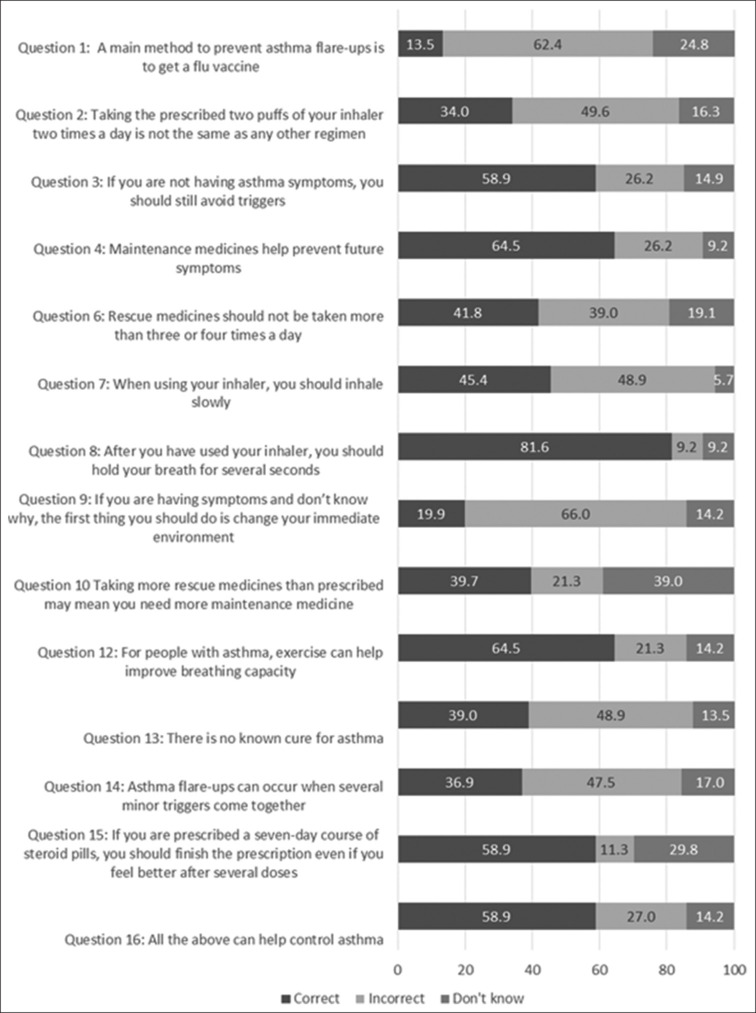
The sample comprised 141 asthma patients; Out of a total of 100 points, the mean ASMQ score was 46.8 (standard deviation 21.7). The scores for the knowledge of self-management of Asthma differed by age, level of education, and having been taught about asthma on bivariate analyses ( < 0.05). Linear regression showed a significant association of asthma self-management knowledge with educational level only. No association was observed between ASMQ scores and asthma control.
There were gaps in patients' knowledge about asthma self-management, although they were generally knowledgeable about the inhaler technique. Higher education levels were associated with higher levels of knowledge beyond the effect of age and having been instructed about asthma, suggest that it is crucial that educational programs on asthma are made accessible to patients with lower levels of education. Further research needs to determine whether asthma educational programs targeting the knowledge gaps found in this study can improve knowledge of self-management and asthma control.
自我管理对哮喘控制很重要,但尚不清楚哮喘患者是否具备足够的知识来最佳地管理自己的疾病。我们研究了在新加坡一家综合诊所就诊的成年患者的自我管理知识、社会人口统计学因素与哮喘控制之间的关联。
采用便利抽样法,对一家公立基层医疗诊所(综合诊所)的成年哮喘患者进行了横断面调查。一份结构化且经过验证的自填式问卷收集了研究参与者的回答。问卷包括三个部分:(1)社会人口统计学和哮喘相关变量,(2)改良哮喘自我管理问卷(ASMQ),以及(3)哮喘控制的全球哮喘防治创议(GINA)评估。参与者在诊所候诊区完成问卷,并将其放入同一区域的密封箱中。使用SPSS 29.0版软件对数据进行分析。汇总统计用于描述研究样本;根据情况,采用t检验或方差分析(ANOVA)来检验社会人口统计学特征在自我管理知识方面的差异。使用逻辑回归来确定哮喘控制与控制社会人口统计学特征后的自我管理知识之间的关联。
样本包括141名哮喘患者;在满分100分中,ASMQ平均得分为46.8(标准差21.7)。在双变量分析中,哮喘自我管理知识得分因年龄、教育程度以及是否接受过哮喘知识教育而有所不同(<0.05)。线性回归显示,哮喘自我管理知识仅与教育程度存在显著关联。未观察到ASMQ得分与哮喘控制之间存在关联。
患者在哮喘自我管理知识方面存在差距,尽管他们通常对吸入器技术有所了解。除年龄和接受过哮喘知识指导的影响外,较高的教育水平与较高的知识水平相关,这表明为教育程度较低的患者提供哮喘教育项目至关重要。需要进一步研究以确定针对本研究中发现的知识差距的哮喘教育项目是否能提高自我管理知识和哮喘控制水平。