Salim Hamza Adel, Lakhani Dhairya A, Mei Janet, Luna Licia, Shahriari Mona, Hyson Nathan Z, Deng Francis, Dmytriw Adam A, Guenego Adrien, Urrutia Victor C, Marsh Elisabeth B, Lu Hanzhang, Xu Risheng, Leigh Rich, Wolman Dylan, Shah Gaurang, Pulli Benjamin, Albers Gregory W, Hillis Argye E, Llinas Rafael, Nael Kambiz, Wintermark Max, Heit Jeremy J, Faizy Tobias D, Yedavalli Vivek
Department of Radiology, Division of Neuroradiology, Johns Hopkins Medical Center, Baltimore, Maryland, USA.
Department of Neuroradiology, MD Anderson Medical Center, Houston, Texas, USA.
Eur J Neurol. 2025 Jan;32(1):e16563. doi: 10.1111/ene.16563.
Acute ischemic stroke due to anterior circulation large-vessel occlusion (AIS-LVO) remains a leading cause of disability despite successful reperfusion therapies. Prolonged venous transit (PVT) has emerged as a potential prognostic imaging biomarker in AIS-LVO. We aimed to investigate whether PVT is associated with a decreased likelihood of excellent functional outcome (modified Rankin Scale [mRS] score of 0-1 at 90 days) after successful reperfusion.
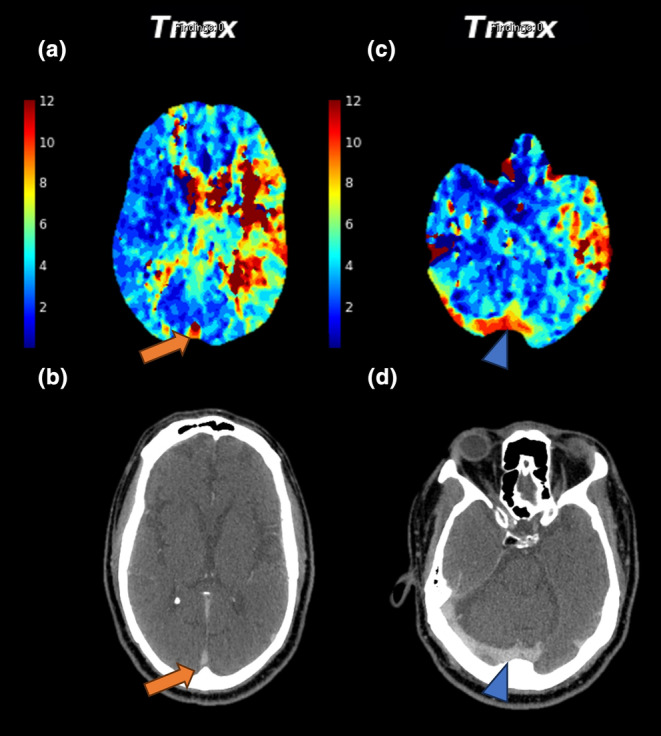
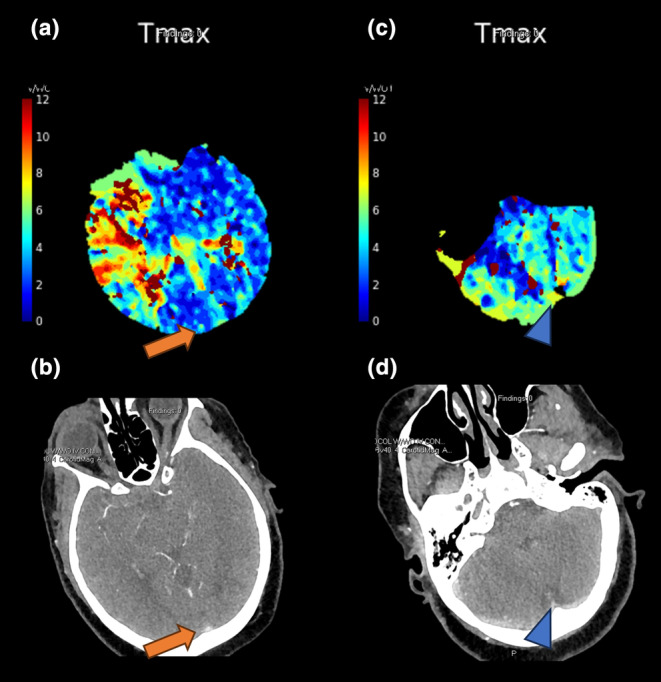
In our prospectively collected, retrospectively reviewed database, we analyzed data from 104 patients with AIS-LVO who achieved successful reperfusion (modified Thrombolysis in Cerebral Infarction score of 2b/2c/3) between September 2017 and September 2022. PVT was defined as a time to maximum (Tmax) of ≥10 s in the superior sagittal sinus and/or torcula on computed tomography perfusion (CTP) imaging. Patients were categorized into PVT-positive (PVT+) and PVT-negative (PVT-) groups. The primary outcome was excellent functional recovery at 90 days.
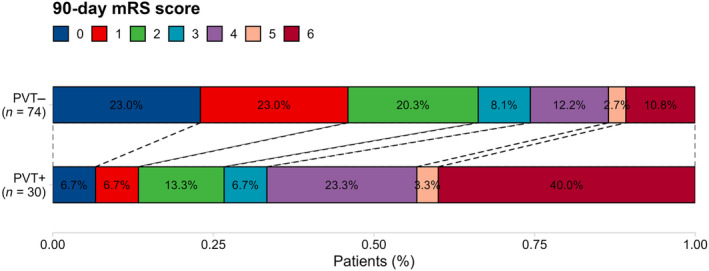
Of the 104 patients, 30 (29%) were PVT+. Excellent functional outcome was achieved in 38 patients (37%). PVT+ patients had a significantly lower rate of excellent recovery compared to PVT- patients (11% vs. 39%; p < 0.001). After adjusting for possible confounders, PVT positivity was independently associated with lower odds of excellent recovery (adjusted odds ratio 0.11, 95% confidence interval 0.02 to 0.48; p = 0.006).
Among patients with AIS-LVO who achieved successful reperfusion, PVT positivity was independently associated with a decreased likelihood of excellent functional outcome at 90 days. Assessment of PVT on CTP may provide valuable prognostic information and aid in clinical decision making for patients with AIS-LVO.
尽管有成功的再灌注治疗,但前循环大血管闭塞所致急性缺血性卒中(AIS-LVO)仍是导致残疾的主要原因。长时间静脉 transit(PVT)已成为AIS-LVO中一种潜在的预后影像生物标志物。我们旨在研究PVT是否与成功再灌注后获得良好功能结局(90天时改良Rankin量表[mRS]评分为0-1)的可能性降低相关。
在我们前瞻性收集、回顾性分析的数据库中,我们分析了2017年9月至2022年9月期间104例成功再灌注(改良脑梗死溶栓评分2b/2c/3)的AIS-LVO患者的数据。PVT定义为计算机断层扫描灌注(CTP)成像中上矢状窦和/或窦汇处最大时间(Tmax)≥10秒。患者被分为PVT阳性(PVT+)组和PVT阴性(PVT-)组。主要结局为90天时良好的功能恢复。
104例患者中,30例(29%)为PVT+。38例(37%)患者获得了良好的功能结局。与PVT-患者相比,PVT+患者的良好恢复率显著更低(11%对39%;p<0.001)。在调整可能的混杂因素后,PVT阳性与良好恢复的较低几率独立相关(调整后的优势比为0.11,95%置信区间为0.02至0.48;p=0.006)。
在成功再灌注的AIS-LVO患者中,PVT阳性与90天时获得良好功能结局的可能性降低独立相关。CTP上PVT的评估可为AIS-LVO患者提供有价值的预后信息并有助于临床决策。