Lakhani Dhairya A, Balar Aneri B, Salim Hamza, Koneru Manisha, Wen Sijin, Ozkara Burak, Lu Hanzhang, Wang Richard, Hoseinyazdi Meisam, Xu Risheng, Nabi Mehreen, Mazumdar Ishan, Cho Andrew, Chen Kevin, Sepehri Sadra, Hyson Nathan, Urrutia Victor, Luna Licia, Hillis Argye E, Heit Jeremy J, Albers Greg W, Rai Ansaar T, Dmytriw Adam A, Faizy Tobias D, Wintermark Max, Nael Kambiz, Yedavalli Vivek S
Department of Radiology and Radiological Sciences, Johns Hopkins University, 600 N. Wolfe St., Phipps B100, Baltimore, MD 21287, USA.
Cooper Medical School, Rowan University, Camden, NJ 08103, USA.
Diagnostics (Basel). 2024 Apr 19;14(8):845. doi: 10.3390/diagnostics14080845.
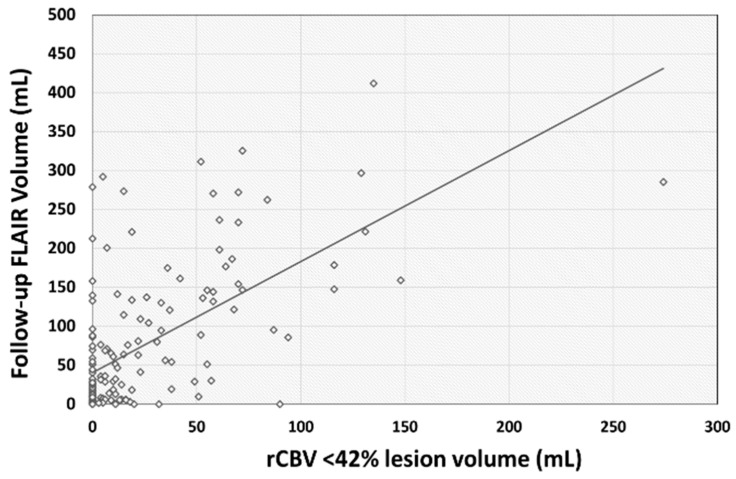
Pretreatment CT Perfusion (CTP) parameter rCBV < 42% lesion volume has recently been shown to predict 90-day mRS. In this study, we aim to assess the relationship between rCBV < 42% and a radiographic follow-up infarct volume delineated on FLAIR images. In this retrospective evaluation of our prospectively collected database, we included acute stroke patients triaged by multimodal CT imaging, including CT angiography and perfusion imaging, with confirmed anterior circulation large vessel occlusion between 9 January 2017 and 10 January 2023. Follow-up FLAIR imaging was used to determine the final infarct volume. Student t, Mann-Whitney-U, and Chi-Square tests were used to assess differences. Spearman's rank correlation and linear regression analysis were used to assess associations between rCBV < 42% and follow-up infarct volume on FLAIR. In total, 158 patients (median age: 68 years, 52.5% female) met our inclusion criteria. rCBV < 42% (ρ = 0.56, < 0.001) significantly correlated with follow-up-FLAIR infarct volume. On multivariable linear regression analysis, rCBV < 42% lesion volume (beta = 0.60, < 0.001), ASPECTS (beta = -0.214, < 0.01), mTICI (beta = -0.277, < 0.001), and diabetes (beta = 0.16, < 0.05) were independently associated with follow-up infarct volume. The rCBV < 42% lesion volume is independently associated with FLAIR follow-up infarct volume.
近期研究表明,治疗前CT灌注(CTP)参数rCBV<42%病变体积可预测90天改良Rankin量表(mRS)评分。在本研究中,我们旨在评估rCBV<42%与FLAIR图像上影像学随访梗死体积之间的关系。在对我们前瞻性收集的数据库进行的这项回顾性评估中,我们纳入了经多模态CT成像(包括CT血管造影和灌注成像)分诊的急性卒中患者,这些患者在2017年1月9日至2023年1月10日期间确诊为前循环大血管闭塞。采用随访FLAIR成像确定最终梗死体积。使用学生t检验、曼-惠特尼U检验和卡方检验评估差异。采用Spearman秩相关和线性回归分析评估rCBV<42%与FLAIR上随访梗死体积之间的关联。共有158例患者(中位年龄:68岁,52.5%为女性)符合我们的纳入标准。rCBV<42%(ρ = 0.56,P<0.001)与随访FLAIR梗死体积显著相关。在多变量线性回归分析中,rCBV<42%病变体积(β = 0.60,P<0.001)、脑缺血半暗带评分(ASPECTS)(β = -0.214,P<0.01)、脑梗死溶栓分级(mTICI)(β = -0.277,P<0.001)和糖尿病(β = 0.16,P<0.05)与随访梗死体积独立相关。rCBV<42%病变体积与FLAIR随访梗死体积独立相关。