Price Menna, Douglas Laura, Hepper Erica G, Wilkinson Laura L
Department of Psychology, Swansea University, Singleton Park, Swansea, United Kingdom.
School of Psychology, University of Surrey, Guildford, Surrey, United Kingdom.
PLoS One. 2024 Dec 2;19(12):e0312691. doi: 10.1371/journal.pone.0312691. eCollection 2024.
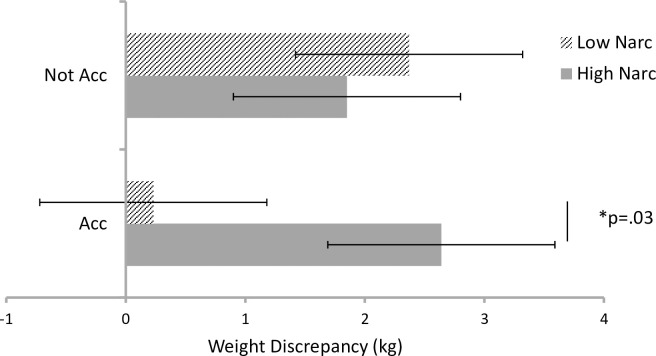
Self-reported height and weight is widely used to calculate Body Mass Index (BMI) and yet little is known about factors that affect accuracy. This study investigated the motivational characteristics-narcissism and social desirability-that influence the accuracy of self-reported weight and how they interact with accountability (telling participants that their weight will be verified). A two-way between-subjects design was used (accountable vs not accountable) with motivational moderators (narcissism and social desirability). Participants (N = 80; Mean Age = 34.63; 58.8% Female) were randomly allocated to accountable (told that their weight would be verified in a follow-up lab session) or not-accountable (no information given) conditions. In Session 1, participants self-reported motivational (social desirability and narcissism) and anthropometric (height and weight) measures online. In Session 2 (24 hours later), objective measures of height and weight were taken in the lab. There was a significant interaction between condition and maladaptive narcissism level. Being told that weight would be later verified improved accuracy of self-reported weight, but only for those low in maladaptive narcissism. Accountability improves the accuracy of self-report weight data, but not for individuals high in narcissism. Though based on a modest sample, these findings suggest that the under-estimation of self- report weight serves a self-protective function and maladaptive narcissism may be a useful covariate to include in research using self-report weight estimates.
自我报告的身高和体重被广泛用于计算体重指数(BMI),但对于影响其准确性的因素却知之甚少。本研究调查了影响自我报告体重准确性的动机特征——自恋和社会期望——以及它们如何与可问责性(告知参与者其体重将被核实)相互作用。采用了一种两因素被试间设计(可问责与不可问责),并设置了动机调节变量(自恋和社会期望)。参与者(N = 80;平均年龄 = 34.63;58.8%为女性)被随机分配到可问责组(被告知其体重将在后续实验室环节中被核实)或不可问责组(未提供任何信息)。在第一阶段,参与者在线自我报告动机性(社会期望和自恋)及人体测量学(身高和体重)指标。在第二阶段(24小时后),在实验室中对身高和体重进行客观测量。条件与适应不良自恋水平之间存在显著交互作用。被告知体重随后将被核实提高了自我报告体重的准确性,但仅对适应不良自恋水平较低的人有效。可问责性提高了自我报告体重数据的准确性,但对自恋程度高的个体无效。尽管基于一个规模不大的样本,但这些发现表明,自我报告体重的低估具有自我保护功能,并且适应不良自恋可能是在使用自我报告体重估计的研究中一个有用的协变量需要纳入考虑。