Etzbach Lara, Gola Susanne, Küllmer Fabian, Acir Ismail-Hakki, Wohlt Daria, Ignatzy Laura Melanie, Bader-Mittermaier Stephanie, Schweiggert-Weisz Ute
Institute for Nutritional and Food Sciences, University of Bonn, Bonn 53115, Germany.
Fraunhofer Institute for Process Engineering and Packaging, Freising 85354, Germany.
Proc Natl Acad Sci U S A. 2024 Dec 10;121(50):e2319019121. doi: 10.1073/pnas.2319019121. Epub 2024 Dec 2.
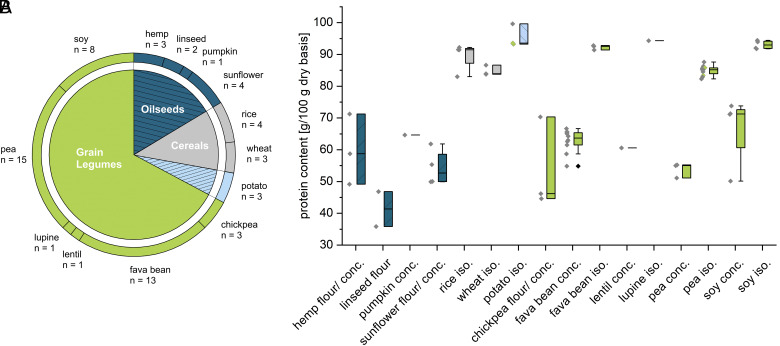
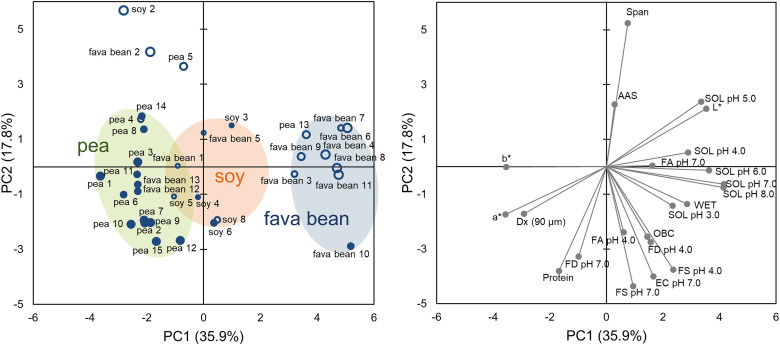
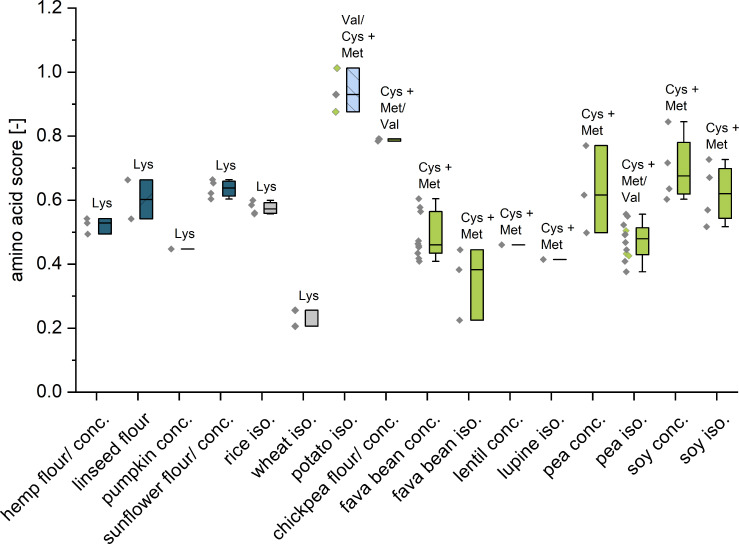
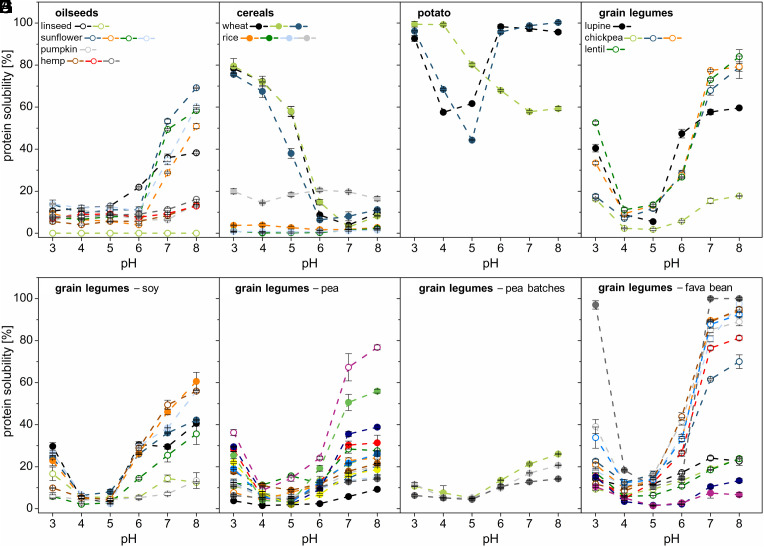
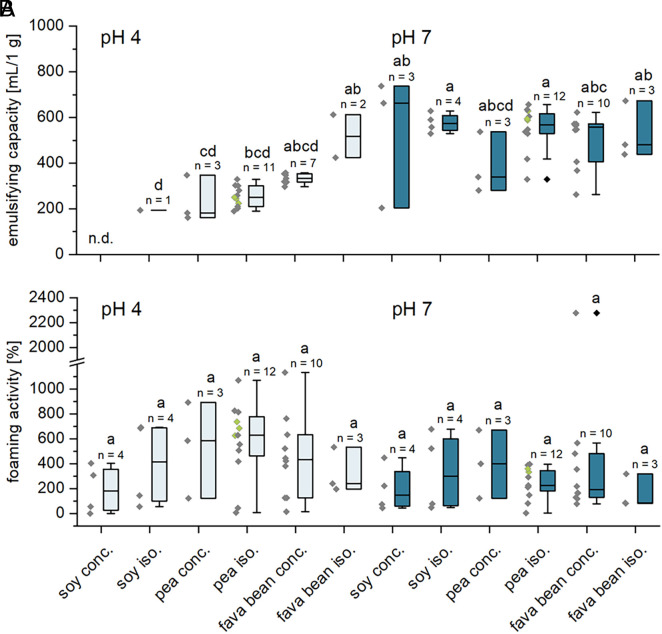
Consumer interest in meat and dairy alternatives drives demand for plant-based protein ingredients. While soy and gluten dominate the market, there is a trend to explore alternative crops for functional ingredient production. The multitude of ingredients poses challenges for food manufacturers in selecting the right protein. We investigated 61 commercially available protein ingredients from various sources, categorizing them based on their protein content into protein-rich flours (protein content less than 50%), protein concentrates (protein content between 50% and 80%), and protein isolates (protein content higher than 80%). Methionine, cysteine, and lysine were decisive for the amino acid score, which even varied between ingredients produced from the same raw material. Such differences were also observed in the protein solubility profiles, characterized by their raw material-specific protein pattern. By focusing on soy, pea, and fava bean ingredients, the broad spectra of emulsifying and foaming properties were illustrated. These ranged from non-emulsifying and non-foaming to high emulsifying capacities of 737 mL/g ingredient and foaming activities of 2,278%, accompanied by a foam stability of 100%. Additionally, we demonstrated that the functionality of ingredients obtained from different batches could vary by up to 24% relative SD. Protein solubility, powder wettability, color, and particle size were determined as key properties for the differentiation of soy, pea, and fava bean protein ingredients by principal component analysis. In our study conclusion, we propose essential measures for overcoming challenges in protein ingredient production and utilization to realize their full potential in fostering sustainable and innovative plant-based food production.
消费者对肉类和奶制品替代品的兴趣推动了对植物性蛋白质成分的需求。虽然大豆和面筋在市场上占据主导地位,但探索用于功能性成分生产的替代作物已成为一种趋势。众多的成分给食品制造商选择合适的蛋白质带来了挑战。我们研究了61种来自不同来源的市售蛋白质成分,根据其蛋白质含量将它们分为富含蛋白质的面粉(蛋白质含量低于50%)、蛋白质浓缩物(蛋白质含量在50%至80%之间)和蛋白质分离物(蛋白质含量高于80%)。蛋氨酸、半胱氨酸和赖氨酸对氨基酸评分起决定性作用,甚至同一原料生产的成分之间也存在差异。在蛋白质溶解度曲线中也观察到了这种差异,其特征在于其特定原料的蛋白质模式。通过关注大豆、豌豆和蚕豆成分,展示了广泛的乳化和发泡特性。这些特性范围从非乳化和非发泡到高达737 mL/g成分的高乳化能力和2278%的发泡活性,同时泡沫稳定性为100%。此外,我们证明了不同批次获得的成分的功能相对标准偏差可能相差高达24%。通过主成分分析确定蛋白质溶解度、粉末润湿性、颜色和粒径是区分大豆、豌豆和蚕豆蛋白质成分的关键特性。在我们的研究结论中,我们提出了克服蛋白质成分生产和利用挑战的基本措施,以充分发挥其在促进可持续和创新植物性食品生产方面的潜力。