Oldrieve Guy R, Venter Frank, Cayla Mathieu, Verney Mylène, Hébert Laurent, Geerts Manon, Van Reet Nick, Matthews Keith R
Institute for Immunology and Infection Research, School of Biological Sciences, University of Edinburgh, Edinburgh, EH9 3FL, UK.
York Biomedical Research Institute and Department of Biology, University of York, York, UK.
Nat Commun. 2024 Dec 2;15(1):10485. doi: 10.1038/s41467-024-54555-w.
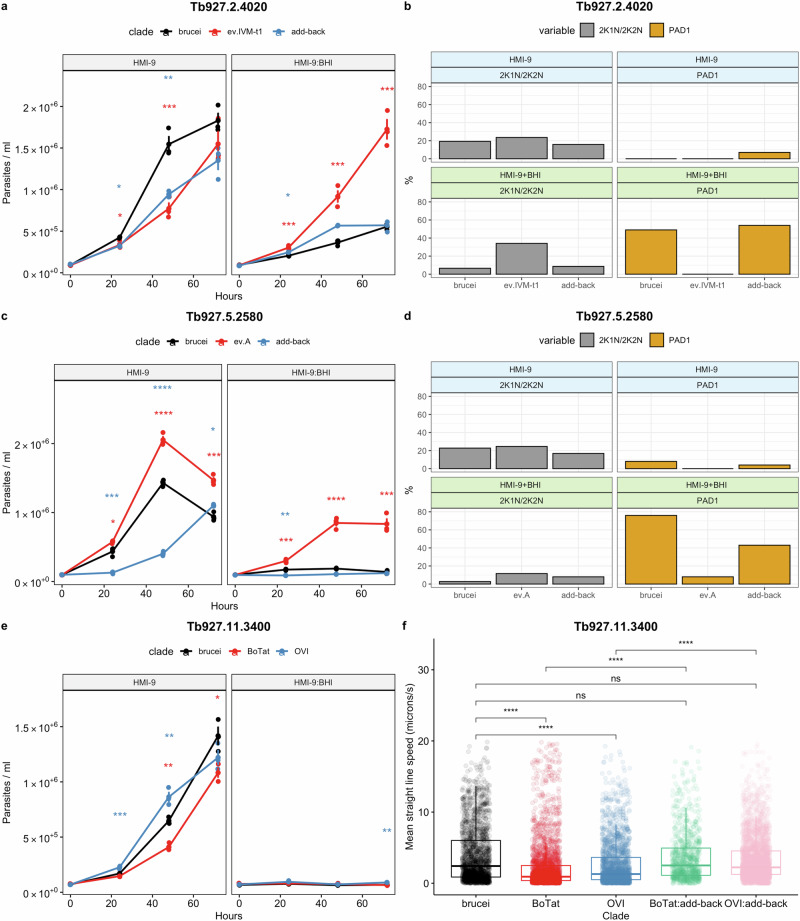
African trypanosomes are important parasites in sub-Saharan Africa that undergo a quorum-sensing dependent development to morphologically 'stumpy forms' in mammalian hosts to favour transmission by tsetse flies. However, some trypanosome clades have simplified their lifecycle by escaping dependence on tsetse allowing an expanded geographic range, with direct transmission between hosts achieved via blood-feeding biting flies and vampire bats (Trypanosoma brucei evansi, causing 'surra') or through sexual transmission (Trypanosoma brucei equiperdum, causing 'dourine'). Concomitantly, stumpy formation is reduced and the isolates are described as monomorphic, with infections spread widely in Africa, Asia, South America and parts of Europe. Here, using genomic analysis of distinct field isolates, we identify molecular changes that accompany the loss of the stumpy formation in monomorphic clades. Using CRISPR-mediated allelic replacement, mutations in two exemplar genes (Tb927.2.4020; Tb927.5.2580) are confirmed to reduce stumpy formation whereas another (Tb927.11.3400) is implicated in altered motility. Using laboratory selection we identify downregulation of RNA regulators as important in the initial development of monomorphism. This identifies a trajectory of events that simplify the life cycle in emergent and established monomorphic trypanosomes, with impact on disease spread, vector control strategies, geographical range and virulence.
非洲锥虫是撒哈拉以南非洲地区的重要寄生虫,它们在哺乳动物宿主体内经历群体感应依赖性发育,形成形态上的“粗短型”,以便于采采蝇传播。然而,一些锥虫进化枝通过摆脱对采采蝇的依赖简化了其生命周期,从而扩大了地理分布范围,可通过吸血蝇类和吸血蝙蝠在宿主之间直接传播(伊氏锥虫,引起“苏拉病”),或通过性传播(马媾疫锥虫,引起“马媾疫”)。与此同时,粗短型的形成减少,这些分离株被描述为单态性,感染在非洲、亚洲、南美洲和欧洲部分地区广泛传播。在这里,通过对不同野外分离株的基因组分析,我们确定了单态性进化枝中粗短型形成丧失所伴随的分子变化。利用CRISPR介导的等位基因替换,证实两个示例基因(Tb927.2.4020;Tb927.5.2580)中的突变会减少粗短型的形成,而另一个基因(Tb927.11.3400)则与运动性改变有关。通过实验室筛选,我们确定RNA调节因子的下调在单态性的初始发育中很重要。这确定了一系列事件的轨迹,这些事件简化了新出现的和已有的单态性锥虫的生命周期,对疾病传播、媒介控制策略、地理分布范围和毒力产生影响。