Xu Rongqing, Yang Qing, Liu Zhi, Shi Xiaolei, Wu Xintong, Chen Yuehan, Du Xinyu, Gao Qiqi, He Di, Shi Ainong, Tao Peijun, Yan Long
Hebei Laboratory of Crop Genetics and Breeding, National Soybean Improvement Center Shijiazhuang Sub-Center, Huang-Huai-Hai Key Laboratory of Biology and Genetic Improvement of Soybean, Ministry of Agriculture and Rural Affairs, Institute of Cereal and Oil Crops, Hebei Academy of Agricultural and Forestry Sciences, Shijiazhuang, China.
College of Agronomy, Hebei Agricultural University, Baoding, China.
Front Plant Sci. 2024 Nov 18;15:1494551. doi: 10.3389/fpls.2024.1494551. eCollection 2024.
Soybean is an important protein and oil crop, and improving yield has traditionally been a major breeding goal. However, salt stress is an important abiotic factor that can severely impair soybean yield by disrupting metabolic processes, inhibiting photosynthesis, and hindering plant growth, ultimately leading to a decrease in productivity.
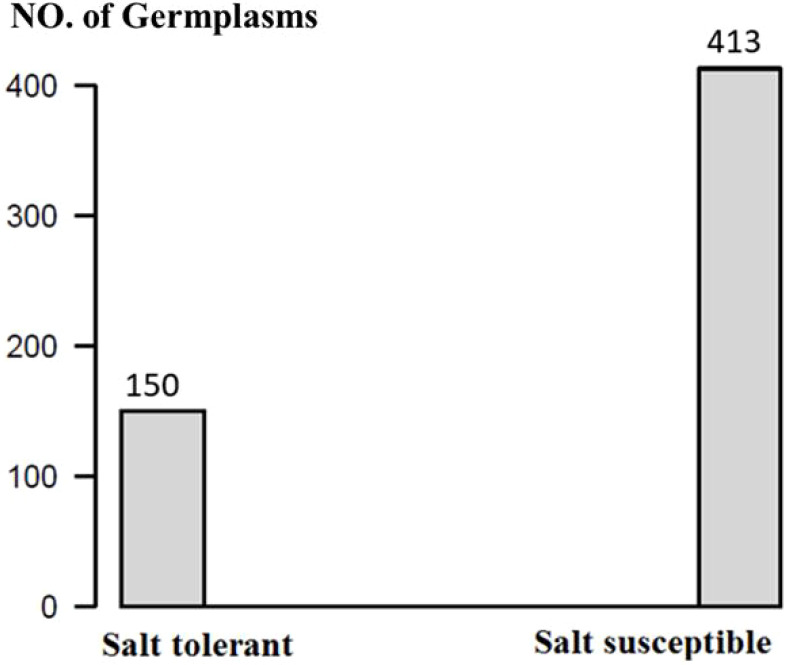
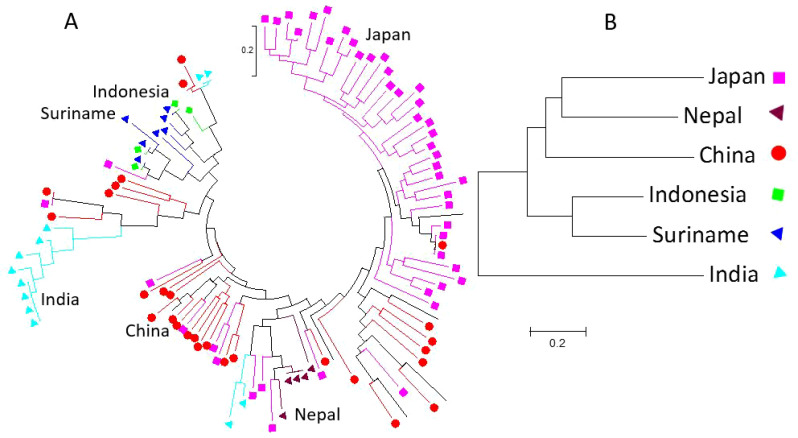
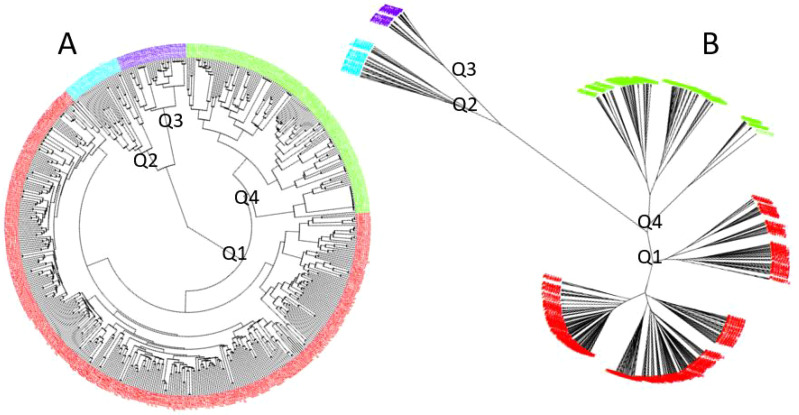
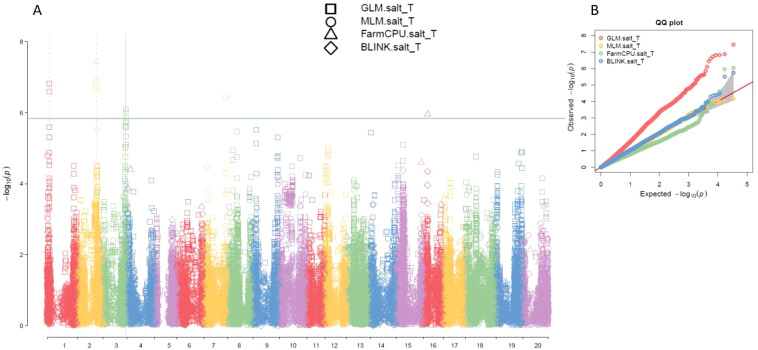
This study utilized phenotypic and genotypic data from 563 soybean germplasms sourced from over 20 countries. Employing four distinct models-we performed a genome-wide association study (GWAS) using four models, including MLM, MLMM, FarmCPU, and BLINK in GAPIT 3, we conducted a Genome-Wide Association Study (GWAS) to identify single nucleotide polymorphism (SNP) associated with salt tolerance in soybean. Subsequently, these identified SNP were further analyzed for candidate gene discovery. Using 34,181 SNPs for genomic prediction (GP) to assess prediction accuracy.
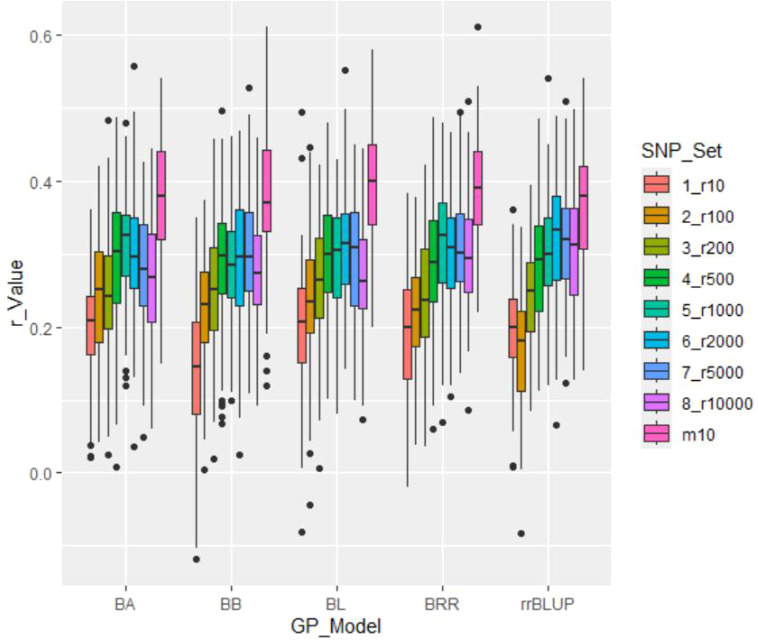
Our study identified 10 SNPs significantly associated with salt tolerance, located on chromosomes 1, 2, 3, 7, and 16. And we identified 11 genes within a 5 kb window upstream and downstream of the QTLs on chromosomes 1, 3, and 16. Utilizing the GWAS-derived SNP marker sets for genomic prediction (GP) yielded r-values greater than 0.35, indicating a higher level of accuracy. This suggests that genomic selection for salt tolerance is feasible.
The 10 identified SNP markers and candidate genes in this study provide a valuable reference for screening and developing salt-tolerant soybean germplasm resources.
大豆是一种重要的蛋白质和油料作物,提高产量一直是传统的主要育种目标。然而,盐胁迫是一种重要的非生物因素,它会破坏代谢过程、抑制光合作用并阻碍植物生长,从而严重损害大豆产量,最终导致生产力下降。
本研究利用了来自20多个国家的563份大豆种质的表型和基因型数据。采用四种不同的模型——我们在GAPIT 3中使用MLM、MLMM、FarmCPU和BLINK这四种模型进行了全基因组关联研究(GWAS),以鉴定与大豆耐盐性相关的单核苷酸多态性(SNP)。随后,对这些鉴定出的SNP进行进一步分析以发现候选基因。使用34,181个SNP进行基因组预测(GP)以评估预测准确性。
我们的研究鉴定出10个与耐盐性显著相关的SNP,位于第1、2、3、7和16号染色体上。并且我们在第1、3和16号染色体上QTL上下游5 kb窗口内鉴定出11个基因。利用GWAS衍生的SNP标记集进行基因组预测(GP)产生的r值大于0.35,表明准确性较高。这表明耐盐性的基因组选择是可行的。
本研究中鉴定出的10个SNP标记和候选基因为筛选和开发耐盐大豆种质资源提供了有价值的参考。