Desilets Antoine, Pinheiro Gabryella, Belkaid Wiam, Salko Olivier, Malo Julie, Zarour Eleyine, Jouquan Adeline, Thibaudeau Anne-Julie, Nolin Marc-Antoine, Stagg John, Florescu Marie, Tehfe Mustapha, Blais Normand, Tabchi Samer, Chalaoui Jean, Stephenson Philippe, Elkrief Arielle, Trinh Vincent Quoc-Huy, Routy Bertrand, Liberman Moishe
Department of Medicine, Division of Hematology-Oncology, Centre hospitalier de l'Université de Montréal (CHUM), Montreal, Canada.
Centre de recherche du CHUM (CRCHUM), University of Montreal, Montreal, Canada.
JTO Clin Res Rep. 2024 Oct 15;5(12):100737. doi: 10.1016/j.jtocrr.2024.100737. eCollection 2024 Dec.
NSCLC is the leading cause of cancer-related mortality. Although immune-checkpoint inhibitors (ICIs) have improved survival in patients with advanced NSCLC, treatment resistance remains a challenge. Cryoactivation, a technique inducing cell death by cycles of freezing and thawing, has the potential to augment tumor responses when combined with ICIs.
This single-arm phase 1 clinical trial enrolled patients with previously untreated advanced NSCLC and 50% or higher programmed cell death ligand-1 (PD-L1). Patients underwent cryoactivation followed by ICI monotherapy initiated 5 days later. The primary end point was the objective response rate. Co-secondary end points included the safety and feasibility of the procedure and overall survival. Immune cell infiltration by immunohistochemistry was performed on paired pre- and post-treatment samples, with patients dichotomized according to clinical benefit (CB) rate (CB versus no CB [NCB]).
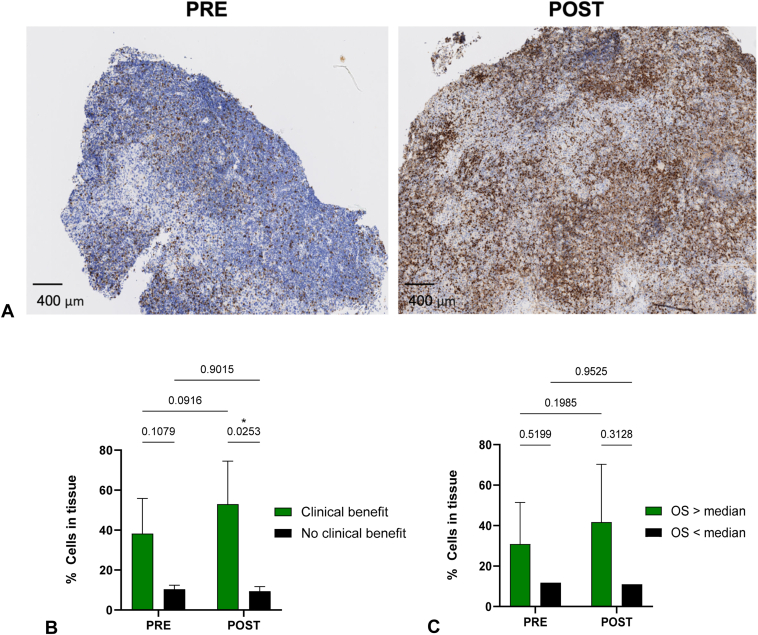
Eight patients were enrolled. Two patients achieved a partial response, yielding an objective response rate of 25%. Median progression-free survival and overall survival were 3.8 and 13.0 months, respectively. The cryoactivation procedure was well tolerated, without grade 3 to 4 adverse events. Post-hoc analysis reported a CB rate of 50%. Immunohistochemistry analysis reported a numerical difference in the cluster of differentiation 8-positive (CD8) T cell infiltration in CB versus NCB in the pre- and post-treatment biopsies ( = 0.09) and an increase in CD8 T cells in the post-treatment biopsies of CB versus NCB ( = 0.03).
Although cryoactivation combined with pembrolizumab was safe and well tolerated in patients with NSCLC, therapeutic benefits were not evident compared with historical cohorts of ICI monotherapy. Correlative analyses validated CD8 T cell recruitment in patients deriving CB.
非小细胞肺癌(NSCLC)是癌症相关死亡的主要原因。尽管免疫检查点抑制剂(ICI)提高了晚期NSCLC患者的生存率,但治疗耐药性仍然是一个挑战。冷冻激活是一种通过冻融循环诱导细胞死亡的技术,与ICI联合使用时有可能增强肿瘤反应。
这项单臂1期临床试验招募了先前未接受过治疗的晚期NSCLC且程序性细胞死亡配体1(PD-L1)表达为50%或更高的患者。患者接受冷冻激活,5天后开始ICI单药治疗。主要终点是客观缓解率。共同次要终点包括该操作的安全性和可行性以及总生存期。对配对的治疗前和治疗后样本进行免疫组化分析免疫细胞浸润情况,根据临床获益(CB)率将患者分为两组(CB组与无临床获益[NCB]组)。
共招募了8名患者。2名患者获得部分缓解,客观缓解率为25%。无进展生存期和总生存期的中位数分别为3.8个月和13.0个月。冷冻激活操作耐受性良好,无3至4级不良事件。事后分析报告CB率为50%。免疫组化分析报告,在治疗前和治疗后的活检中,CB组与NCB组相比,分化簇8阳性(CD8)T细胞浸润存在数值差异(P = 0.09),且治疗后活检中CB组与NCB组相比,CD8 T细胞增加(P = 0.03)。
尽管冷冻激活联合帕博利珠单抗在NSCLC患者中安全且耐受性良好,但与ICI单药治疗的历史队列相比,治疗益处并不明显。相关性分析证实了从CB中获益的患者有CD8 T细胞募集。