• 文献检索
  • 文档翻译
  • 深度研究
  • 学术资讯
  • Suppr Zotero 插件Zotero 插件
  • 邀请有礼
  • 套餐&价格
  • 历史记录
应用&插件
Suppr Zotero 插件Zotero 插件浏览器插件Mac 客户端Windows 客户端微信小程序
定价
高级版会员购买积分包购买API积分包
服务
文献检索文档翻译深度研究API 文档MCP 服务
关于我们
关于 Suppr公司介绍联系我们用户协议隐私条款
关注我们

Suppr 超能文献

核心技术专利:CN118964589B侵权必究
粤ICP备2023148730 号-1Suppr @ 2026

文献检索

告别复杂PubMed语法,用中文像聊天一样搜索,搜遍4000万医学文献。AI智能推荐,让科研检索更轻松。

立即免费搜索

文件翻译

保留排版,准确专业,支持PDF/Word/PPT等文件格式,支持 12+语言互译。

免费翻译文档

深度研究

AI帮你快速写综述,25分钟生成高质量综述,智能提取关键信息,辅助科研写作。

立即免费体验

是什么推动了中国数字乡村生活的发展?

What drives the development of digital rural life in China?

作者信息

Xiong Chunlin, Wang Yaling, Wu Zhenyu, Liu Fen

机构信息

School of Public Administration and Law, Hunan Agricultural University, Hunan, 400125, China.

School of agriculture, Orient science & technology college of Hunan Agricultural University, Hunan, 400125, China.

出版信息

Heliyon. 2024 Oct 21;10(22):e39511. doi: 10.1016/j.heliyon.2024.e39511. eCollection 2024 Nov 30.

DOI:10.1016/j.heliyon.2024.e39511
PMID:39624305
原文链接:https://pmc.ncbi.nlm.nih.gov/articles/PMC11609444/
Abstract

BACKGROUND AND OBJECTIVE

Empowering rural life through digital technology reflects the collective aspirations of millions of farmers striving for a better quality of life. Ensuring that the benefits of digital advancements reach every corner of the population is a crucial and inevitable choice. To expedite the establishment of an inclusive digital life for all citizens, the Chinese government has exerted substantial efforts by positioning the development of digital villages as a national strategy. Through comprehensive initiatives in digital village construction, facilitating the extension of "Internet+" services such as education, healthcare, transportation, and entertainment to rural areas. 24-hour digital village libraries, smart health stations, intelligent homes, facial recognition payments, unmanned supermarkets, and a variety of digitized, networked, and intelligent lifestyle applications are increasingly prevalent in Chinese rural regions. The digital gap between urban and rural areas in China is gradually diminishing, and the ongoing evolution of rural digital lifestyles paints a picturesque picture of an enhanced rural life. This study endeavors to provide a meticulous analysis of the digital landscape in Chinese villages, seeking to unravel the intricacies behind the swift development of rural digital life.

METHODS

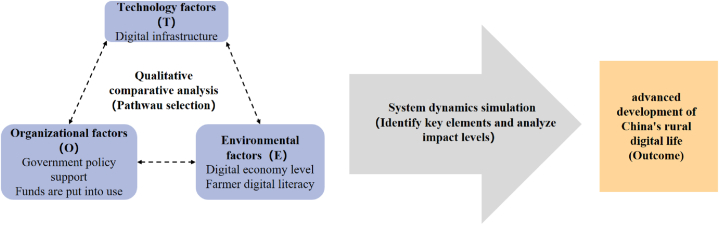
Using the top 100 counties in China's 2020 Rural Life Digitization Index ranking as case studies, this research collected the necessary data through industry research reports and official statistical sources. To begin with, based on the Technology-Organization-Environment (TOE) analysis framework, variables such as digital infrastructure, government policy support, funds are put into utilization, digital economy level, and farmer digital literacy were identified. The fuzzy set qualitative comparative analysis (fsQCA) method was then employed to recognize the influencing factors of rural digital life and combinations of condition variables. Subsequently, utilizing the system dynamics methodology, the relationships between factors were analyzed, simulating changes in rural digital life development to gain a deeper understanding of the key elements affecting rural digital life. Sensitivity analysis was conducted to further reveal the extent of influence of these key elements on rural digital life.

RESULTS

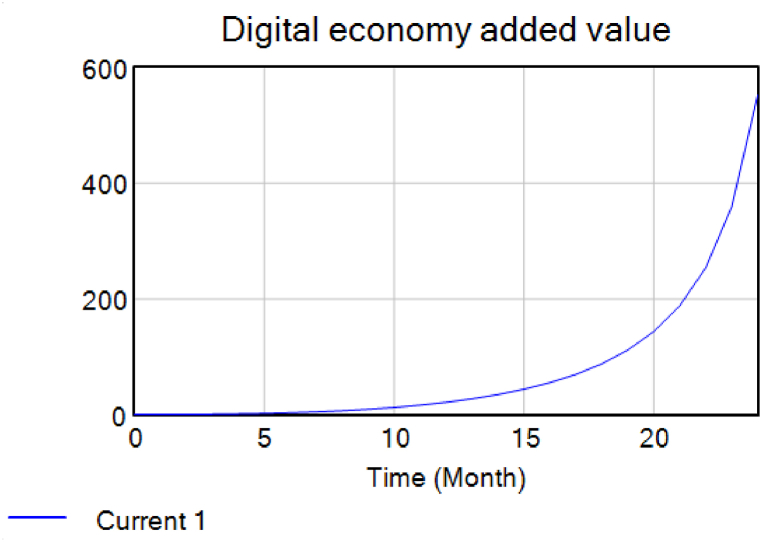
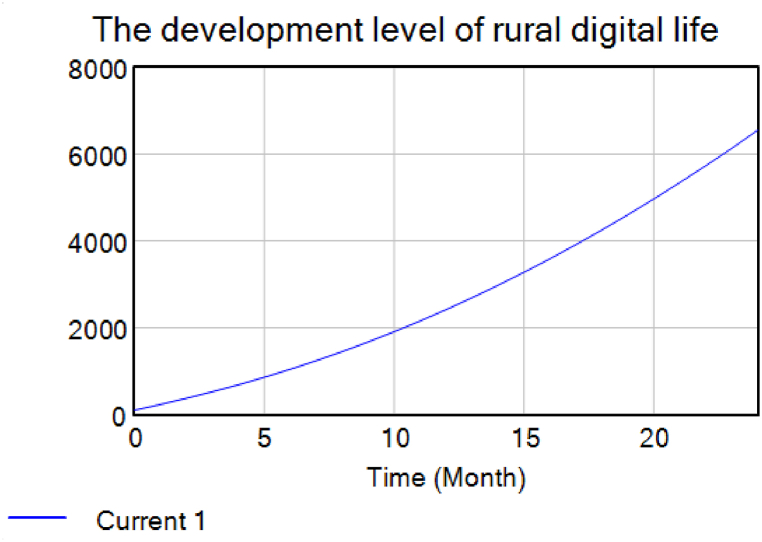
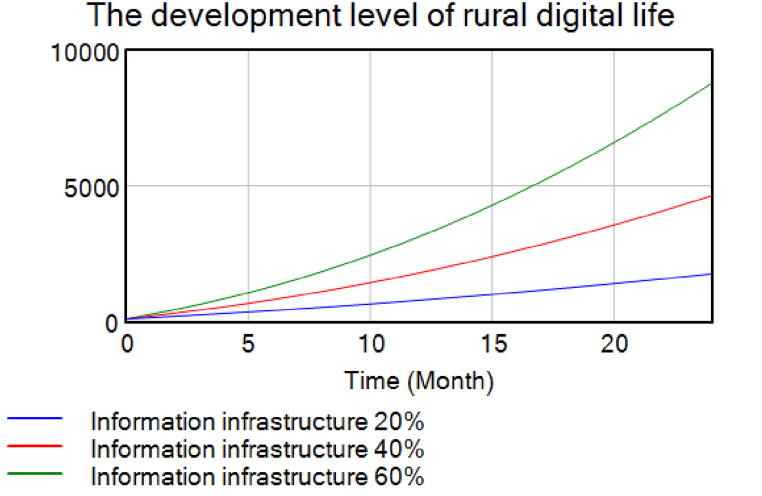
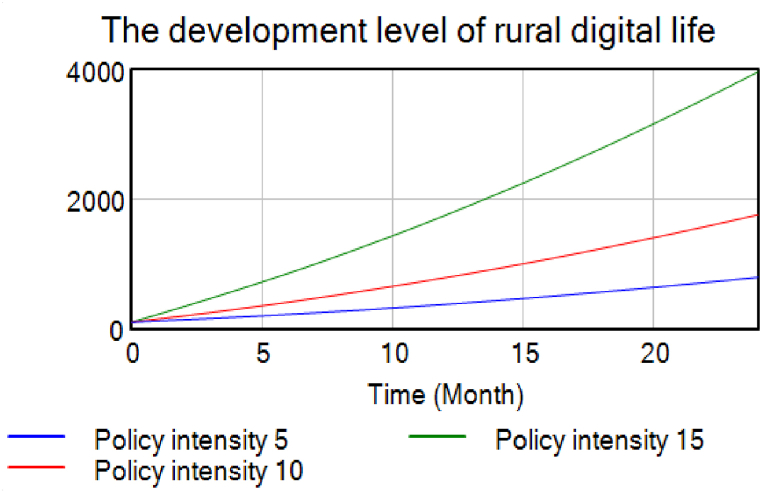
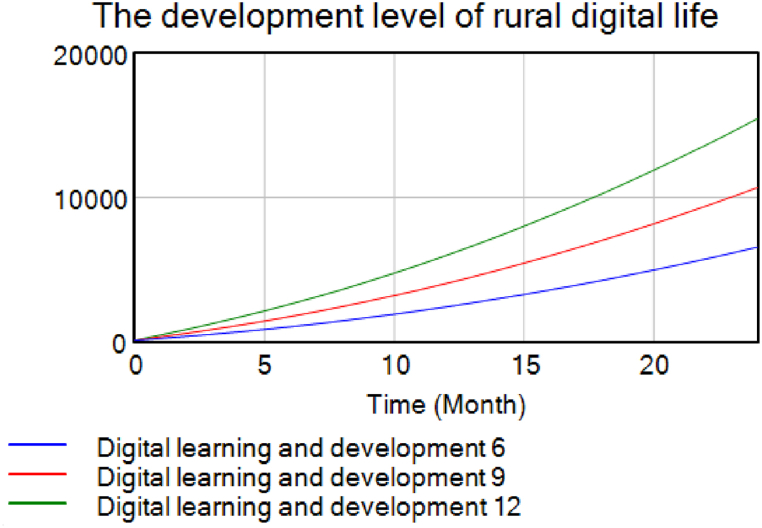
The fuzzy set qualitative comparative analysis reveals that the evolution of rural digital life in China is a complex outcome influenced by the simultaneous interplay of multiple factors. It demonstrates a pattern of diverse combinations and parallel pathways encompassing various variables. Among these configurations, six paths stand out with the highest coverage. These six paths can be further classified into three modes of rural digital life development in China: environment-empowered type, organization-pushed type, and compound-driven type. Further dissection of causal combinations through a system dynamics model unveils that the progression of rural digital life is intricately linked to key factors such as information infrastructure, policy intensity, and digital learning and development. Over time, there is a discernible upward trajectory in the level of rural digital life, characterized by an accelerating pace of improvement. The influence of policy intensity on rural digital life surpasses that of information infrastructure and digital learning and development, indicating that policy intensity exerts the most significant impact overall.

CONCLUSION

The evolution of rural digital life in China is a complex, long-term process propelled by a combination of multiple factors. China's experience demonstrates that achieving high-level development in rural digital life demands attention not only to the synergistic interplay of various factors but also a strategic focus on leveraging specific key elements. This entails skillfully integrating diverse factors and identifying pivotal areas to maximize the impact of relevant conditions to the greatest extent possible.
https://cdn.ncbi.nlm.nih.gov/pmc/blobs/eb3b/11609444/6be0ddec6cf4/gr10.jpg
https://cdn.ncbi.nlm.nih.gov/pmc/blobs/eb3b/11609444/9dc5c2240410/gr1.jpg
https://cdn.ncbi.nlm.nih.gov/pmc/blobs/eb3b/11609444/fd6cfc279a02/gr2.jpg
https://cdn.ncbi.nlm.nih.gov/pmc/blobs/eb3b/11609444/60c3e8b1c7ef/gr3.jpg
https://cdn.ncbi.nlm.nih.gov/pmc/blobs/eb3b/11609444/1aed911e5ae1/gr4.jpg
https://cdn.ncbi.nlm.nih.gov/pmc/blobs/eb3b/11609444/a1574d7f613a/gr5.jpg
https://cdn.ncbi.nlm.nih.gov/pmc/blobs/eb3b/11609444/8b0c6efb1fea/gr6.jpg
https://cdn.ncbi.nlm.nih.gov/pmc/blobs/eb3b/11609444/b4f8b67965d5/gr7.jpg
https://cdn.ncbi.nlm.nih.gov/pmc/blobs/eb3b/11609444/9f6bbf1e5ddc/gr8.jpg
https://cdn.ncbi.nlm.nih.gov/pmc/blobs/eb3b/11609444/7857d46180c1/gr9.jpg
https://cdn.ncbi.nlm.nih.gov/pmc/blobs/eb3b/11609444/6be0ddec6cf4/gr10.jpg
https://cdn.ncbi.nlm.nih.gov/pmc/blobs/eb3b/11609444/9dc5c2240410/gr1.jpg
https://cdn.ncbi.nlm.nih.gov/pmc/blobs/eb3b/11609444/fd6cfc279a02/gr2.jpg
https://cdn.ncbi.nlm.nih.gov/pmc/blobs/eb3b/11609444/60c3e8b1c7ef/gr3.jpg
https://cdn.ncbi.nlm.nih.gov/pmc/blobs/eb3b/11609444/1aed911e5ae1/gr4.jpg
https://cdn.ncbi.nlm.nih.gov/pmc/blobs/eb3b/11609444/a1574d7f613a/gr5.jpg
https://cdn.ncbi.nlm.nih.gov/pmc/blobs/eb3b/11609444/8b0c6efb1fea/gr6.jpg
https://cdn.ncbi.nlm.nih.gov/pmc/blobs/eb3b/11609444/b4f8b67965d5/gr7.jpg
https://cdn.ncbi.nlm.nih.gov/pmc/blobs/eb3b/11609444/9f6bbf1e5ddc/gr8.jpg
https://cdn.ncbi.nlm.nih.gov/pmc/blobs/eb3b/11609444/7857d46180c1/gr9.jpg
https://cdn.ncbi.nlm.nih.gov/pmc/blobs/eb3b/11609444/6be0ddec6cf4/gr10.jpg
摘要

背景与目的

通过数字技术赋能乡村生活,体现了数百万农民追求更高生活质量的共同愿望。确保数字进步的福祉惠及每一个角落,是一项关键且必然的选择。为加快为全体公民建立包容性数字生活,中国政府将数字乡村发展定位为国家战略,付出了巨大努力。通过数字乡村建设的综合举措,推动教育、医疗、交通和娱乐等“互联网 +”服务向农村地区延伸。24 小时数字乡村图书馆、智能健康站、智能家居、人脸识别支付、无人超市以及各种数字化、网络化、智能化的生活方式应用在中国农村地区越来越普遍。中国城乡数字鸿沟正在逐渐缩小,农村数字生活方式的不断演变描绘出一幅乡村生活提升的美好画卷。本研究旨在对中国乡村的数字格局进行细致分析,试图揭示农村数字生活快速发展背后的复杂情况。

方法

本研究以 2020 年中国农村生活数字化指数排名前 100 的县为案例研究,通过行业研究报告和官方统计来源收集必要数据。首先,基于技术 - 组织 - 环境(TOE)分析框架,确定数字基础设施、政府政策支持、资金使用、数字经济水平和农民数字素养等变量。然后采用模糊集定性比较分析(fsQCA)方法来识别农村数字生活的影响因素以及条件变量的组合。随后,利用系统动力学方法分析各因素之间的关系,模拟农村数字生活发展的变化,以更深入了解影响农村数字生活的关键要素。进行敏感性分析以进一步揭示这些关键要素对农村数字生活的影响程度。

结果

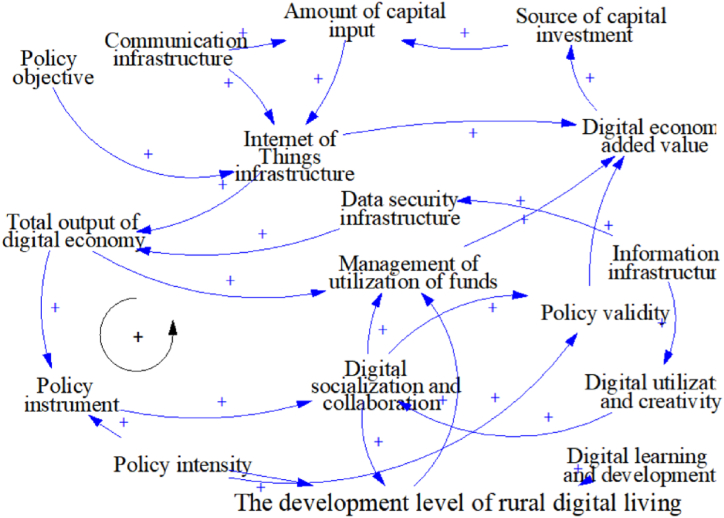
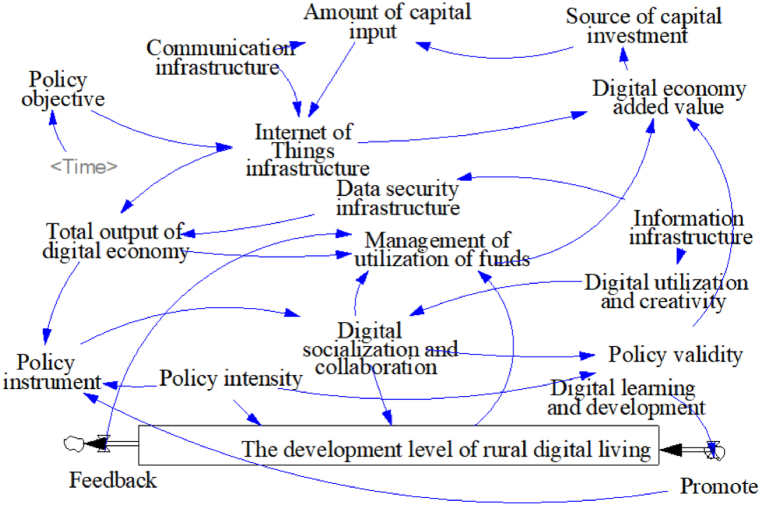
模糊集定性比较分析表明,中国农村数字生活的演变是多种因素同时相互作用的复杂结果。它呈现出各种变量的多样组合和平行路径模式。在这些配置中,有六条路径的覆盖度最高。这六条路径可进一步分为中国农村数字生活发展的三种模式:环境赋能型、组织推动型和复合驱动型。通过系统动力学模型对因果组合的进一步剖析表明,农村数字生活的发展与信息基础设施、政策强度以及数字学习与发展等关键因素密切相关。随着时间的推移,农村数字生活水平呈现出明显的上升趋势,且提升速度不断加快。政策强度对农村数字生活的影响超过信息基础设施和数字学习与发展,表明政策强度总体上发挥着最显著的影响。

结论

中国农村数字生活的演变是一个由多种因素共同推动的复杂、长期过程。中国的经验表明,要实现农村数字生活的高水平发展,不仅需要关注各种因素的协同相互作用,还需要战略性地聚焦于利用特定关键要素。这需要巧妙整合各种因素并确定关键领域,以最大程度地发挥相关条件的影响。

相似文献

1
What drives the development of digital rural life in China?是什么推动了中国数字乡村生活的发展?
Heliyon. 2024 Oct 21;10(22):e39511. doi: 10.1016/j.heliyon.2024.e39511. eCollection 2024 Nov 30.
2
Research on the evaluation and configuration path of China's rural common Prosperity-NCA and fsQCA based on provincial panel data.基于省级面板数据的中国农村共同富裕评价与组态路径研究——NCA与fsQCA
Heliyon. 2023 Dec 20;10(1):e23888. doi: 10.1016/j.heliyon.2023.e23888. eCollection 2024 Jan 15.
3
The impact of the rural digital economy on China's new-type urbanization.农村数字经济对中国新型城镇化的影响。
PLoS One. 2025 Apr 24;20(4):e0321663. doi: 10.1371/journal.pone.0321663. eCollection 2025.
4
Comprehensive evaluation of digital village development in the context of rural revitalization: A case study from Jiangxi Province of China.乡村振兴背景下数字乡村发展的综合评价:以中国江西省为例。
PLoS One. 2024 May 16;19(5):e0303847. doi: 10.1371/journal.pone.0303847. eCollection 2024.
5
Coupling coordination evaluation and driving path of digital economy and carbon emission efficiency in China: A fuzzy-set qualitative comparative analysis based on 30 provinces.中国数字经济与碳排放效率的耦合协调评价及驱动路径:基于 30 个省份的模糊集定性比较分析
PLoS One. 2023 Oct 26;18(10):e0287819. doi: 10.1371/journal.pone.0287819. eCollection 2023.
6
Spatio-temporal evolution and driving factors of the coupling and coordinated development of China's digital economy and older adult care services.中国数字经济与老年护理服务耦合协调发展的时空演变及驱动因素
Front Public Health. 2025 Feb 26;13:1490461. doi: 10.3389/fpubh.2025.1490461. eCollection 2025.
7
Beyond the black stump: rapid reviews of health research issues affecting regional, rural and remote Australia.超越黑木树:影响澳大利亚地区、农村和偏远地区的健康研究问题的快速综述。
Med J Aust. 2020 Dec;213 Suppl 11:S3-S32.e1. doi: 10.5694/mja2.50881.
8
Regional unevenness in the construction of digital villages: A case study of China.数字村庄建设的区域性不平衡:以中国为例。
PLoS One. 2023 Jul 13;18(7):e0287672. doi: 10.1371/journal.pone.0287672. eCollection 2023.
9
Driving rural industry revitalization in the digital economy era: Exploring strategies and pathways in China.数字经济时代推动中国农村产业振兴:探索策略与路径
PLoS One. 2023 Sep 28;18(9):e0292241. doi: 10.1371/journal.pone.0292241. eCollection 2023.
10
Chinese villages and their sustainable future: the European Union-China-Research Project "SUCCESS".中国乡村及其可持续未来:欧盟-中国研究项目“SUCCESS”
J Environ Manage. 2008 Apr;87(2):204-15. doi: 10.1016/j.jenvman.2007.06.012. Epub 2007 Sep 20.

本文引用的文献

1
Exploring the impact of agricultural digitalization on smallholder farmers' livelihoods in Ghana.探索农业数字化对加纳小农户生计的影响。
Heliyon. 2024 Mar 12;10(6):e27541. doi: 10.1016/j.heliyon.2024.e27541. eCollection 2024 Mar 30.
2
Digital transformation, well-being and shrinking communities: Narrowing the divides between urban and rural.数字转型、福祉与社区萎缩:缩小城乡差距
Heliyon. 2023 Aug 6;9(8):e18801. doi: 10.1016/j.heliyon.2023.e18801. eCollection 2023 Aug.
3
Development and Validation of the Digital Life Balance (DLB) Scale: A Brand-New Measure for Both Harmonic and Disharmonic Use of ICTs.
数字生活平衡(DLB)量表的开发与验证:一种用于信息通信技术和谐与不和谐使用的全新测量方法。
Behav Sci (Basel). 2022 Dec 1;12(12):489. doi: 10.3390/bs12120489.
4
Digital literacy and subjective happiness of low-income groups: Evidence from rural China.低收入群体的数字素养与主观幸福感:来自中国农村的证据。
Front Psychol. 2022 Nov 23;13:1045187. doi: 10.3389/fpsyg.2022.1045187. eCollection 2022.
5
Does the digital economy promote "innovation and entrepreneurship" in rural tourism in China?数字经济是否促进了中国乡村旅游的“创新创业”?
Front Psychol. 2022 Oct 12;13:979027. doi: 10.3389/fpsyg.2022.979027. eCollection 2022.
6
Urban/Rural Digital Divide Exists in Older Adults: Does It Vary by Racial/Ethnic Groups?老年人中存在城乡数字鸿沟:它在不同种族/族裔群体中是否存在差异?
J Appl Gerontol. 2022 May;41(5):1348-1356. doi: 10.1177/07334648211073605. Epub 2022 Feb 24.
7
The dynamic systems approach to control and regulation of intracellular networks.用于控制和调节细胞内网络的动态系统方法。
FEBS Lett. 2005 Mar 21;579(8):1846-53. doi: 10.1016/j.febslet.2005.02.008.