Rocour Samuel, Vinatier Emeline, Fassot Céline, Dauvé Jonathan, Toutain Agnès, Fronteau Sabrina, Monnier Marine, Preisser Laurence, Croué Anne, Le Saux Olivier, Morel Alain, Delneste Yves, Martin Ludovic
PXE National Reference Center MAGEC Nord University Hospital of Angers Angers France.
Immunology and Allergology Laboratory University Hospital of Angers Angers France.
Skin Health Dis. 2024 Nov 26;4(6):e430. doi: 10.1002/ski2.430. eCollection 2024 Dec.
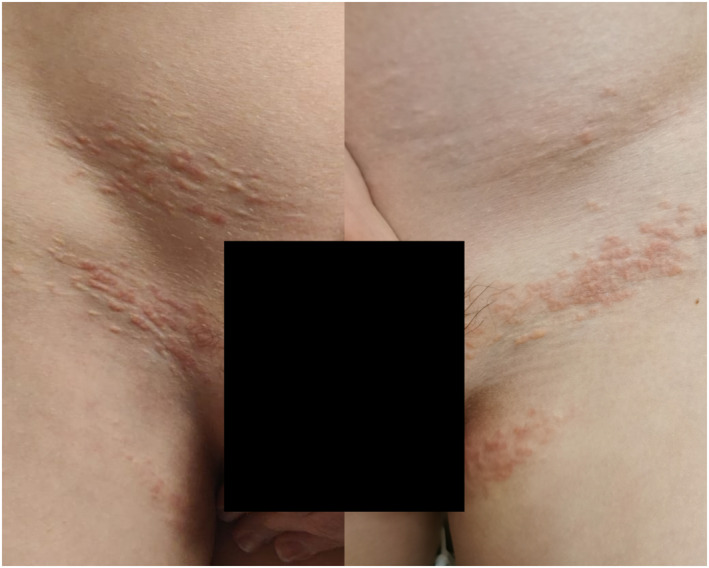
Pseudoxanthoma elasticum (PXE) is a genetic disorder characterized by ectopic calcification of tissues rich in elastic fibres (OMIM 264800). To date, PXE is considered a metabolic disease linked to an imbalance between pro- and anti-calcifying factors. The occurrence of sporadic erythematous flareups of PXE skin lesions is a complaint that we heard about on several occasions at the French PXE reference centre. However, this rare clinical aspect had never been extensively studied. We have had the opportunity to investigate a 13-year-old patient experiencing an erythematous flareup of his PXE lesions. We conducted this work to identify what type of inflammation was implicated in his lesions. An incisional skin biopsy on a recent erythematous inguinal PXE lesion was performed and sent for histological and transcriptomic analyses. The findings were compared to a non-erythematous PXE-affected skin biopsy obtained from another young PXE patient. Histological examination revealed perivascular T-cell infiltrates with Th1 polarity and elevated expression of cytotoxicity markers in RNAseq and RT-qPCR analyses. There was no increase in Th17 or Th2 markers. Our findings support the previous evidence of a possible inflammatory component in the development of PXE. Whether Th1-dependent inflammation contributes to the pathology as an active process or is an aggravating factor requires further investigations.
弹性假黄瘤(PXE)是一种遗传性疾病,其特征为富含弹性纤维的组织发生异位钙化(OMIM 264800)。迄今为止,PXE被认为是一种与促钙化和抗钙化因子失衡相关的代谢性疾病。PXE皮肤病变出现散发性红斑发作是我们在法国PXE参考中心多次听到的主诉。然而,这种罕见的临床情况从未得到广泛研究。我们有机会对一名13岁的PXE病变出现红斑发作的患者进行调查。我们开展这项工作以确定其病变中涉及何种类型的炎症。对近期腹股沟处出现红斑的PXE病变进行了切口皮肤活检,并送去进行组织学和转录组分析。将结果与从另一名年轻PXE患者身上获取的未出现红斑的PXE病变皮肤活检结果进行比较。组织学检查显示血管周围有Th1极性的T细胞浸润,并且在RNA测序和逆转录定量聚合酶链反应分析中细胞毒性标志物表达升高。Th17或Th2标志物没有增加。我们的研究结果支持了之前关于PXE发展过程中可能存在炎症成分的证据。Th1依赖性炎症是作为一个活跃过程导致病变还是一个加重因素,这需要进一步研究。