Tomita Ryo, Smith Corey A, Dyachok Oksana M, Sharpe Glen P, Rafuse Paul E, Shuba Lesya M, Nicolela Marcelo T, Chauhan Balwantray C
Department of Ophthalmology and Visual Sciences, Dalhousie University, Halifax, Nova Scotia, Canada.
Invest Ophthalmol Vis Sci. 2024 Dec 2;65(14):8. doi: 10.1167/iovs.65.14.8.
To investigate whether macular perfusion density (PD) changes measured over time by optical coherence tomography angiography (OCTA) are detectable before progressive macular ganglion cell layer (GCL) thinning in early glaucoma.
This prospective longitudinal cohort study involved patients with early open-angle glaucoma and healthy subjects imaged by OCT and OCTA every 4 months. GCL thickness and macular PD were evaluated in 16 tiles in the macula. We estimated baseline percentage losses of GCL thickness or macular PD in glaucoma patients with age-corrected normative values derived from the healthy subjects. Additionally, the threshold slope separating glaucoma patients from healthy subjects with 90% specificity was used to determine the number of patients with steeper slopes than the threshold slope.
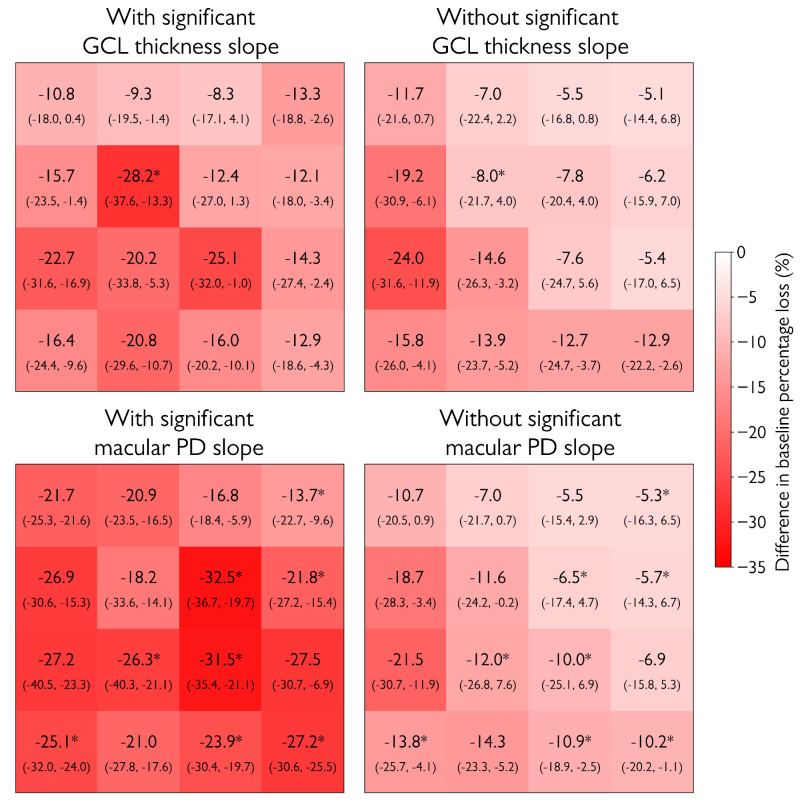
Eighty patients with glaucoma and 42 healthy subjects were included. In eight tiles (50%), patients with a significant macular PD slope had a significantly greater baseline percentage loss of GCL thickness relative to macular PD compared to patients without a significant macular PD slope. Furthermore, in 15 tiles (94%), a greater baseline percentage loss of GCL thickness relative to PD was significantly correlated with faster PD slopes. In contrast, only one tile (6%) showed these significant trends for GCL slopes. The number of patients with faster GCL slopes than threshold slopes was significantly larger than patients with faster PD slopes in 12 tiles (75%).
A decrease in GCL thickness precedes a measurable decrease in macular PD. Early glaucomatous progression is more frequently detectable with changes in GCL thickness compared to macular PD.
研究在早期青光眼患者黄斑神经节细胞层(GCL)逐渐变薄之前,通过光学相干断层扫描血管造影(OCTA)随时间测量的黄斑灌注密度(PD)变化是否可被检测到。
这项前瞻性纵向队列研究纳入了早期开角型青光眼患者和健康受试者,每4个月进行一次OCT和OCTA成像。对黄斑区的16个区域评估GCL厚度和黄斑PD。我们根据健康受试者的年龄校正规范值估计青光眼患者GCL厚度或黄斑PD的基线百分比损失。此外,使用将青光眼患者与具有90%特异性的健康受试者区分开的阈值斜率来确定斜率比阈值斜率更陡的患者数量。
纳入了80例青光眼患者和42例健康受试者。在8个区域(50%)中,与没有显著黄斑PD斜率的患者相比,具有显著黄斑PD斜率的患者GCL厚度相对于黄斑PD的基线百分比损失显著更大。此外,在15个区域(94%)中,GCL厚度相对于PD的基线百分比损失更大与更快的PD斜率显著相关。相比之下,只有1个区域(6%)显示出GCL斜率的这些显著趋势。在12个区域(75%)中,GCL斜率比阈值斜率更快的患者数量显著多于PD斜率更快的患者。
GCL厚度的降低先于黄斑PD的可测量降低。与黄斑PD相比,早期青光眼进展更常通过GCL厚度的变化被检测到。