Wang Yang, Xiu Yan, Dong Qianze, Zhao Jinming, Neumbo Kelao, Miyagi Masaru, Borcherding Nicholas, Fu Lin, De Celis Havana, Pintozzi Nicolas, Starczynowski Daniel T, Zhao Chen
Department of Pathology, Case Western Reserve University, Cleveland, OH.
Department of Pathology, China Medical University, Shenyang, China.
Blood Adv. 2025 Feb 25;9(4):844-855. doi: 10.1182/bloodadvances.2024013446.
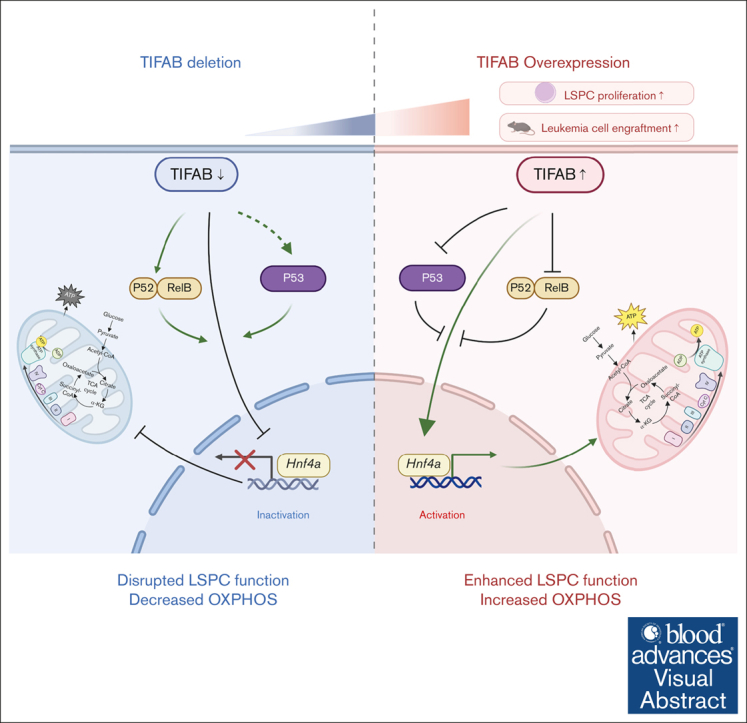
Tumor necrosis factor (TNF) receptor-associated factor (TRAF)-interacting protein with forkhead-associated domain B (TIFAB), an inhibitor of NF-κB signaling, plays critical roles in hematopoiesis, myelodysplastic neoplasms, and leukemia. We previously demonstrated that Tifab enhances KMT2A::MLLT3-driven acute myeloid leukemia (AML) by either upregulating Hoxa9 or through ubiquitin-specific peptidase 15-mediated downregulation of p53 signaling. In this study, we show that Tifab deletion in KMT2A::MLLT3-induced AML impairs leukemia stem/progenitor cell (LSPC) engraftment, glucose uptake, and mitochondrial function. Gene set enrichment analysis reveals that Tifab deletion downregulates MYC, HOXA9/MEIS1, mTORC1 signaling, and genes involved in glycolysis and oxidative phosphorylation. By comparing genes upregulated in TIFAB-overexpressing LSPCs with those downregulated upon Tifab deletion, we identify hepatocyte nuclear factor 4 alpha (Hnf4a) as a key TIFAB target, regulated through the inhibition of NF-κB component RelB, which suppresses Hnf4a in leukemia cells. HNF4A, a nuclear receptor involved in organ development, metabolism, and tumorigenesis, rescues the metabolic defects caused by Tifab deletion and enhances leukemia cell engraftment. Conversely, Hnf4a knockdown attenuates TIFAB-mediated enhancement of LSPC function. These findings highlight the critical role of the TIFAB-HNF4A axis in KMT2A::MLLT3-induced AML and uncover a novel regulator in leukemia biology.
肿瘤坏死因子(TNF)受体相关因子(TRAF)相互作用蛋白与叉头相关结构域B(TIFAB)是一种核因子κB(NF-κB)信号通路的抑制剂,在造血、骨髓增生异常肿瘤和白血病中发挥关键作用。我们之前证明,Tifab通过上调Hoxa9或通过泛素特异性肽酶15介导的p53信号通路下调来增强KMT2A::MLLT3驱动的急性髓系白血病(AML)。在本研究中,我们发现KMT2A::MLLT3诱导的AML中Tifab缺失会损害白血病干/祖细胞(LSPC)的植入、葡萄糖摄取和线粒体功能。基因集富集分析显示,Tifab缺失会下调MYC、HOXA9/MEIS1、mTORC1信号通路以及参与糖酵解和氧化磷酸化的基因。通过比较TIFAB过表达的LSPC中上调的基因与Tifab缺失时下调的基因,我们确定肝细胞核因子4α(Hnf4a)是一个关键的TIFAB靶点,其通过抑制NF-κB成分RelB来调节,RelB在白血病细胞中抑制Hnf4a。HNF4A是一种参与器官发育、代谢和肿瘤发生的核受体,可挽救由Tifab缺失引起的代谢缺陷并增强白血病细胞的植入。相反,Hnf4a敲低会减弱TIFAB介导的LSPC功能增强。这些发现突出了TIFAB-HNF4A轴在KMT2A::MLLT3诱导的AML中的关键作用,并揭示了白血病生物学中的一种新型调节因子。