Wang Yibo, Pan Limin, Guan Ruiqian
Graduate School, Heilongjiang University of Chinese Medicine, Harbin, Heilongjiang, People's Republic of China.
Out-Patient Department, The First Affiliated Hospital of Heilongjiang University of Chinese Medicine, Harbin, Heilongjiang, People's Republic of China.
Int J Gen Med. 2024 Nov 25;17:5493-5502. doi: 10.2147/IJGM.S488714. eCollection 2024.
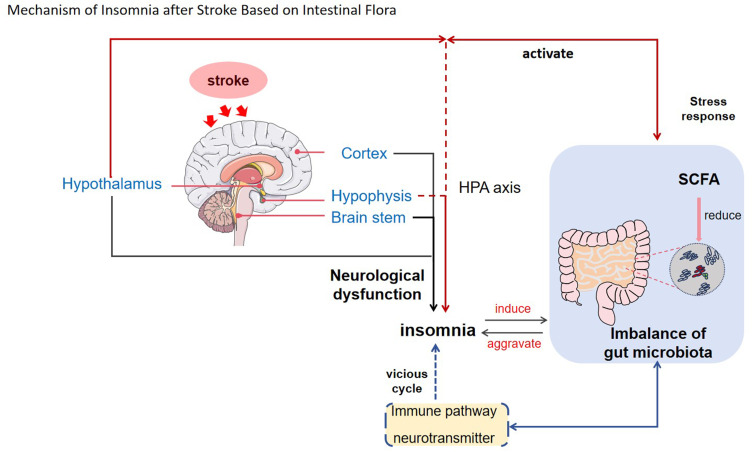
Stroke has emerged as the second leading cause of mortality. Insomnia after stroke is a highly prevalent complication of stroke with a complex mechanism, impacting daily activities and hindering neurological function rehabilitation while also increasing the risk of stroke recurrence. With the development of molecular biology, intestinal flora has garnered considerable interest in the past few years because of its significant implications for human physiology and pathology. Numerous studies have emphasized the crucial function of intestinal flora in the pathological changes associated with insomnia after stroke. It can influence sleep patterns following a stroke by modulating various pathways, including the hypothalamic-pituitary-adrenal (HPA) axis, immune responses, and neural mechanisms. Disruption of intestinal flora can adversely affect post-stroke sleep quality, while sleep after stroke can also lead to intestinal flora imbalance. Based on the intestinal flora, this paper explores the involvement of hypothalamic-pituitary-adrenal axis (HPA axis), immune pathway and neural pathway in insomnia after stroke, aiming to offer insights for the prevention, treatment, and research of post-stroke insomnia.
中风已成为第二大致死原因。中风后失眠是中风一种非常常见的并发症,其机制复杂,影响日常活动,阻碍神经功能康复,同时还增加中风复发的风险。随着分子生物学的发展,肠道菌群在过去几年中受到了相当大的关注,因为它对人体生理和病理具有重要意义。许多研究都强调了肠道菌群在中风后失眠相关病理变化中的关键作用。它可以通过调节各种途径影响中风后的睡眠模式,包括下丘脑 - 垂体 - 肾上腺(HPA)轴、免疫反应和神经机制。肠道菌群的破坏会对中风后的睡眠质量产生不利影响,而中风后的睡眠也会导致肠道菌群失衡。基于肠道菌群,本文探讨下丘脑 - 垂体 - 肾上腺轴(HPA轴)、免疫途径和神经途径在中风后失眠中的作用,旨在为中风后失眠的预防、治疗和研究提供见解。