García-Bohórquez Belén, Barberán-Martínez Pilar, Aller Elena, Jaijo Teresa, Mínguez Pablo, Rodilla Cristina, Fernández-Caballero Lidia, Blanco-Kelly Fiona, Ayuso Carmen, Sanchis-Juan Alba, Broekman Sanne, de Vrieze Erik, van Wijk Erwin, García-García Gema, Millán José M
Molecular, Cellular and Genomics Biomedicine, Health Research Institute La Fe, 46026 Valencia, Spain.
Center for Biomedical Network Research on Rare Diseases (CIBERER), Instituto de Salud Carlos III, 28029 Madrid, Spain.
Mol Ther Nucleic Acids. 2024 Oct 28;35(4):102374. doi: 10.1016/j.omtn.2024.102374. eCollection 2024 Dec 10.
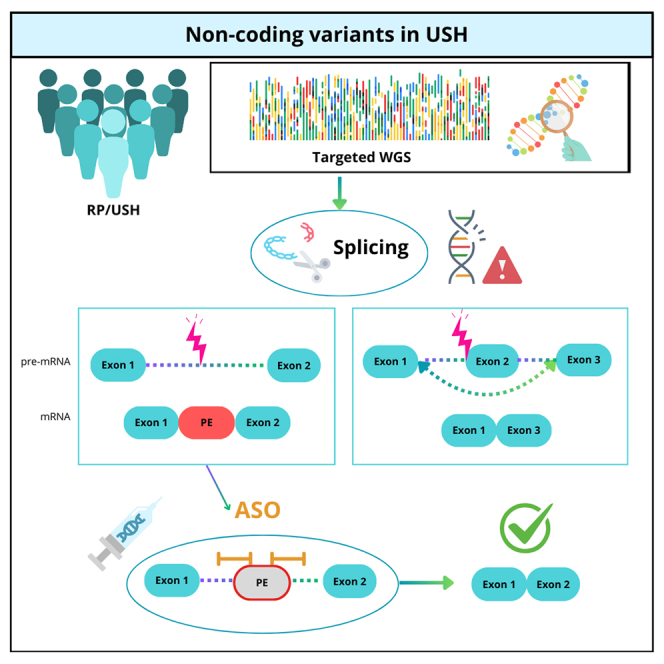
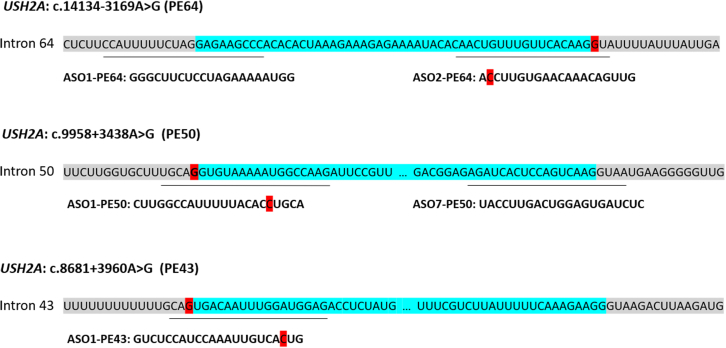
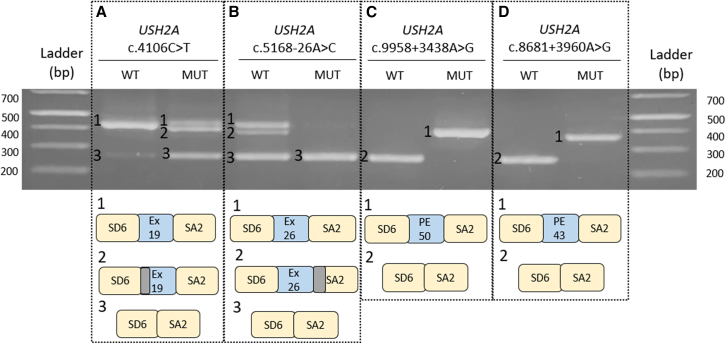
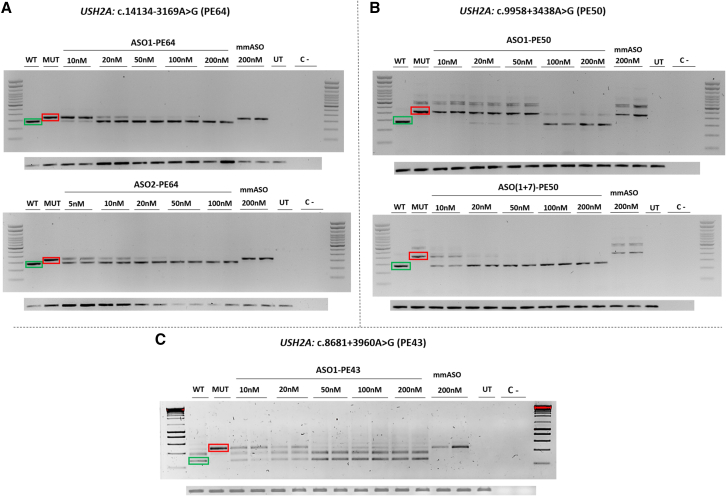
Exploring non-coding regions is increasingly gaining importance in the diagnosis of inherited retinal dystrophies. Deep-intronic variants causing aberrant splicing have been identified, prompting the development of antisense oligonucleotides (ASOs) to modulate splicing. We performed a screening of five previously described deep-intronic variants among monoallelic patients with Usher syndrome (USH) or isolated retinitis pigmentosa. Sequencing of entire or USH genes was then conducted in unresolved or newly monoallelic cases. The splicing impact of identified variants was assessed using minigene assays, and ASOs were designed to correct splicing. The screening allowed to diagnose 30.95% of the studied patients. The sequencing of USH genes revealed 16 new variants predicted to affect splicing, with four confirmed to affect splicing through minigene assays. Two of them were unreported deep-intronic variants and predicted to include a pseudoexon in the pre-mRNA, and the other two could alter a regulatory -element. ASOs designed for three deep-intronic variants successfully redirected splicing . Our study demonstrates the improvement in genetic characterization of IRDs when analyzing non-coding regions, highlighting that deep-intronic variants significantly contribute to pathogenicity. Furthermore, successful splicing modulation through ASOs highlights their therapeutic potential for patients carrying deep-intronic variants.
在遗传性视网膜营养不良的诊断中,探索非编码区域正变得越来越重要。已鉴定出导致异常剪接的内含子深处变异,这促使了反义寡核苷酸(ASO)的开发以调节剪接。我们对患有Usher综合征(USH)或孤立性视网膜色素变性的单等位基因患者中的五个先前描述的内含子深处变异进行了筛查。然后,对未解决的或新的单等位基因病例进行了整个USH基因的测序。使用小基因检测评估已鉴定变异的剪接影响,并设计ASO来纠正剪接。该筛查使30.95%的研究患者得到诊断。USH基因的测序揭示了16个预测会影响剪接的新变异,其中四个通过小基因检测证实会影响剪接。其中两个是未报告的内含子深处变异,预计会在前体mRNA中包含一个假外显子,另外两个可能会改变一个调控元件。为三个内含子深处变异设计的ASO成功地重新引导了剪接。我们的研究表明,在分析非编码区域时,IRD的遗传特征得到了改善,突出了内含子深处变异对致病性有显著贡献。此外,通过ASO成功进行剪接调节突出了它们对携带内含子深处变异患者的治疗潜力。