Prosty Connor, Le Michelle, Lu Yang, Khoury Lauren, Cormier Maxime, Cheng Mathew P, Fowler Robert, Murthy Srinivas, Tsang Jennifer Ly, Lejtenyi Duncan, Ben-Shoshan Moshe, Rahme Elham, Golchi Shirin, Dendukuri Nandini, Lee Todd C, Netchiporouk Elena
Faculty of Medicine, McGill University, Montreal, QC, Canada.
Division of Dermatology, Department of Medicine, McGill University, Montreal, QC, Canada.
Front Med (Lausanne). 2024 Nov 19;11:1437322. doi: 10.3389/fmed.2024.1437322. eCollection 2024.
The CIAO trial recently demonstrated a probable clinical benefit of omalizumab in the treatment of severe COVID-19; however, the mechanism underlying this benefit remains unclear. Therefore, we sought to longitudinally assess the impact of omalizumab on serum cytokines in CIAO trial patients to determine its mechanism of action.
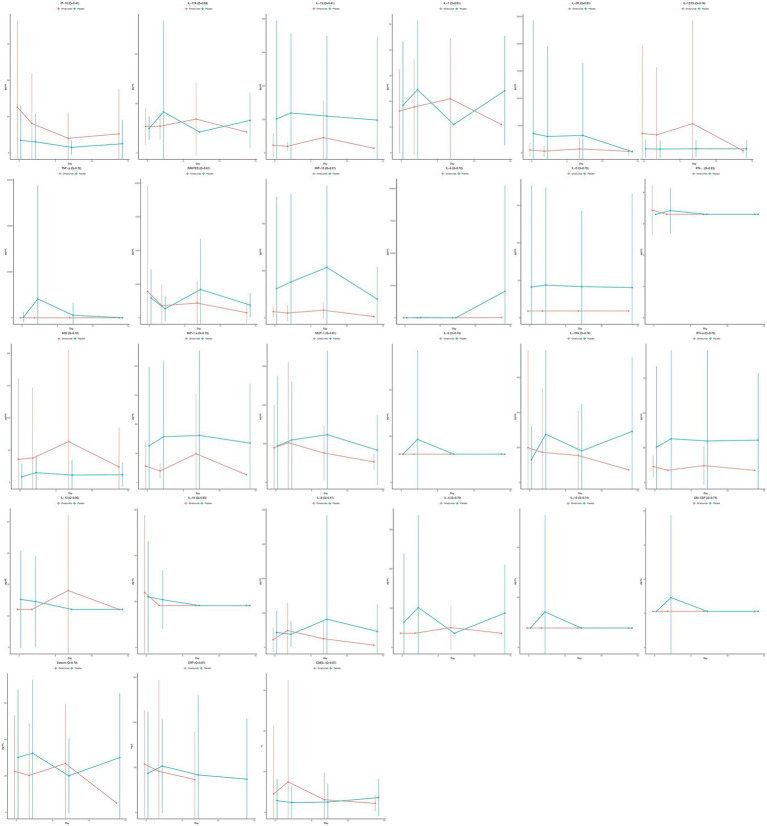
Blood samples were collected on days 0, 2, 7, and 14 from patients recruited into the CIAO trial and who consented to this substudy. Blood samples were tested by a panel of 25 inflammatory cytokines, as well as for markers of mast cell activation. Levels of inflammatory biomarkers were compared over time between omalizumab- and placebo-treated patients by generalized linear mixed-effects model. Associations between biomarkers and clinical outcomes were investigated by mixed-effects logistic regression.
Nineteen patients were recruited into this substudy; 10 were assigned to placebo and 9 to omalizumab. Monokine induced by gamma interferon was significantly positively associated with severe COVID-19 (Odds Ratio [OR] = 1.06, 95%CI = 1.00-1.11, = 0.043). Further, omalizumab significantly reduced interleukin-15 (Coefficient = -0.95, = 0.048) and macrophage inflammatory protein-1 (Coefficient = -1.31, = 0.010) levels. However, neither was significant in analyses adjusting for multiple hypothesis testing.
Although limited by a small sample size, these results suggest that omalizumab's potential benefit in COVID-19 may be mediated independently of modulation of the measured serum biomarkers. Further studies are needed to investigate omalizumab's mechanism of action in COVID-19.
CIAO试验最近证明了奥马珠单抗在治疗重症COVID-19方面可能具有临床益处;然而,这种益处背后的机制仍不清楚。因此,我们试图纵向评估奥马珠单抗对CIAO试验患者血清细胞因子的影响,以确定其作用机制。
在第0、2、7和14天从参与CIAO试验并同意参与该子研究的患者中采集血样。血样通过一组25种炎性细胞因子以及肥大细胞活化标志物进行检测。通过广义线性混合效应模型比较奥马珠单抗治疗组和安慰剂治疗组患者随时间变化的炎性生物标志物水平。通过混合效应逻辑回归研究生物标志物与临床结局之间的关联。
19名患者被纳入该子研究;10名被分配到安慰剂组,9名被分配到奥马珠单抗组。γ干扰素诱导的单核细胞趋化蛋白与重症COVID-19显著正相关(优势比[OR]=1.06,95%置信区间=1.00-1.11,P=0.043)。此外,奥马珠单抗显著降低了白细胞介素-15(系数=-0.95,P=0.048)和巨噬细胞炎性蛋白-1(系数=-1.31,P=0.010)的水平。然而,在调整多重假设检验的分析中,两者均无统计学意义。
尽管受样本量小的限制,但这些结果表明奥马珠单抗在COVID-19中的潜在益处可能独立于所检测血清生物标志物的调节作用。需要进一步研究来探究奥马珠单抗在COVID-19中的作用机制。