Celen Zeynep, Murray Ryan J, Smith Mariana Magnus, Jouabli Sondes, Ivanova Vladimira, Pham Eleonore, Schilliger Zoe, Vuilleumier Patrik, Merglen Arnaud, Klauser Paul, Piguet Camille
Department of Psychiatry, Faculty of Medicine, University of Geneva, Geneva, Switzerland.
Department of Neurosciences, Faculty of Medicine, University of Geneva, Geneva, Switzerland.
Brain Behav. 2024 Dec;14(12):e70154. doi: 10.1002/brb3.70154.
Early adolescence is a time of high psychosocial stress exposure and high stress reactivity, associated with the development of mental disorders. Understanding how the brain reacts to acute and social stressors during this period might help us detect and protect those at risk.
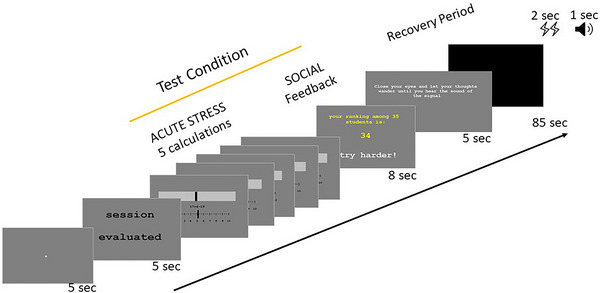
We used functional magnetic resonance imaging to investigate acute social stress reactivity in non-clinical adolescents between ages 13 and 15 years (N = 61) with a range of depression scores (Beck Depression Inventory scores 0-32). Participants underwent a modified Montreal Imaging Stress Task (MIST) with psychosocial stress condition consisting of two parts: acute stress (challenging maths) followed by social feedback (positive or negative), separated by brief recovery periods. The test condition was compared to a non-stressful control. We examined brain responses to social feedback relative to the acute stressor and feedback valence.
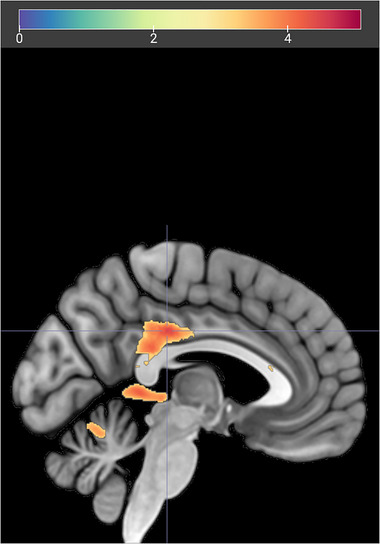
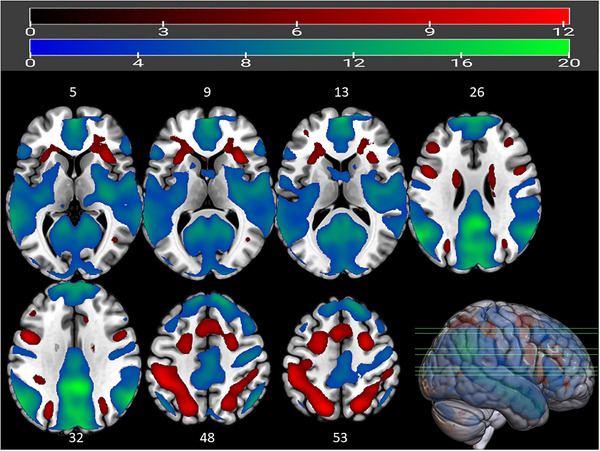
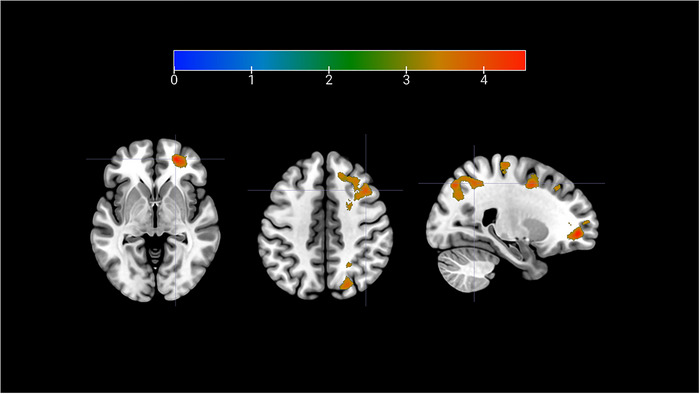
Psychosocial stress produced differential activation in the paracingulate gyrus, insula, and deactivation in the ventral striatum. Receiving social feedback, compared to acute stress, activated cortical midline regions such as the medial prefrontal cortex and posterior cingulate cortex. Positive feedback increased activity in frontal pole and middle frontal gyrus whereas negative feedback did not show any differential response in the whole group. However, participants with depressive symptoms reacted with higher activation in the posterior cingulate cortex to negative feedback.
We show that social feedback after an acute stressor activates regions involved in self-referential processing, with positive feedback eliciting generally higher activation and negative feedback impacting only individuals with vulnerable mood traits during early adolescence.
青春期早期是心理社会压力暴露程度高且压力反应性强的时期,与精神障碍的发展相关。了解这一时期大脑对急性和社会应激源的反应方式可能有助于我们发现并保护处于风险中的人群。
我们使用功能磁共振成像来研究13至15岁非临床青少年(N = 61)的急性社会应激反应,这些青少年具有一系列抑郁评分(贝克抑郁量表评分0 - 32)。参与者接受了一项改良的蒙特利尔成像应激任务(MIST),其社会心理应激条件包括两个部分:急性应激(具有挑战性的数学任务),随后是社会反馈(积极或消极),中间有短暂的恢复期。将测试条件与无压力对照组进行比较。我们研究了大脑相对于急性应激源和反馈效价对社会反馈的反应。
社会心理应激在扣带旁回、脑岛产生了不同的激活,并使腹侧纹状体失活。与急性应激相比,接受社会反馈激活了皮质中线区域,如内侧前额叶皮质和后扣带回皮质。积极反馈增加了额极和额中回的活动,而消极反馈在整个组中未显示出任何差异反应。然而,有抑郁症状的参与者对消极反馈在后扣带回皮质有更高的激活反应。
我们表明,急性应激源后的社会反馈激活了参与自我参照加工的区域,积极反馈通常引发更高的激活,而消极反馈仅影响青春期早期情绪易感性个体。