Department of Clinical Psychology, Institute of Psychology, Leiden University, Leiden, South Holland 2300 RB, The Netherlands.
Leiden Institute for Brain and Cognition, Leiden University, Leiden, South Holland 2300 RC, The Netherlands.
Soc Cogn Affect Neurosci. 2021 Mar 24;16(4):406-417. doi: 10.1093/scan/nsab004.
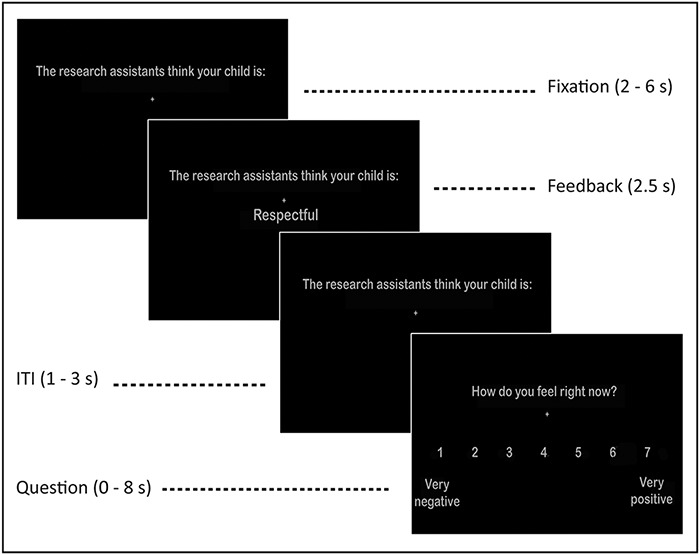
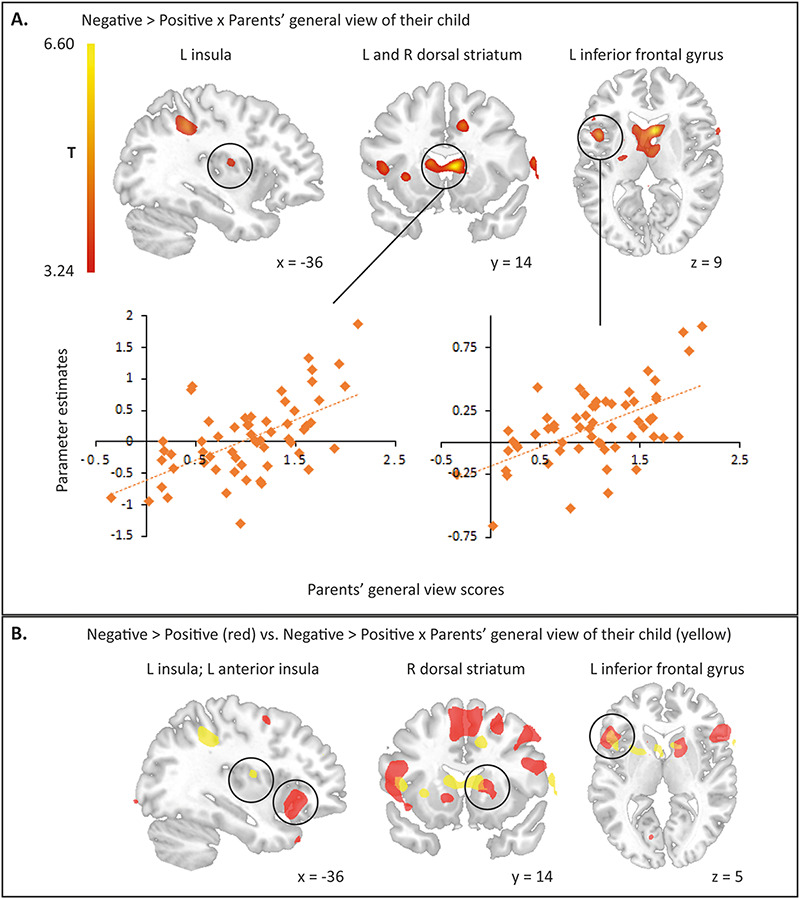
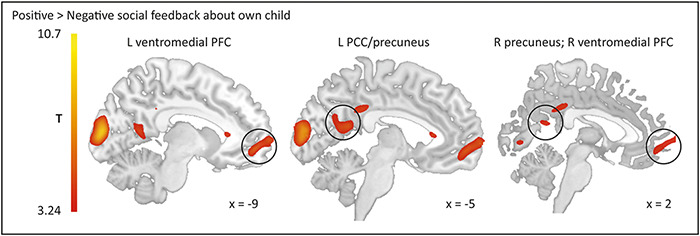
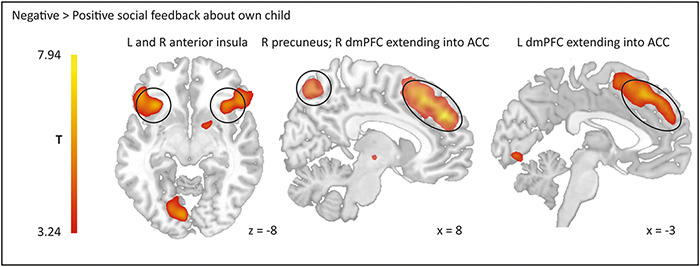
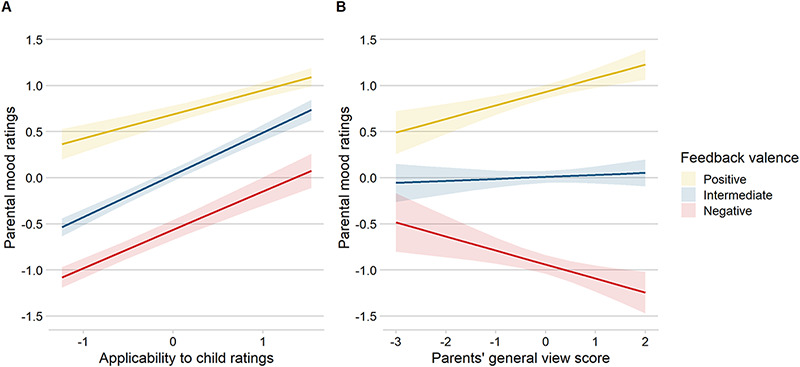
Social feedback, such as praise or critique, profoundly impacts our mood and social interactions. It is unknown, however, how parents experience praise and critique about their child and whether their mood and neural responses to such 'vicarious' social feedback are modulated by parents' perceptions of their child. Parents (n = 60) received positive, intermediate and negative feedback words (i.e. personality characteristics) about their adolescent child during a magnetic resonance imaging scan. After each word, parents indicated their mood. After positive feedback their mood improved and activity in ventromedial prefrontal cortex and posterior cingulate cortex/precuneus increased. Negative feedback worsened parents' mood, especially when perceived as inapplicable to their child, and increased activity in anterior cingulate cortex, anterior insula, dorsomedial prefrontal cortex and precuneus. Parents who generally viewed their child more positively showed amplified mood responses to both positive and negative feedback and increased activity in dorsal striatum, inferior frontal gyrus and insula in response to negative feedback. These findings suggest that vicarious feedback has similar effects and engages similar brain regions as observed during feedback about the self and illustrates this is dependent on parents' beliefs of their child's qualities and flaws. Potential implications for parent-child dynamics and children's own self-views are discussed.
社会反馈,如赞扬或批评,深刻影响我们的情绪和社交互动。然而,我们不知道父母是如何体验对孩子的赞扬和批评的,以及他们对这种“替代性”社会反馈的情绪和神经反应是否受到他们对孩子的看法的调节。父母(n=60)在磁共振成像扫描期间收到了关于其青少年孩子的积极、中等和消极的反馈词(即个性特征)。在每个词之后,父母都表明了他们的情绪。积极反馈后,他们的情绪得到改善,腹内侧前额叶皮质和后扣带回/楔前叶的活动增加。负面反馈会恶化父母的情绪,尤其是当他们认为这些反馈不适用自己的孩子时,并且会增加前扣带皮质、前岛叶、背侧前额叶皮质和楔前叶的活动。一般来说,对孩子的看法更为积极的父母,对积极和消极反馈的情绪反应更为强烈,并且在对消极反馈时,背侧纹状体、下额回和岛叶的活动增加。这些发现表明,替代性反馈具有与自我反馈相同的效果,并涉及到相同的大脑区域,这取决于父母对孩子的品质和缺点的看法。讨论了对亲子动态和孩子自身自我观念的潜在影响。