Yang Hsiao-Yu, Wu Chang-Fu, Tsai Kun-Hsien
Institute of Environmental and Occupational Health Sciences, National Taiwan University College of Public Health, No 17 Xuzhou Road, Taipei, 100, Taiwan, 886 233668102.
Department of Public Health, National Taiwan University College of Public Health, Taipei, Taiwan.
JMIR Public Health Surveill. 2024 Oct 16;10:e57948. doi: 10.2196/57948.
With global warming, the number of days with extreme heat is expected to increase and may cause more acute heat illnesses. While decreasing emissions may mitigate the climate impacts, its effectiveness in reducing acute heat illnesses remains uncertain. Taiwan has established a real-time epidemic surveillance and early warning system to monitor acute heat illnesses since January 1, 2011. Predicting the number of acute heat illnesses requires forecasting temperature changes that are influenced by adaptation policies.
The aim of this study was to estimate the changes in the number of acute heat illnesses under different adaptation policies.
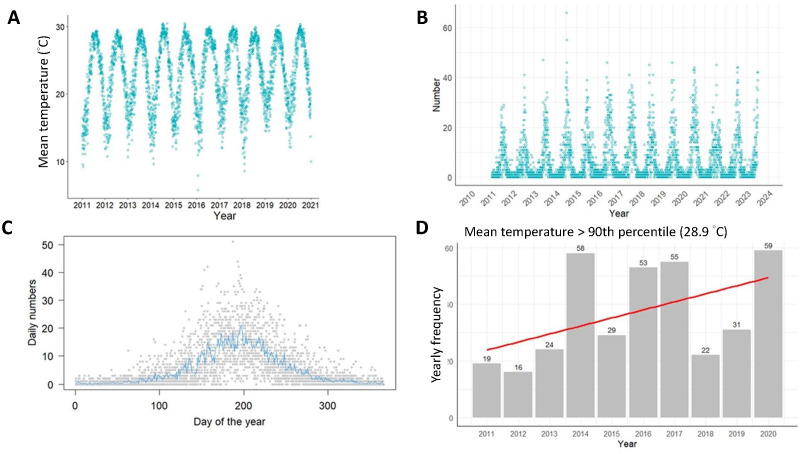
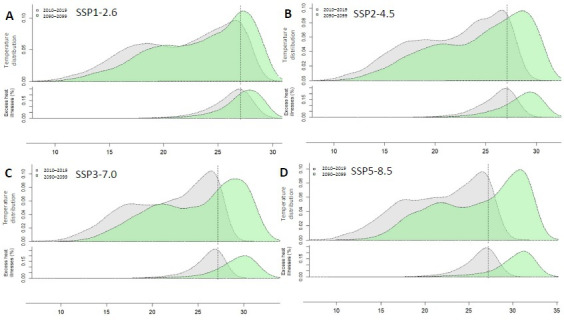
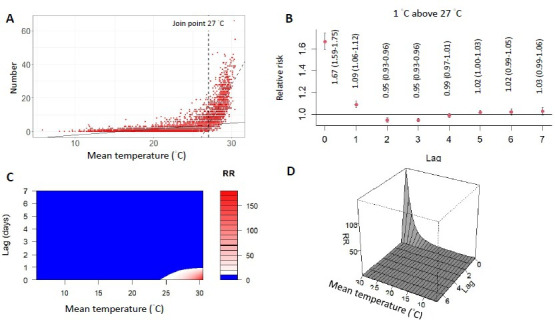
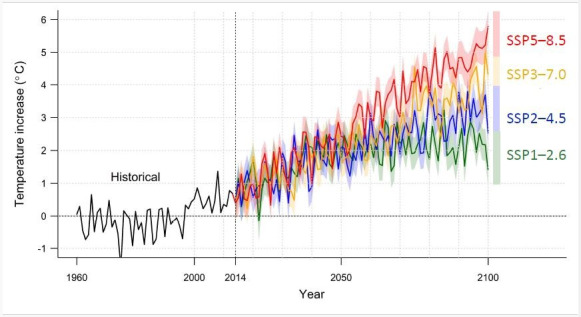
We obtained the numbers of acute heat illnesses in Taiwan from January 2011 to July 2023 using emergency department visit data from the real-time epidemic surveillance and early warning system. We used segmented linear regression to identify the join point as a nonoptimal temperature threshold. We projected the temperature distribution and excess acute heat illnesses through the end of the century when Taiwan adopts the "Sustainability (shared socioeconomic pathways 1-2.6 [SSP1-2.6])," "Middle of the road (SSP2-4.5)," "Regional rivalry (SSP3-7.0)," and "Fossil-fueled development (SSP5-8.5)" scenarios. Distributed lag nonlinear models were used to analyze the attributable number (AN) and attributable fraction (AF) of acute heat illnesses caused by nonoptimal temperature.
We enrolled a total of 28,661 patients with a mean age of 44.5 (SD 15.3) years up to July 2023, of whom 21,619 (75.4%) were male patients. The nonoptimal temperature was 27 °C. The relative risk of acute heat illnesses with a 1-degree increase in mean temperature was 1.71 (95% CI 1.63-1.79). In the SSP5-8.5 worst-case scenario, the mean temperature was projected to rise by +5.8 °C (SD 0.26), with the AN and AF of acute heat illnesses above nonoptimal temperature being 19,021 (95% CI 2249-35,792) and 89.9% (95% CI 89.3%-90.5%) by 2090-2099. However, if Taiwan adopts the Sustainability SSP1-2.6 scenario, the AN and AF of acute heat illnesses due to nonoptimal temperature will be reduced to 12,468 (95% CI 3233-21,704) and 62.1% (95% CI 61.2-63.1).
Adopting sustainable development policies can help mitigate the risk of acute heat illnesses caused by global warming.
随着全球变暖,预计酷热天数将会增加,可能导致更多急性热相关疾病。虽然减少排放或许能减轻气候影响,但其在降低急性热相关疾病方面的效果仍不确定。台湾自2011年1月1日起建立了实时疫情监测和预警系统,以监测急性热相关疾病。预测急性热相关疾病的数量需要对受适应政策影响的温度变化进行预测。
本研究旨在估计不同适应政策下急性热相关疾病数量的变化。
我们利用实时疫情监测和预警系统的急诊科就诊数据,获取了2011年1月至2023年7月台湾急性热相关疾病的数量。我们使用分段线性回归来确定连接点作为非最佳温度阈值。当台湾采用“可持续发展(共享社会经济路径1 - 2.6 [SSP1 - 2.6])”、“中间道路(SSP2 - 4.5)”、“区域竞争(SSP3 - 7.0)”和“化石燃料驱动发展(SSP5 - 8.5)”情景时,我们预测了到本世纪末的温度分布和额外的急性热相关疾病。使用分布滞后非线性模型分析非最佳温度导致的急性热相关疾病的归因数(AN)和归因比例(AF)。
截至2023年7月,我们共纳入了28661例患者,平均年龄为44.5(标准差15.3)岁,其中21619例(75.4%)为男性患者。非最佳温度为27°C。平均温度每升高1度,急性热相关疾病的相对风险为1.71(95%置信区间1.63 - 1.79)。在SSP5 - 8.5最坏情景下,预计到2090 - 2099年平均温度将上升5.8°C(标准差0.26),非最佳温度以上的急性热相关疾病的AN和AF分别为19021(95%置信区间2249 - 35792)和89.9%(95%置信区间89.3% - 90.5%)。然而,如果台湾采用可持续发展SSP1 - 2.6情景,非最佳温度导致的急性热相关疾病的AN和AF将分别降至12468(95%置信区间3233 - 21704)和62.1%(95%置信区间61.2 - 63.1)。
采用可持续发展政策有助于减轻全球变暖导致的急性热相关疾病风险。