School of Economics and Business Administration, Chongqing University, Chongqing 400030, China.
Int J Environ Res Public Health. 2022 Sep 4;19(17):11076. doi: 10.3390/ijerph191711076.
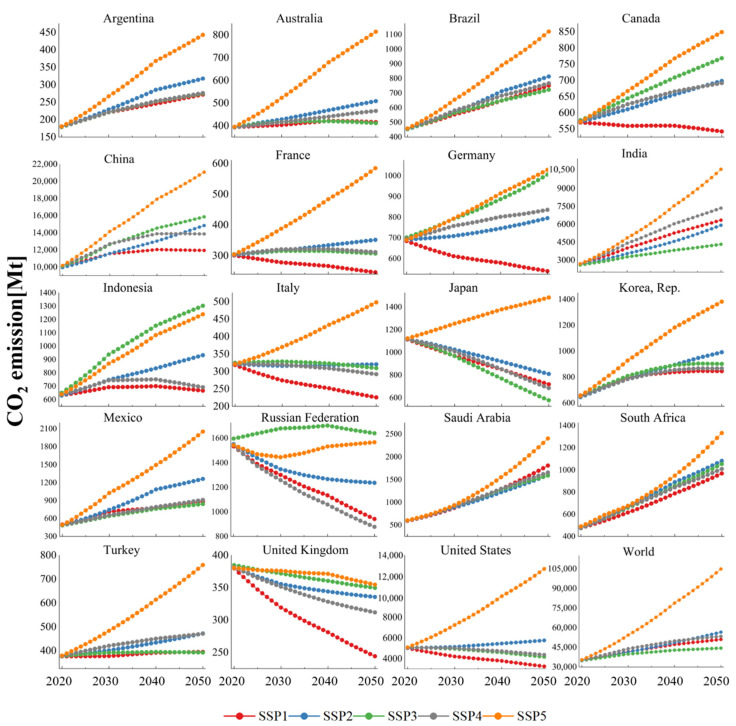
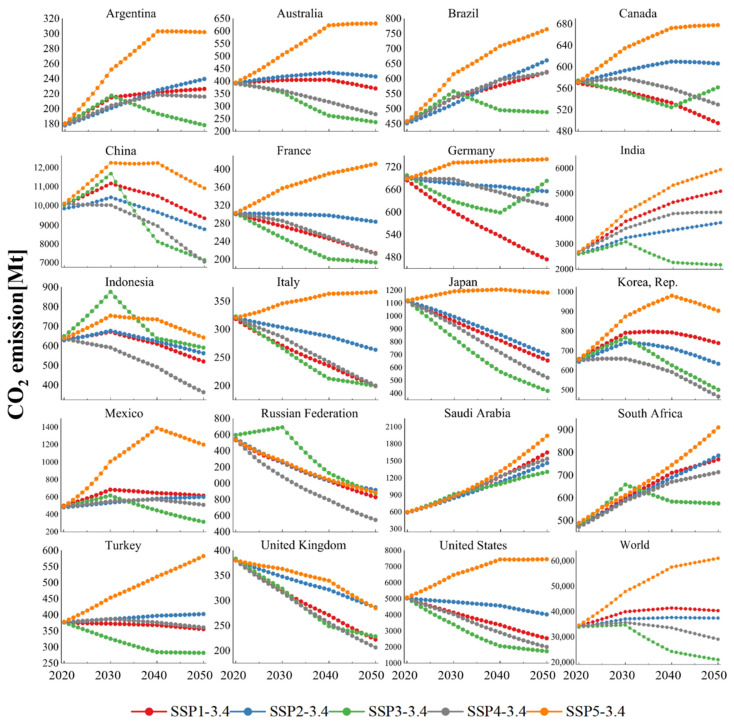
Mitigating climate change requires long-term global efforts. The aim of this study is to simulate the possible paths of CO emissions in G20 countries and the world from 2020 to 2050, by using the STIRPAT model and SSP scenarios with different constraints (SSP baseline, SSP-3.4). The results show that: (1) the world's CO emissions cannot peak in the SSP baseline scenarios, but can peak in the SSP-3.4 scenarios through four paths other than the high fossil energy consumption path; (2) for G20 countries, in the SSP baseline scenarios, 13 countries such as China, the United States, and the United Kingdom can achieve the peak, while six countries such as Argentina, India, and Saudi Arabia cannot. In the SSP-3.4 scenarios, Saudi Arabia cannot achieve the peak, while other countries can achieve the peak, and most of them are likely to achieve significant CO emission reductions by 2050; (3) climate goals have a crowding-out effect on other sustainable development goals, with less impact on developed countries and a greater impact on developing countries; and (4) the optimization of the energy structure and a low energy intensity can greatly advance the peak time of CO emissions.
减缓气候变化需要全球长期努力。本研究旨在使用 STIRPAT 模型和具有不同约束条件的 SSP 情景(SSP 基线、SSP-3.4),模拟 2020 年至 2050 年 G20 国家和全球 CO2 排放的可能路径。结果表明:(1)在 SSP 基线情景下,全球 CO2 排放无法达到峰值,但可以通过除高化石能源消耗路径以外的其他四条路径在 SSP-3.4 情景下达到峰值;(2)对于 G20 国家,在 SSP 基线情景下,中国、美国和英国等 13 个国家可以达到峰值,而阿根廷、印度和沙特阿拉伯等 6 个国家则无法达到峰值。在 SSP-3.4 情景下,沙特阿拉伯无法达到峰值,而其他国家则可以达到峰值,并且它们中的大多数国家很可能在 2050 年前实现 CO2 排放的显著减少;(3)气候目标对其他可持续发展目标具有挤出效应,对发达国家的影响较小,对发展中国家的影响较大;(4)优化能源结构和降低能源强度可以大大提前 CO2 排放的峰值时间。