Succurro Elena, Vizza Patrizia, Cicone Francesco, Rubino Mariangela, Fiorentino Teresa Vanessa, Perticone Maria, Mannino Gaia Chiara, Sciacqua Angela, Guzzi Pietro Hiram, Veltri Pierangelo, Cascini Giuseppe Lucio, Andreozzi Francesco, Sesti Giorgio
Department of Medical and Surgical Sciences, University Magna Graecia of Catanzaro, Viale Europa, 88100, Catanzaro, Italy.
Research Center for the Prevention and Treatment of Metabolic Diseases (CR METDIS), University Magna Graecia of Catanzaro, Catanzaro, Italy.
Cardiovasc Diabetol. 2024 Dec 4;23(1):431. doi: 10.1186/s12933-024-02513-7.
Increased whole blood viscosity (WBV) was associated with impaired peripheral glucose metabolism, type 2 diabetes, and cardiovascular disease (CVD). Impaired myocardial glucose metabolism is a risk factor for CVD. Whether an increased WBV is associated with impaired myocardial glucose metabolism is still undefined.
To elucidate this issue, we evaluated the association between WBV and myocardial glucose metabolic rate (MRGlu) in 57 individuals with different glucose tolerance status. Myocardial MRGlu was assessed using dynamic cardiac F-FDG PET combined with euglycemic hyperinsulinemic clamp. WBV was calculated using a validated equation including hematocrit and plasma proteins: WBV = [0.12 × h] + [0.17 × (p - 2.07)], where h is the hematocrit (%) and p the plasma proteins (g/dl). The subjects were stratified into tertiles according to their myocardial MrGlu values.
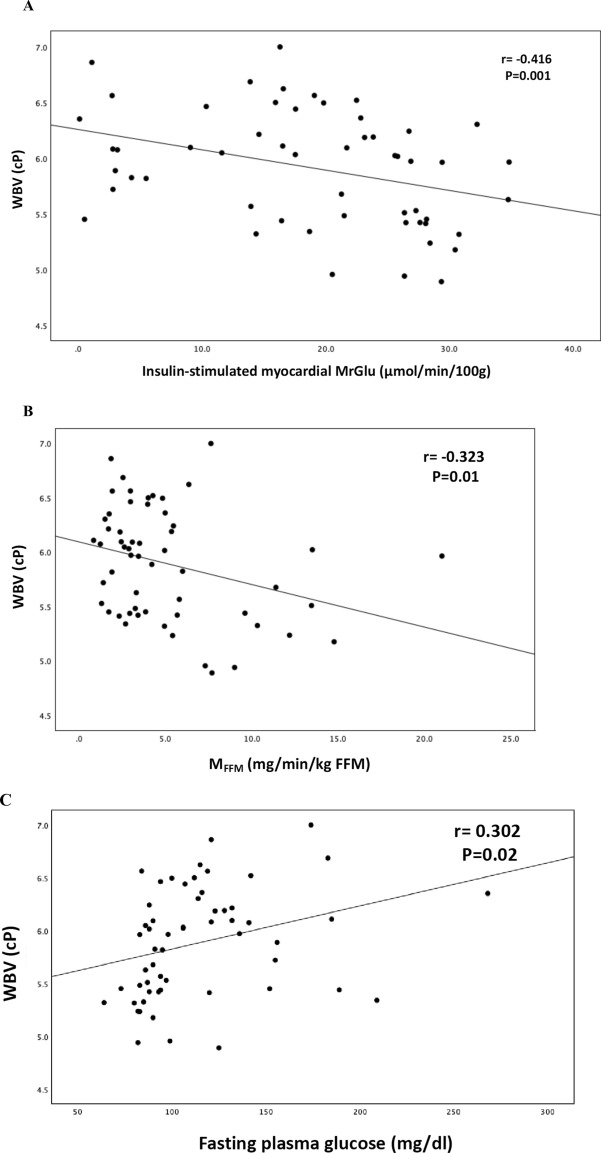
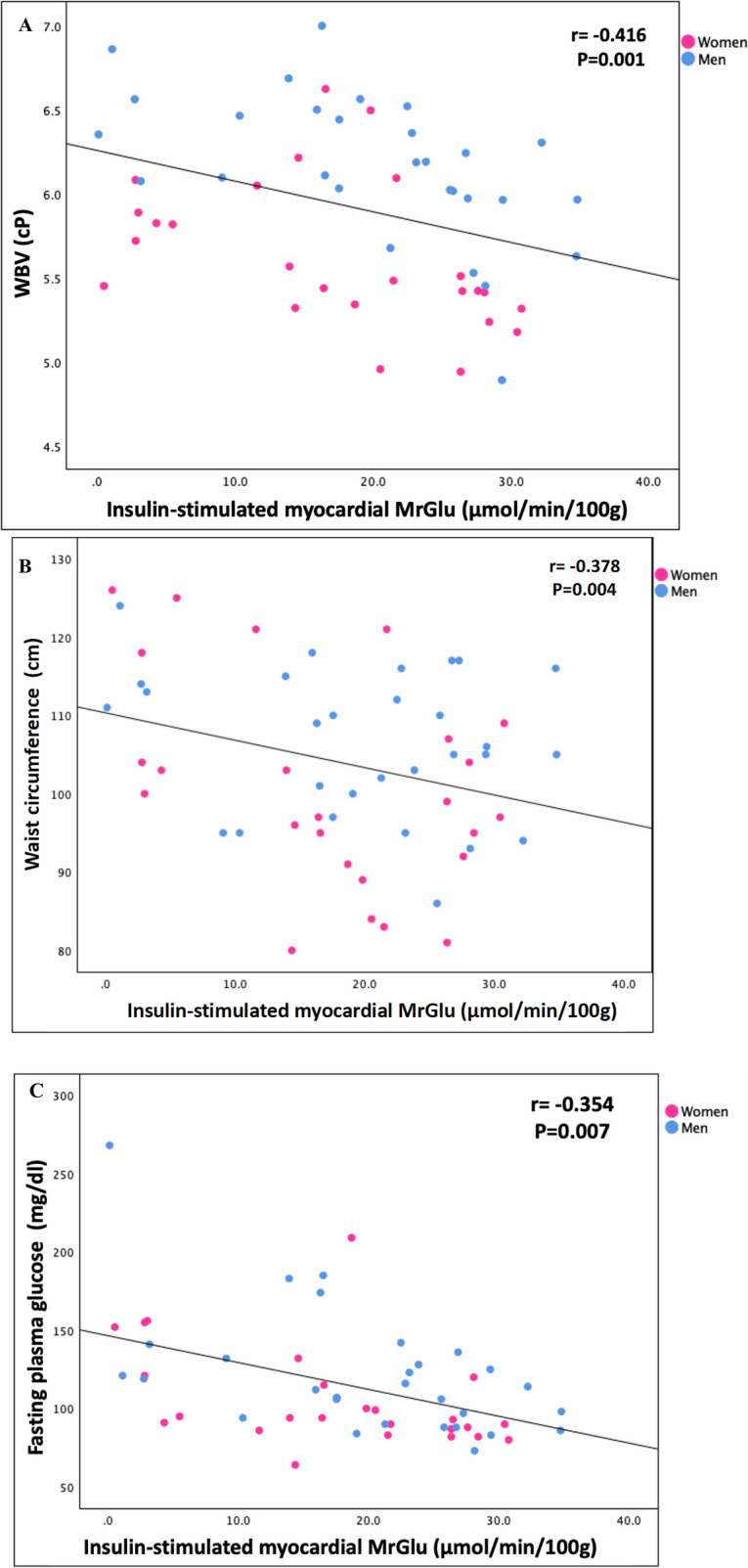
As compared with individuals in the highest myocardial MrGlu tertile, those in the lowest tertile showed an age-adjusted increase in WBV (5.54 ± 0.3 cP vs. 6.13 ± 0.4 cP respectively; P = 0.001), hematocrit (39.1 ± 3.1% vs. 43.2 ± 3.7% respectively; P = 0.004), and total proteins (7.06 ± 0.3 g/l vs. 7.60 ± 0.3 g/l respectively; P < 0.0001). WBV was negatively correlated with myocardial MRGlu (r = - 0.416, P = 0.001). In a stepwise multivariate regression analysis, including several cardiovascular risk factors, the only variables significantly associated with myocardial MrGlu were WBV (β - 0.505; P < 0.0001), fasting insulin (β - 0.346; P = 0.004), fasting plasma glucose (β - 0.287; P = 0.01), and sex (β 0.280; P = 0.003) explaining the 69.6% of its variation.
The current study showed a strongly association between an increase of WBV and an impaired myocardial glucose metabolism in individuals with a broad spectrum of glucose tolerance.
全血粘度(WBV)升高与外周葡萄糖代谢受损、2型糖尿病和心血管疾病(CVD)相关。心肌葡萄糖代谢受损是CVD的一个危险因素。WBV升高是否与心肌葡萄糖代谢受损相关仍不明确。
为阐明这一问题,我们评估了57例不同糖耐量状态个体的WBV与心肌葡萄糖代谢率(MRGlu)之间的关联。使用动态心脏F-FDG PET联合正常血糖高胰岛素钳夹技术评估心肌MRGlu。使用包含血细胞比容和血浆蛋白的经验证方程计算WBV:WBV = [0.12×h] + [0.17×(p - 2.07)],其中h为血细胞比容(%),p为血浆蛋白(g/dl)。根据心肌MrGlu值将受试者分为三分位数组。
与心肌MrGlu最高三分位数组的个体相比,最低三分位数组的个体经年龄调整后的WBV升高(分别为5.54±0.3 cP和6.13±0.4 cP;P = 0.001)、血细胞比容升高(分别为39.1±3.1%和43.2±3.7%;P = 0.004)以及总蛋白升高(分别为7.06±0.3 g/l和7.60±0.3 g/l;P < 0.0001)。WBV与心肌MRGlu呈负相关(r = -0.416,P = 0.001)。在包括多个心血管危险因素的逐步多变量回归分析中,与心肌MrGlu显著相关的唯一变量是WBV(β -0.505;P < 0.0001)、空腹胰岛素(β -0.346;P = 0.004)、空腹血糖(β -0.287;P = 0.01)和性别(β 0.280;P = 0.003),它们解释了其变异的69.6%。
当前研究表明,在糖耐量范围广泛的个体中,WBV升高与心肌葡萄糖代谢受损之间存在密切关联。