Espinoza Randy, Cahua Daniel Valenzuela, Magro Kyle, Nguyen Son C
Department of Chemistry and Biochemistry, University of California Merced, 5200 North Lake Road, Merced, California 95343, United States.
J Phys Chem Lett. 2024 Dec 19;15(50):12243-12247. doi: 10.1021/acs.jpclett.4c02998. Epub 2024 Dec 5.
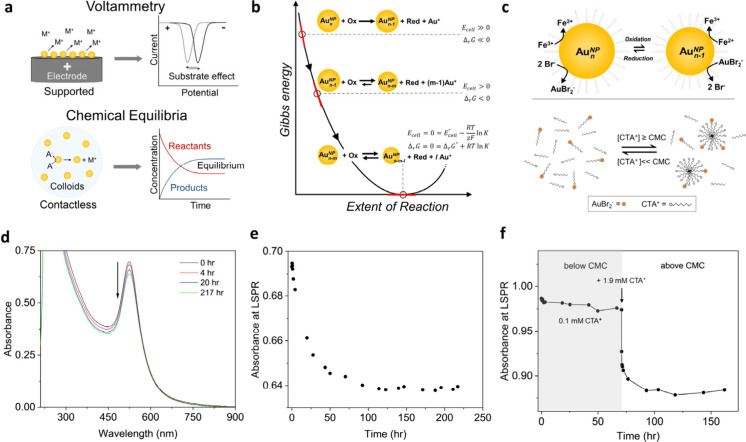
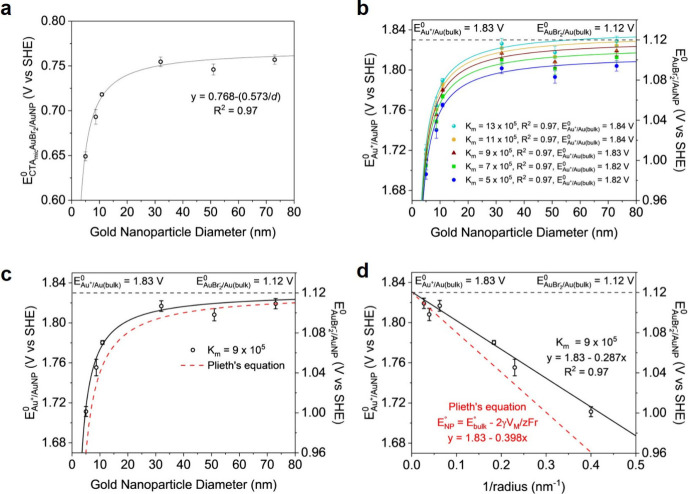
The standard redox potentials of metal nanoparticles are important for understanding their chemical properties. Traditionally, these redox potentials are measured by using voltammetry. Although voltammetry is fast and cost-effective, loading or landing the nanoparticles on electrodes alters their electrochemical properties, posing a challenge for accurately determining their intrinsic redox potentials. Here, a contactless method was developed utilizing chemical assays and the Nernst equation to measure the standard reduction potentials of gold nanoparticles in their colloidal state. To showcase the versatility and accuracy of this Nernstian approach, the reduction potentials were measured for a size range of 5.0-73 nm, revealing their scaling law and dependence on the nanoparticle surface energy.
金属纳米颗粒的标准氧化还原电位对于理解其化学性质至关重要。传统上,这些氧化还原电位是通过伏安法测量的。尽管伏安法快速且具有成本效益,但将纳米颗粒负载或沉积在电极上会改变其电化学性质,这对准确测定其固有氧化还原电位构成了挑战。在此,开发了一种非接触式方法,利用化学分析和能斯特方程来测量处于胶体状态的金纳米颗粒的标准还原电位。为了展示这种能斯特方法的通用性和准确性,对尺寸范围为5.0 - 73 nm的纳米颗粒进行了还原电位测量,揭示了它们的标度律以及对纳米颗粒表面能的依赖性。