Miyamori Yuta, Kong Youngwon, Nabae Yuta, Hatakeyama-Sato Kan, Hayakawa Teruaki
Department of Materials Science and Engineering, School of Materials and Chemical Technology, Institute of Science Tokyo, 2-12-1 S8-36 Ookayama, Meguro-ku, Tokyo 152-8552, Japan.
ACS Macro Lett. 2024 Dec 17;13(12):1698-1703. doi: 10.1021/acsmacrolett.4c00651. Epub 2024 Dec 5.
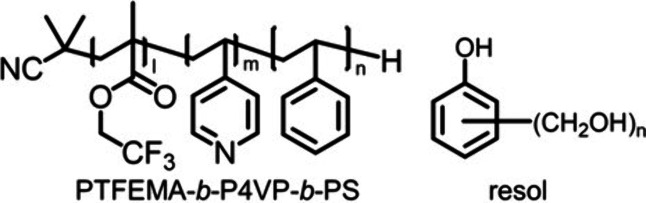
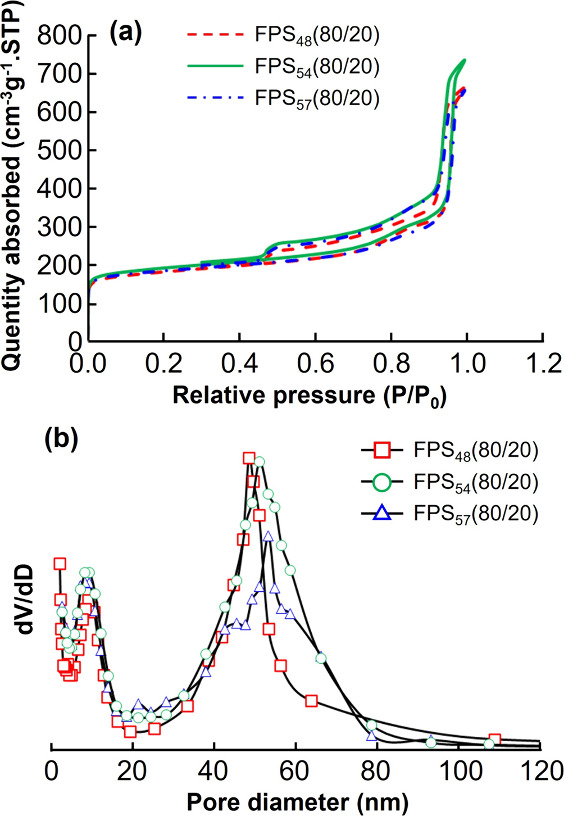
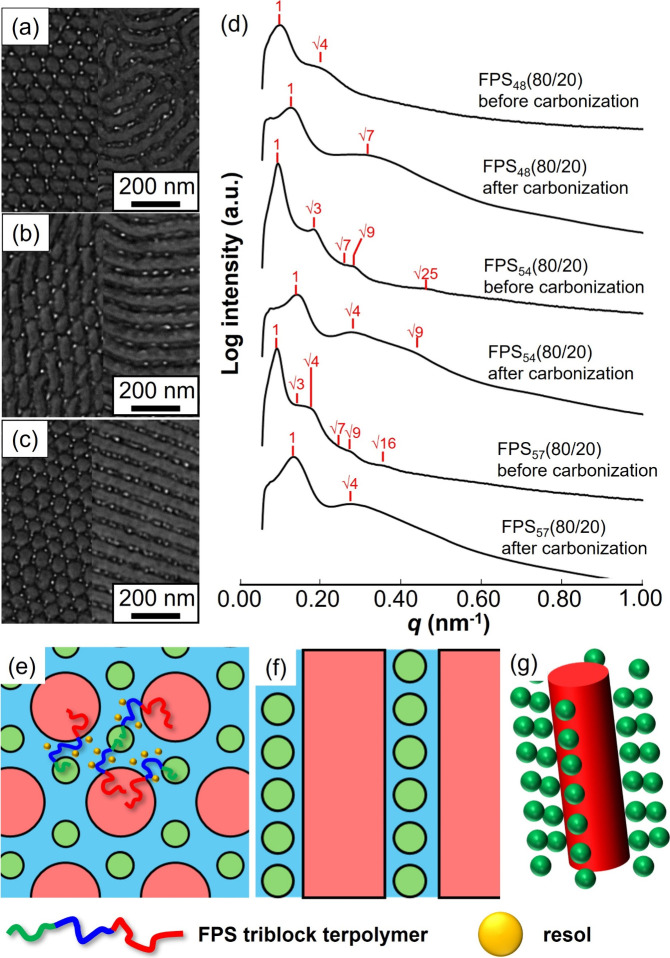
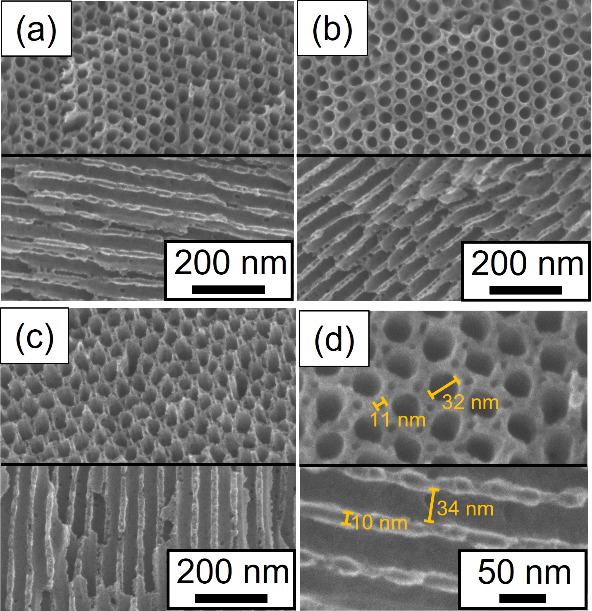
Mesoporous carbons (MPCs) with a bimodal distribution of pore diameters are more advantageous than their monomodal counterparts for applications in adsorption, catalysis, and drug delivery systems; however, reports on their fabrication remain limited. In this study, we successfully fabricated bimodal MPCs using a soft template method with poly(2,2,2-trifluoroethyl methacrylate) (PTFEMA)--poly(4-vinylpyridine) (P4VP)--polystyrene (PS) and resol. The blend samples formed microphase-separated structures comprising PTFEMA spheres, PS cylinders, and matrix domains composed of P4VP and resol, leading to the separation of the PTFEMA and PS domains. The P4VP and resol matrix domains were carbonized at a high temperature of 900 °C, whereas the PTFEMA and PS domains were thermally decomposed. This process resulted in bimodal MPCs with both spherical and cylindrical mesopores. The pore diameters calculated using scanning electron microscopy were approximately 10 and 30 nm, while nitrogen adsorption measurements indicated a large specific surface area with a bimodal pore distribution.
孔径呈双峰分布的介孔碳(MPCs)在吸附、催化和药物递送系统中的应用比单峰介孔碳更具优势;然而,关于其制备的报道仍然有限。在本研究中,我们使用聚(甲基丙烯酸2,2,2-三氟乙酯)(PTFEMA)-聚(4-乙烯基吡啶)(P4VP)-聚苯乙烯(PS)和甲阶酚醛树脂通过软模板法成功制备了双峰MPCs。共混样品形成了由PTFEMA球、PS柱以及由P4VP和甲阶酚醛树脂组成的基体域构成的微相分离结构,导致PTFEMA和PS域分离。P4VP和甲阶酚醛树脂基体域在900℃的高温下碳化;而PTFEMA和PS域则发生热分解。该过程产生了具有球形和圆柱形介孔的双峰MPCs。使用扫描电子显微镜计算的孔径约为10和30nm,而氮气吸附测量表明其具有大的比表面积和双峰孔径分布。