Lee Dong-Wook, Jung Jaehak, Park Seul-Ah, Lee Yunjeong, Kim Juyang, Han Changwoo, Kim Hwan-Cheol, Lee Joon Hee, Hong Yun-Chul
Department of Occupational and Environmental Medicine, Inha University Hospital, Inha University, Incheon, Republic of Korea.
Korea Institute of Analytical Science and Technology, Seoul, Republic of Korea.
Sci Rep. 2024 Dec 6;14(1):30419. doi: 10.1038/s41598-024-81931-9.
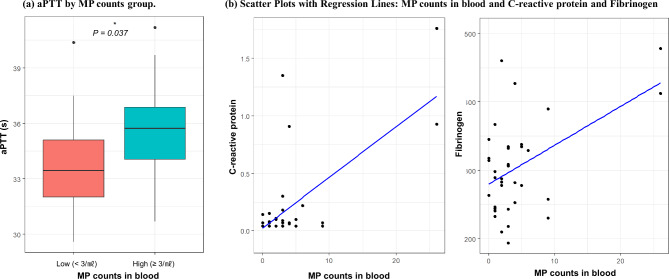
Recent studies have indicated potential health risks associated with microplastics (MPs) exposure, including alterations in blood coagulation homeostasis. This cross-sectional study aimed to quantitatively examine MPs in human blood and assess their association with coagulation markers. We recruited 36 healthy adults, collected whole blood samples, and analyzed MPs using Fourier-transform infrared (µ-FTIR) spectroscopy. Lifestyle factors related to MP exposure were assessed, such as the use of plastic food containers. Coagulation and inflammatory markers in blood samples were analyzed, including C-reactive protein, prothrombin time, activated partial prothrombin time (aPTT), antithrombin III, platelet count, erythrocyte sedimentation rate, and fibrinogen. MPs were detected in 88.9% of the participants, with a mean concentration of 4.2 MPs/mL. The predominant types of plastics identified were polystyrene and polypropylene. MPs were significantly higher in participants with a greater use of plastic food containers. A high MP load in the blood (≥ 3 MPs/mL) was significantly correlated with increased aPTT, C-reactive protein, and fibrinogen. We identified MPs in human blood, their association with specific lifestyle factors, and significant alterations in coagulation markers. This underscores the need for strategies to reduce human exposure to MPs, particularly in relation to blood coagulation and potential cardiovascular risks.
最近的研究表明,接触微塑料(MPs)存在潜在健康风险,包括血液凝固稳态的改变。这项横断面研究旨在定量检测人体血液中的微塑料,并评估它们与凝血标志物的关联。我们招募了36名健康成年人,采集全血样本,并使用傅里叶变换红外(µ-FTIR)光谱法分析微塑料。评估了与微塑料接触相关的生活方式因素,如使用塑料食品容器的情况。分析了血样中的凝血和炎症标志物,包括C反应蛋白、凝血酶原时间、活化部分凝血活酶时间(aPTT)、抗凝血酶III、血小板计数、红细胞沉降率和纤维蛋白原。88.9%的参与者检测到了微塑料,平均浓度为每毫升4.2个微塑料。鉴定出的主要塑料类型是聚苯乙烯和聚丙烯。使用塑料食品容器较多的参与者体内微塑料含量显著更高。血液中高微塑料负荷(≥3个微塑料/毫升)与aPTT、C反应蛋白和纤维蛋白原增加显著相关。我们确定了人体血液中的微塑料、它们与特定生活方式因素的关联以及凝血标志物的显著改变。这凸显了制定策略以减少人类接触微塑料的必要性,特别是在血液凝固和潜在心血管风险方面。