Grieb Nora, Oeser Alexander, Ferle Maximilian, Hanke Franziska, Flossdorf Sarah, Sauer Sandra, Goldschmidt Hartmut, Müller-Tidow Carsten, Salwender Hans-Jürgen, Fenk Roland, Engelhardt Monika, Zeiser Robert, Vucinic Vladan, Franke Georg-Nikolaus, Blau Igor Wolfgang, Teschner Daniel, Einsele Hermann, Kimmich Christoph, Kull Miriam, Besemer Britta, Gagelmann Nico, Kröger Nicolaus, Neumuth Thomas, Platzbecker Uwe, Merz Maximilian
Innovation Center Computer Assisted Surgery (ICCAS), University of Leipzig, Leipzig, Germany.
Department of Hematology, Hemostaseology, Cellular Therapy and Infectiology, University Hospital Leipzig, Leipzig, Germany.
Bone Marrow Transplant. 2025 Mar;60(3):335-345. doi: 10.1038/s41409-024-02490-1. Epub 2024 Dec 5.
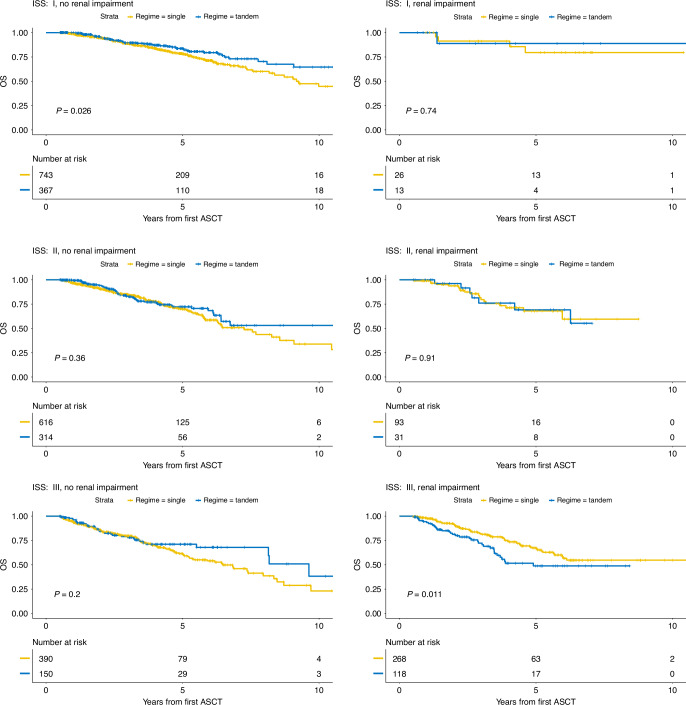
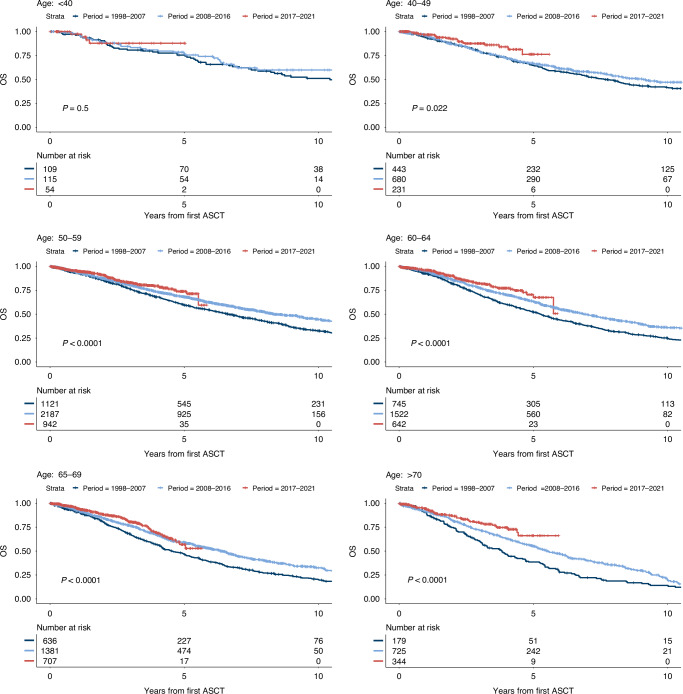
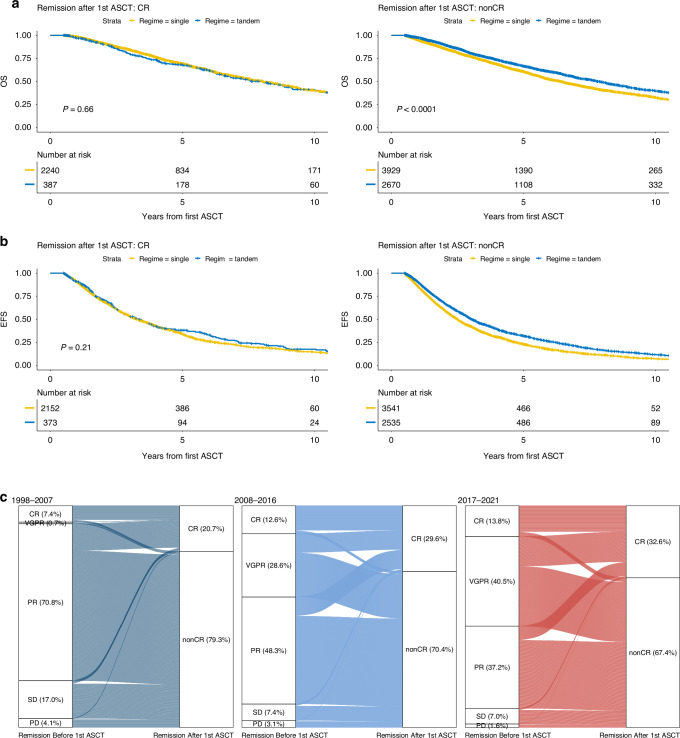
Identifying patients who may benefit from autologous stem cell transplantation (ASCT) in newly diagnosed multiple myeloma is crucial, especially in the era of effective induction and consolidation strategies. We analyzed data from 12763 patients enrolled in the German Registry for Hematopoietic Stem Cell Transplantation and Cell Therapy (DRST), distinguishing those who underwent single (n = 8736) or tandem ASCT (n = 4027) from 1998 to 2021. Our findings show that the median age at first ASCT increased over time, while the use of tandem ASCT declined. The shift in treatment practices coincided with higher rates of complete response (CR) post-induction therapy. Significantly improved overall survival and event-free survival over time were observed across all age groups, especially in older patients, but not in patients under 40. Tandem ASCT showed benefits for patients who did not achieve CR after initial ASCT. However, patients with ISS III and renal impairment had poorer outcomes with tandem ASCT. In conclusion, while ASCT remains an important anti-myeloma tool, careful patient selection for tandem ASCT is essential, particularly avoiding its use in patients with ISS III and renal impairment, older age, and those already achieving CR after initial ASCT.
确定新诊断的多发性骨髓瘤患者中可能从自体干细胞移植(ASCT)中获益的人群至关重要,尤其是在有效的诱导和巩固治疗策略时代。我们分析了德国造血干细胞移植和细胞治疗登记处(DRST)登记的12763例患者的数据,区分了1998年至2021年期间接受单次(n = 8736)或串联ASCT(n = 4027)的患者。我们的研究结果表明,首次ASCT时的中位年龄随时间增加,而串联ASCT的使用则有所下降。治疗方式的转变与诱导治疗后更高的完全缓解(CR)率相吻合。随着时间的推移,所有年龄组的总生存期和无事件生存期均显著改善,尤其是老年患者,但40岁以下患者并非如此。串联ASCT对初次ASCT后未达到CR的患者显示出益处。然而,国际分期系统(ISS)III期和肾功能损害的患者接受串联ASCT的预后较差。总之,虽然ASCT仍然是一种重要的抗骨髓瘤工具,但对于串联ASCT进行仔细的患者选择至关重要,特别是避免在ISS III期、肾功能损害、年龄较大以及初次ASCT后已达到CR的患者中使用。