Calaça Francisco J Simões, Araújo Jéssica Conceição, de Melo E Silva-Neto Carlos, Xavier-Santos Solange
Laboratório de Pesquisa em Ensino de Ciências-LabPEC, Centro de Pesquisas e Educação Científica, Universidade Estadual de Goiás, Campus Central (CEPEC/UEG), Anápolis, 75132-903, Goiás, Brazil.
Laboratório de Micologia Básica, Aplicada e Divulgação Científica-FungiLab, Universidade Estadual de Goiás, Campus Central, Anápolis, 75132-903, Goiás, Brazil.
Sci Rep. 2024 Dec 5;14(1):30334. doi: 10.1038/s41598-024-82059-6.
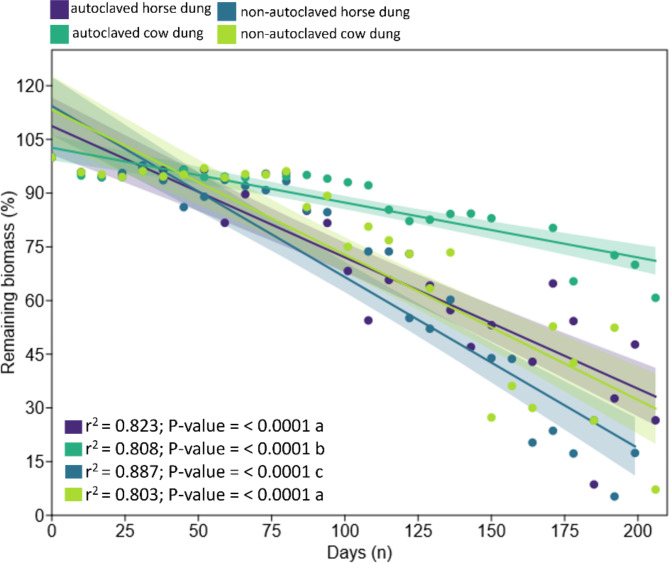
Dung serves as a critical resource for diverse organisms, including dung-inhabiting fungi, which play a key role in nutrient cycling. In this study, we examined the decomposition rates and half-lives of dung from ruminant and monogastric herbivores in a microcosm experiment, assessing the impact of autoclaving (fungal exclusion) on decomposition dynamics. Over six months, autoclaved dung decomposed more slowly, retaining greater biomass and highlighting the fungi's role in matter cycling. Decomposition followed a Gaussian linear model, with constants k ranging from 0.02 to 0.03 and half-lives of 19-23 days. Nutrient mineralization varied significantly between the start and end of the experiment, underscoring the contribution of the fungi to nutrient release. Our findings emphasize the ecological importance of dung-inhabiting fungi and suggest areas for future research on factors influencing dung decomposition in terrestrial ecosystems.
粪便对包括栖粪真菌在内的多种生物来说是一种关键资源,而栖粪真菌在养分循环中起着关键作用。在本研究中,我们在一个微观实验中检测了反刍动物和单胃食草动物粪便的分解速率和半衰期,评估了高压灭菌(排除真菌)对分解动态的影响。在六个月的时间里,经过高压灭菌的粪便分解得更慢,保留了更多的生物量,突出了真菌在物质循环中的作用。分解过程遵循高斯线性模型,常数k在0.02至0.03之间,半衰期为19 - 23天。实验开始和结束时养分矿化有显著差异,这突出了真菌对养分释放的贡献。我们的研究结果强调了栖粪真菌的生态重要性,并为未来关于影响陆地生态系统粪便分解因素的研究指明了方向。