Sugihara Koichi, Wakiya Risa, Kameda Tomohiro, Shimada Hiromi, Nakashima Shusaku, Miyagi Taichi, Ushio Yusuke, Mino Rina, Mizusaki Mao, Chujo Kanako, Kagawa Ryoko, Yamaguchi Hayamasa, Manabe Naoto, Kadowaki Norimitsu, Dobashi Hiroaki
Faculty of Medicine, Division of Hematology, Rheumatology and Respiratory Medicine, Department of Internal Medicine, Kagawa University, 1750-1 Ikenobe, Miki-cho, Kita-gun, 761-0793, Kagawa, Japan.
Sci Rep. 2024 Dec 6;14(1):30416. doi: 10.1038/s41598-024-82102-6.
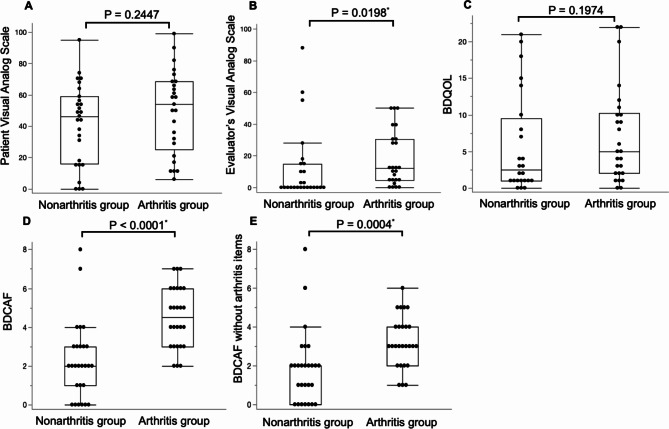
Arthritis is one of the most common symptoms of Behcet's Disease (BD) observed in 57% of Japanese patients with BD. The relationship between arthritis and other clinical symptoms of BD and the impact of arthritis on the quality of life (QOL) of patients with BD are still unclear. Therefore, the current study aimed to clarify the differences in clinical symptoms depending on the presence or absence of arthritis and evaluate the impact of arthritis on QOL in these patients. Fifty-three Japanese patients diagnosed with BD and being treated for more than 6 months were included in this study. Patients were divided based on the presence of arthritis symptoms into an arthritis and a non-arthritis group. Clinical symptoms, disease activity, and QOL of both groups were compared using the Patient's global assessment (PGA), Evaluator's global assessment (EGA), and Behcet's disease current activity form (BDCAF) as indices of disease activity. To evaluate disease activity related to lesions other than arthritis, BDCAF excluding arthritis items was also calculated. The Behcet's disease quality of life (BDQOL) scale was used to assess patients' QOL. Oral ulcers and skin lesions were significantly more frequent in the arthritis group than in the non-arthritis group (p = 0.009 and 0.048, respectively). Among skin domains, papulopustular lesions tended to be more frequent in the arthritis group. EGA and BDCAF (both including and excluding arthritis-related items) scores were significantly higher in the arthritis group (p = 0.019, < 0.0001, and 0.0004 respectively). Although PGA and BDQOL tended to be higher in the arthritis group, the difference between the two groups was not statistically significant. The disease course in Japanese BD patients with arthritis was more frequently complicated by oral ulcers and skin lesions than in those without arthritis. In addition, BD patients with arthritis tended to have generally higher disease activity and low QOL than their non-arthritis counterparts. Further research is required to confirm these results.
关节炎是白塞病(BD)最常见的症状之一,在57%的日本BD患者中可见。关节炎与BD的其他临床症状之间的关系以及关节炎对BD患者生活质量(QOL)的影响仍不清楚。因此,本研究旨在阐明根据关节炎的有无临床症状的差异,并评估关节炎对这些患者QOL的影响。本研究纳入了53名被诊断为BD且接受治疗超过6个月的日本患者。根据关节炎症状的有无将患者分为关节炎组和非关节炎组。以患者整体评估(PGA)、评估者整体评估(EGA)和白塞病当前活动形式(BDCAF)作为疾病活动指标,比较两组的临床症状、疾病活动度和QOL。为了评估与关节炎以外病变相关的疾病活动度,还计算了排除关节炎项目的BDCAF。使用白塞病生活质量(BDQOL)量表评估患者的QOL。关节炎组口腔溃疡和皮肤病变的发生率明显高于非关节炎组(分别为p = 0.009和0.048)。在皮肤领域中,丘疹脓疱性病变在关节炎组中往往更常见。关节炎组的EGA和BDCAF(包括和排除与关节炎相关的项目)评分明显更高(分别为p = 0.019、<0.0001和0.0004)。虽然PGA和BDQOL在关节炎组中往往更高,但两组之间的差异无统计学意义。与无关节炎的日本BD患者相比,有关节炎的患者病程更常并发口腔溃疡和皮肤病变。此外,与非关节炎的BD患者相比,有关节炎的BD患者总体疾病活动度往往更高,生活质量更低。需要进一步研究来证实这些结果。