Plackett Ruth, Hulin Joe, Mukuria Clara, Clowes Mark, Ramsay Sheena E, Spencer Liam, Adams Emma A, Dykxhoorn Jennifer, Walters Kate, Osborn David P J, Zamperoni Victoria, Jones Oliver, Weich Scott
UCL Research Department of Primary Care & Population Health, Royal Free Hospital, University College London, Upper 3rd Floor, Rowland Hill Street, London, NW3 2PF, UK.
University of Sheffield, Sheffield, UK.
BMC Public Health. 2024 Dec 5;24(1):3384. doi: 10.1186/s12889-024-20779-0.
Poor social connectedness has been identified as a risk factor for poor mental health but there is a lack of standardisation in how it is measured. This systematic review aimed to identify suitable measures of social connectedness for use in UK adult general populations.
Searches were undertaken in two stages to identify: (1) measures of social connectedness from review articles and grey literature and (2) studies reporting on the psychometric properties of the identified measures. Grey literature and five databases were searched: MEDLINE, Embase and PsycINFO; CINAHL and Web of Science. Studies based on UK adult general populations (16-65 years) or other English language speaking countries with similar cultures (US, Canada, Ireland, Australia and New Zealand) were included. Psychometric evidence was extracted relating to six general domains: conceptual model, content validity, reliability, construct validity, scoring and interpretability, and respondent burden and presentation. A narrative synthesis summarised these psychometric properties.
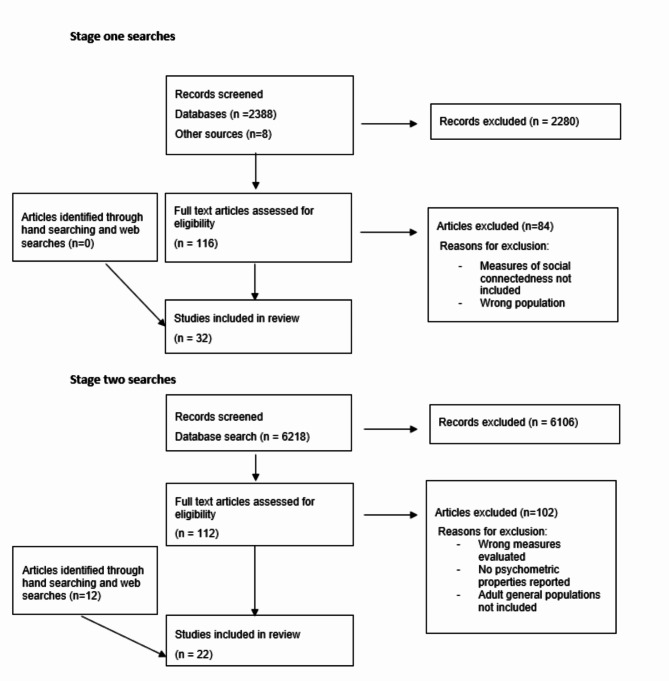
Stage (1) 2,396 studies were retrieved and, 24 possible measures of social connectedness were identified; stage (2) 6,218 studies were identified reporting on psychometrics of identified measures and 22 studies were included. These studies provided psychometric evidence for 10 measures, and we did not find psychometric studies for the other identified measures. Six measures (6/10, 60%) reported assessing loneliness and four (4/10, 40%) reported assessing social support but there was a degree of overlap between the assessments of each concept. There was good evidence of reliability across measures, 90% (9/10) had adequate internal consistency, but evidence of content validity was only available for one scale. Five measures (5/10, 50%) reported on at least half of the psychometric criteria, and these were: UCLA-3 (for loneliness), and MSPSS, F-SozU K-6, SPS-10 and SPS-5 (for social support).
This review identified ten social connectedness measures, and identified UCLA-3, MSPSS, F-SozUK-6, SPS-10, and SPS-5 as having the most robust psychometric properties for the UK adult population. Further testing is required to establish content validity, and to clarify the definition and conceptualisation of social connectedness, to enable standardisation in the approach to measuring social connectedness.
社会联系薄弱已被确定为心理健康状况不佳的一个风险因素,但在其测量方法上缺乏标准化。本系统评价旨在确定适用于英国成年普通人群的社会联系测量方法。
检索分两个阶段进行,以确定:(1)来自综述文章和灰色文献的社会联系测量方法;(2)报告所确定测量方法心理测量特性的研究。检索了灰色文献和五个数据库:MEDLINE、Embase和PsycINFO;CINAHL和科学引文索引。纳入基于英国成年普通人群(16 - 65岁)或其他具有相似文化的英语国家(美国、加拿大、爱尔兰、澳大利亚和新西兰)的研究。提取了与六个一般领域相关的心理测量证据:概念模型、内容效度、信度、结构效度、评分与可解释性,以及应答负担和呈现方式。叙述性综合总结了这些心理测量特性。
第一阶段检索到2396项研究,确定了24种可能的社会联系测量方法;第二阶段确定了6218项报告所确定测量方法心理测量学的研究,纳入了22项研究。这些研究为10种测量方法提供了心理测量证据,对于其他所确定的测量方法,我们未找到心理测量学研究。六种测量方法(6/10,60%)报告评估孤独感,四种(4/10,40%)报告评估社会支持,但每个概念的评估之间存在一定程度的重叠。各测量方法的信度有充分证据,90%(9/10)具有足够的内部一致性,但仅一种量表有内容效度的证据。五种测量方法(5/10,50%)报告了至少一半的心理测量标准,这些是:UCLA - 3(用于孤独感),以及MSPSS、F - SozU K - 6、SPS - 10和SPS - 5(用于社会支持)。
本综述确定了十种社会联系测量方法,并确定UCLA - 3、MSPSS、F - SozUK - 6、SPS - 10和SPS - 5在英国成年人群中具有最可靠的心理测量特性。需要进一步测试以确立内容效度,并澄清社会联系的定义和概念化,以便在测量社会联系的方法上实现标准化。