Liu Qian, Zhu Jiayu, Abulizi Guzalinuer, Hasim Ayshamgul
Department of Basic Medicine, Xinjiang Medical University and Xinjiang Key Laboratory of Molecular Biology of Endemic Diseases, Urumqi, China.
Fifth Department of Gynecologic Surgery, Xinjiang Medical University Affiliated Tumor Hospital, Urumqi, China.
BMC Cancer. 2024 Dec 6;24(1):1504. doi: 10.1186/s12885-024-13275-6.
Reprogramming of cellular metabolism is a pivotal mechanism employed by tumor cells to facilitate cell growth, proliferation, and differentiation, thereby propelling the progression of cancer. A comprehensive analysis of the transcriptional and metabolic landscape of cervical squamous cell carcinoma (CSCC) at high resolution could greatly enhance the precision of management and therapeutic strategies for this malignancy.
The Air-flow-assisted Desorption Electrospray Ionization Mass Spectro-metric Imaging (AFADESI-MSI) and Spatial Transcriptomics techniques (ST) were employed to investigate the metabolic and transcription profiles of CSCC and normal tissues. For clinical validation, the expression of ASCT2(Ala, Ser, Cys transporter 2) was assessed using immune histochemistry in 122 cases of cervical cancer and 30 cases of cervicitis.
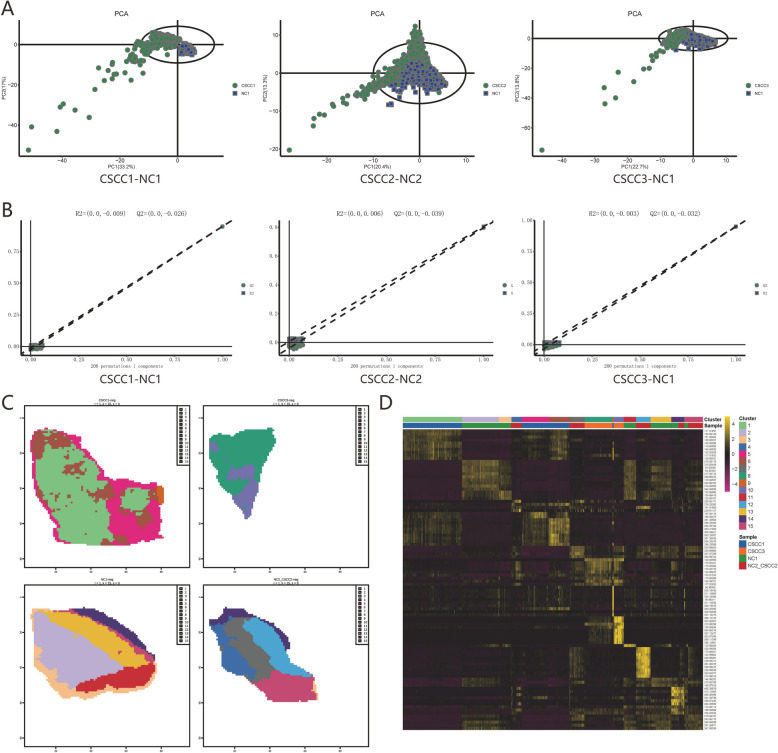
The AFADESI-MSI findings have revealed metabolic differences among different CSCC patients. Among them, the metabolic pathways of glutamine show more significant differences. After in situ detection of metabolites, the intensity of glutamate is observed to be significantly higher in cancerous tissue compared to normal tissue, but the intensity is not uniform. To elucidate the potential factors underlying alterations in glutamine metabolism across tissues, we employ ST to quantify mRNA levels. This analysis unveils significant perturbations in glutamine metabolism accompanied by extensive heterogeneity within cervical cancer tissues. After conducting a comprehensive analysis, it has been revealed that the differential expression of ASCT2(encoded by SLC1A5) in distinct regions of cervical cancer tissues plays a pivotal role in inducing heterogeneity in glutamine metabolism. Furthermore, the higher the expression level of ASCT2, the higher the intensity of glutamate is in the region. Further verification, it is found that the expression of ASCT2 protein in CSCC tissues is significantly higher than that in normal tissues (105/122, 86.07%).
This finding suggests that the variation in glutamine metabolism is not uniform throughout the tumor. The differential expression of ASCT2 in different regions of cervical cancer tissues seems to play a key role in causing this heterogeneity. This research has opened up new avenues for exploring the glutamine metabolic characteristics of CSCC which is essential for developing more effective targeted therapies.
细胞代谢重编程是肿瘤细胞用于促进细胞生长、增殖和分化的关键机制,从而推动癌症进展。对宫颈鳞状细胞癌(CSCC)的转录和代谢图谱进行高分辨率的全面分析,可大大提高这种恶性肿瘤的管理和治疗策略的精准度。
采用气流辅助解吸电喷雾电离质谱成像(AFADESI-MSI)和空间转录组学技术(ST)研究CSCC和正常组织的代谢和转录谱。为进行临床验证,采用免疫组织化学方法评估122例宫颈癌和30例宫颈炎患者中ASCT2(丙氨酸、丝氨酸、半胱氨酸转运体2)的表达。
AFADESI-MSI研究结果揭示了不同CSCC患者之间的代谢差异。其中,谷氨酰胺的代谢途径差异更为显著。在对代谢物进行原位检测后,发现癌组织中谷氨酸的强度明显高于正常组织,但强度并不均匀。为阐明不同组织间谷氨酰胺代谢改变的潜在因素,我们采用ST对mRNA水平进行定量。该分析揭示了谷氨酰胺代谢的显著扰动以及宫颈癌组织内广泛的异质性。综合分析后发现,宫颈癌组织不同区域中ASCT2(由SLC1A5编码)的差异表达在诱导谷氨酰胺代谢异质性方面起关键作用。此外,ASCT2表达水平越高,该区域谷氨酸的强度越高。进一步验证发现,CSCC组织中ASCT2蛋白的表达明显高于正常组织(105/122,86.07%)。
这一发现表明,谷氨酰胺代谢在整个肿瘤中的变化并不均匀。宫颈癌组织不同区域中ASCT2的差异表达似乎在导致这种异质性方面起关键作用。本研究为探索CSCC的谷氨酰胺代谢特征开辟了新途径,这对于开发更有效的靶向治疗至关重要。