Lin Ashleigh Peng, Nguyen Bao Tu Thai, Tran Son Quang, Kuo Yi-Jie, Huang Shu-Wei, Chen Yu-Pin
Department of Medical Education, Taipei Veterans General Hospital, Taipei, Taiwan.
The International Ph.D. Program in Medicine, College of Medicine, Taipei Medical University, Taipei, Taiwan.
Knee Surg Relat Res. 2024 Dec 5;36(1):45. doi: 10.1186/s43019-024-00248-z.
Septic arthritis is a rare but devastating complication after anterior cruciate ligament reconstruction (ACLR). While early treatment can prevent significant graft complications, outcomes are often inferior to those in uncomplicated ACLR. Furthermore, whether to retain or remove the graft after infection remains debatable. Therefore, we sought to compare the outcomes of septic arthritis post ACLR with uncomplicated ACLR and evaluate graft retention versus removal in infected patients.
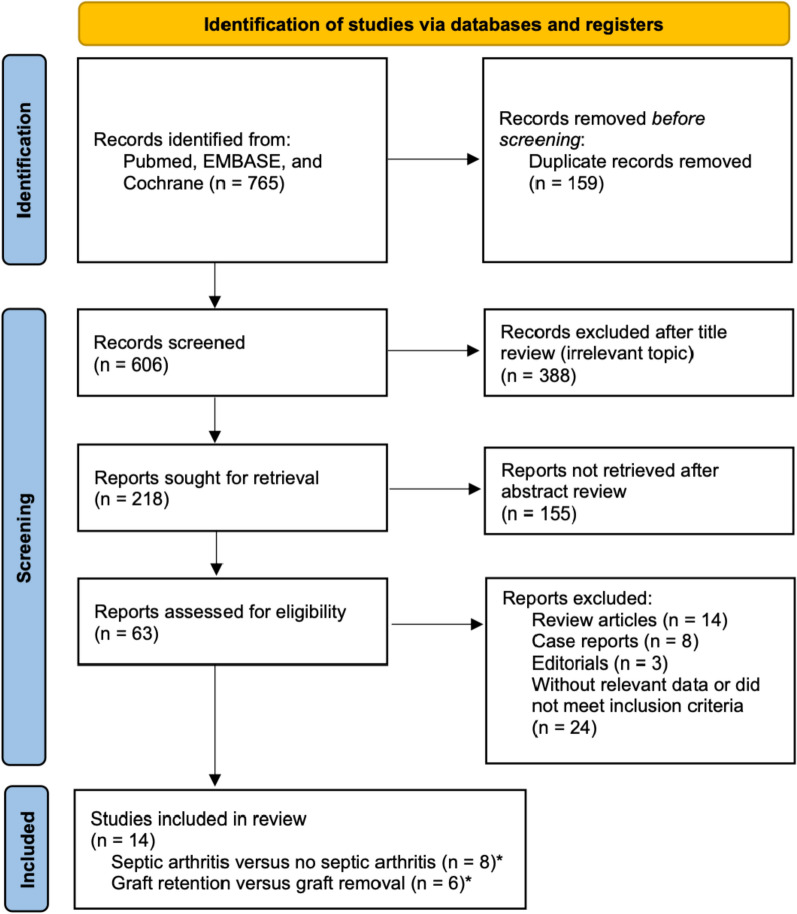
We conducted a systematic review and meta-analysis in which PubMed, Embase, and Cochrane Library databases were searched. Clinical studies were included if they compared patient-reported, clinician-reported, or radiographic outcomes (minimum follow-up of 12 months) between patients with post-ACLR septic arthritis and those with uncomplicated ACLR or that compared graft retention and removal in patients with post-ACLR septic arthritis.
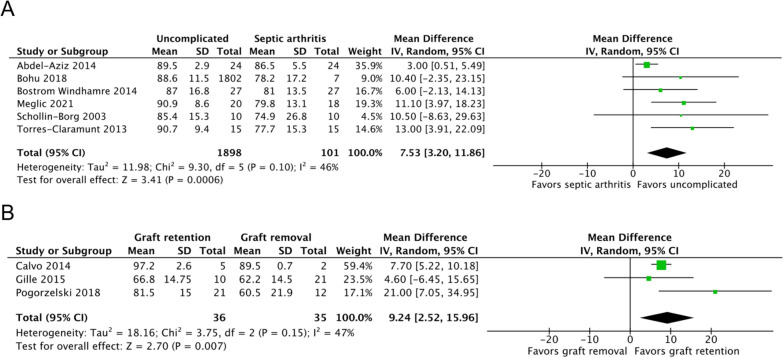
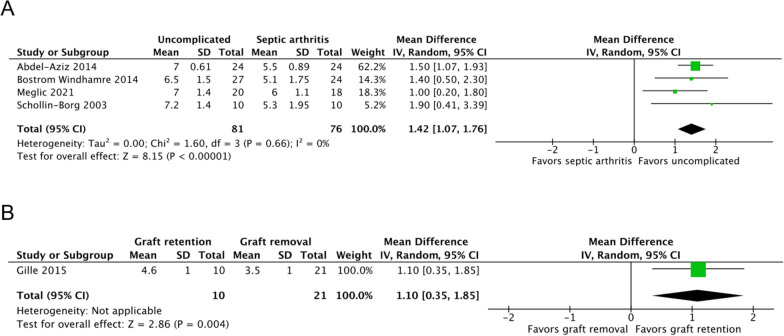
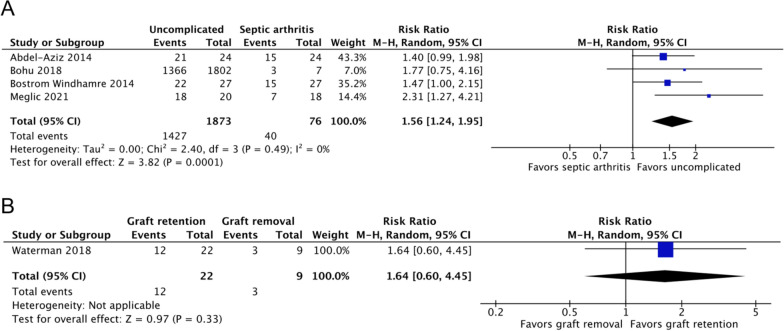
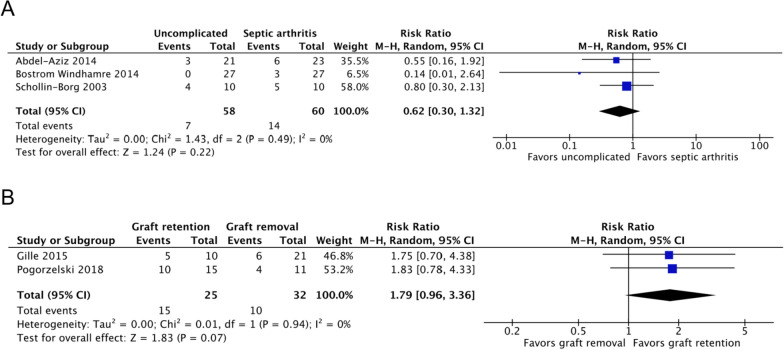
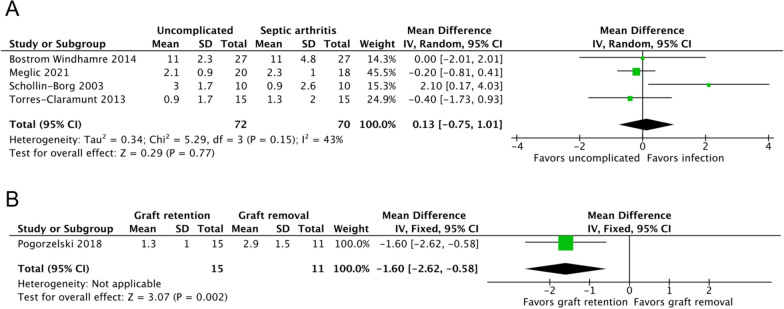
Thirteen studies were retrieved. Patients with post-ACLR septic arthritis reported inferior Lysholm Knee Scoring Scale scores (mean difference (MD) 7.53; 95% confidence interval (CI) 3.20-11.86; P = 0.0006), Tegner Activity Scale scores (MD, 1.42; 95% CI 1.07-1.76; P < .00001), and return to sports rates (53% versus 76%, respectively) to those of patients with uncomplicated ACLR. Patients with post-ACLR septic arthritis and those with uncomplicated ACLR did not differ in terms of the pooled estimate of various clinician-reported outcomes, such as the objective International Knee Documentation Committee score, anterior-posterior laxity, pivot shift, and Lachman test results. Furthermore, no significant difference was noted between the aforementioned patient groups regarding osteoarthritis (detected radiographically). Graft retention led to better patient- and clinician-reported outcomes than graft removal.
Despite similar clinician-reported outcomes and osteoarthritis rates, patients with post-ACLR septic arthritis reported worse outcomes than those with uncomplicated ACLR. Graft retention leads to improved patient- and clinician-reported outcomes compared with the outcomes of graft removal. Our findings may help develop realistic expectations and management strategies for this rare complication.
化脓性关节炎是前交叉韧带重建(ACLR)术后一种罕见但具有破坏性的并发症。虽然早期治疗可预防严重的移植物并发症,但其预后通常不如单纯ACLR。此外,感染后移植物是保留还是移除仍存在争议。因此,我们旨在比较ACLR术后化脓性关节炎与单纯ACLR的预后,并评估感染患者移植物保留与移除的情况。
我们进行了一项系统评价和荟萃分析,检索了PubMed、Embase和Cochrane图书馆数据库。纳入的临床研究需比较ACLR术后化脓性关节炎患者与单纯ACLR患者的患者报告、临床医生报告或影像学结果(最小随访12个月),或者比较ACLR术后化脓性关节炎患者移植物保留与移除的情况。
共检索到13项研究。ACLR术后化脓性关节炎患者的Lysholm膝关节评分量表得分(平均差(MD)7.53;95%置信区间(CI)3.20 - 11.86;P = 0.0006)、Tegner活动量表得分(MD,1.42;95%CI 1.07 - 1.76;P <.00001)及恢复运动率(分别为53%和76%)均低于单纯ACLR患者。ACLR术后化脓性关节炎患者与单纯ACLR患者在各种临床医生报告的结果汇总估计方面无差异,如客观国际膝关节文献委员会评分、前后向松弛度、轴移和Lachman试验结果。此外,上述患者组在骨关节炎(影像学检测)方面无显著差异。与移植物移除相比,移植物保留使患者和临床医生报告的结果更好。
尽管临床医生报告的结果和骨关节炎发生率相似,但ACLR术后化脓性关节炎患者的预后比单纯ACLR患者更差。与移植物移除的结果相比,移植物保留可改善患者和临床医生报告的结果。我们的研究结果可能有助于为这种罕见并发症制定现实的预期和管理策略。