Jolivet Sarah, Couturier Jeanne, Le Neindre Killian, Ehmig Muriel, Dortet Laurent, Emeraud Cécile, Barbut Frédéric
Unité de prévention du risque infectieux, Hôpital Saint-Antoine, Assistance Publique - Hôpitaux de Paris, Paris, France.
Service de microbiologie de l'environnement, Hôpital Saint-Antoine, Assistance Publique - Hôpitaux de Paris, Paris, France.
Euro Surveill. 2024 Dec;29(49). doi: 10.2807/1560-7917.ES.2024.29.49.2400262.
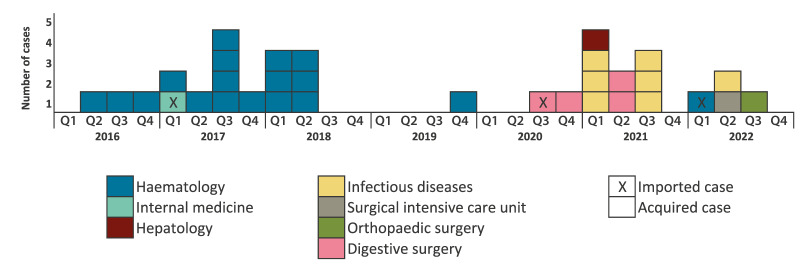
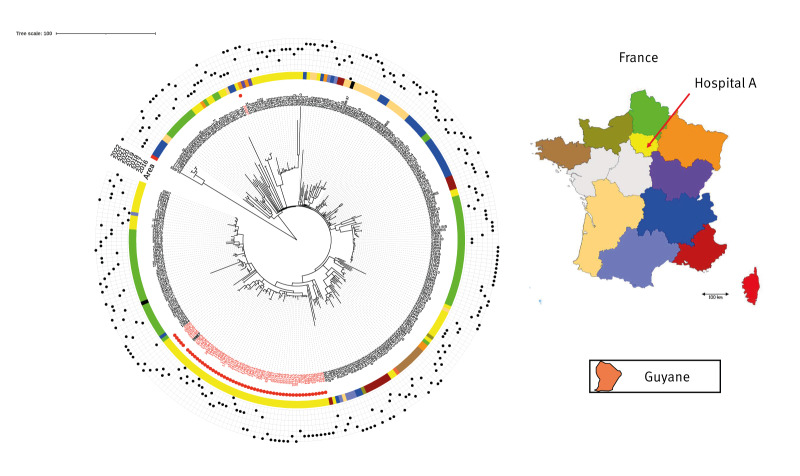
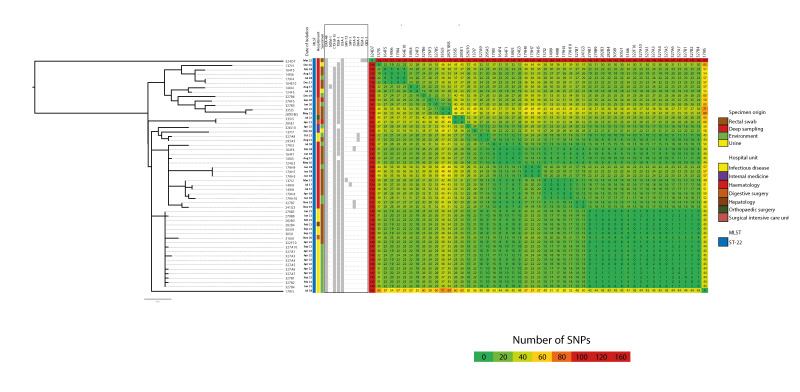
In 2016-2019, hospital A's haematology ward experienced an outbreak of OXA-48-producing ST-22 strains, with toilets identified as source of transmission. Between 2020 and 2022, 28 strains of OXA-48-producing ST-22 were isolated on other wards. This study aimed to determine whether all OXA-48-producing ST-22 strains belonged to the same clone and to investigate the persistence of this clone using whole genome sequencing. OXA-48-producing ST-22 strains collected from patients (n = 33) and from the hospital environment (n = 20) of seven wards were sequenced using Illumina technology and clonal relationships were determined using single nucleotide polymorphism (SNP). Phylogenetic analyses were performed on 53 strains from hospital A and on 240 epidemiologically unrelated carbapenem-resistant ST-22 isolated from elsewhere in France. SNP analysis suggested long-lasting persistence of the same clone for more than 6 years. Phylogenetic analysis showed that 52 of 53 strains isolated in hospital A belonged to the same cluster and were different from the 240 epidemiologically unrelated ST-22. Our data suggest that this clone can persist in hospital environments for years, representing a risk for hospital-acquired infections and outbreaks. Reservoir management is essential to prevent further transmission.
在2016年至2019年期间,A医院血液科病房爆发了产OXA-48的ST-22菌株感染,已确定厕所为传播源。在2020年至2022年期间,在其他病房分离出28株产OXA-48的ST-22菌株。本研究旨在确定所有产OXA-48的ST-22菌株是否属于同一克隆,并使用全基因组测序研究该克隆的持续性。使用Illumina技术对从七个病房的患者(n = 33)和医院环境(n = 20)中收集的产OXA-48的ST-22菌株进行测序,并使用单核苷酸多态性(SNP)确定克隆关系。对来自A医院的53株菌株以及从法国其他地方分离出的240株与流行病学无关的耐碳青霉烯类ST-22菌株进行了系统发育分析。SNP分析表明同一克隆持续存在超过6年。系统发育分析表明,A医院分离出的53株菌株中有52株属于同一簇,与240株与流行病学无关的ST-22不同。我们的数据表明,该克隆可在医院环境中持续存在数年,这对医院获得性感染和暴发构成风险。蓄水池管理对于防止进一步传播至关重要。