
宫颈癌同步放化疗与免疫检查点抑制剂的早期联合优于晚期联合:一项倾向评分匹配分析
An early combination of concurrent chemoradiotherapy with immune checkpoint inhibitors for cervical cancer is superior to a late combination: a propensity-score matching analysis.
作者信息
Ma Yi-Ming, Cheng Shu-Xia, Zhang Ming-Chuan, Zhang Hui-Ying, Gu Jun-Jiao, Zhao Pan-Pan, Ge Hong
机构信息
Department of Gynecologic Oncology, The Affiliated Cancer Hospital of Zhengzhou University and Henan Cancer Hospital, Zhengzhou, China.
Department of Oncology, First Affiliated Hospital of Henan University, Kaifeng, China.
出版信息
Front Oncol. 2024 Nov 21;14:1429176. doi: 10.3389/fonc.2024.1429176. eCollection 2024.
PURPOSE
This study compared the timing effects of immune checkpoint inhibitor (ICIs) administration on the efficacy and safety of concurrent chemoradiotherapy for cervical cancer.
METHODS
This study included patients with advanced cervical cancer who received concurrent chemoradiotherapy with ICIs. The patients were divided into early-application (n=51) and late-application groups (n=56) according to the ICI application timing. The primary objective was assessing progression-free survival (PFS) and its associated factors; secondary objectives included assessing objective remission rates (ORR) and treatment-related adverse events (TRAEs).
RESULTS
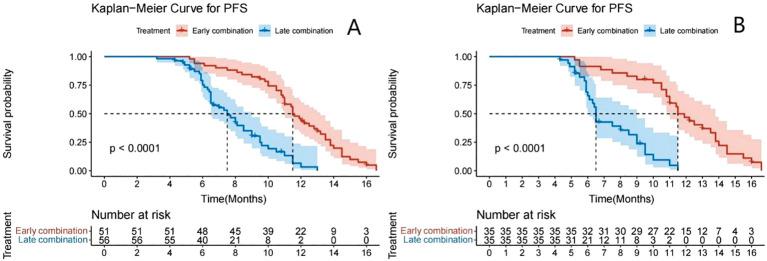
Before propensity score matching (PSM), the median PFS (mPFS) times were significantly different: 11.5 months (95% CI: 11.0-13.2) and 7.5 months (95% CI: 6.5-9.0) for the early and late groups, respectively (P<0.001). After PSM, the mPFS times remained significantly different: 11.5 months (95% CI: 11.0-13.8) and 6.5 months (95% CI: 6.1-9.0), respectively (P<0.001). The PSM tumor-response ORR in the early combination group (74.3%) was significantly greater than the 31.4% in the late combination group (P<0.001). After PSM, multivariate Cox analysis showed tumor diameter (P=0.004), distant organ metastasis (P=0.047), and timing of combination therapy (P<0.001) were independently associated factors affecting PFS. The most common TRAEs in the two groups of patients were neutropenia, nausea and vomiting, and fatigue, with no significant difference in incidence (P>0.050).All adverse reactions were resolved, and no adverse reaction-related deaths occurred.
CONCLUSION
In patients with cervical cancer treated with concurrent chemoradiotherapy, earlier immunotherapy improves survival and is equivalent in safety to ICIs late application.
目的
本研究比较了免疫检查点抑制剂(ICI)给药时机对宫颈癌同步放化疗疗效和安全性的影响。
方法
本研究纳入了接受ICI同步放化疗的晚期宫颈癌患者。根据ICI应用时机,将患者分为早期应用组(n = 51)和晚期应用组(n = 56)。主要目标是评估无进展生存期(PFS)及其相关因素;次要目标包括评估客观缓解率(ORR)和治疗相关不良事件(TRAEs)。
结果
在倾向评分匹配(PSM)之前,中位PFS(mPFS)时间有显著差异:早期组和晚期组分别为11.5个月(95%CI:11.0 - 13.2)和7.5个月(95%CI:6.5 - 9.0)(P < 0.001)。PSM后,mPFS时间仍有显著差异:分别为11.5个月(95%CI:11.0 - 13.8)和6.5个月(95%CI:6.1 - 9.0)(P < 0.001)。早期联合组的PSM肿瘤反应ORR(74.3%)显著高于晚期联合组的31.4%(P < 0.001)。PSM后,多因素Cox分析显示肿瘤直径(P = 0.004)、远处器官转移(P = 0.047)和联合治疗时机(P < 0.001)是影响PFS的独立相关因素。两组患者最常见的TRAEs是中性粒细胞减少、恶心呕吐和疲劳,发生率无显著差异(P > 0.050)。所有不良反应均得到缓解,未发生与不良反应相关的死亡。
结论
在接受同步放化疗的宫颈癌患者中,早期免疫治疗可提高生存率,且安全性与晚期应用ICI相当。


 Zotero 插件