Khadka Dipak, Wu BaoHuan, Bhatta Sijar, Paudel Hem Raj, Fu Keyi, Cui Dafang, Shi Shi
Guangdong Key Laboratory for Innovative Development and Utilization of Forest Plant Germplasm, College of Forestry and Landscape Architecture, South China Agricultural University, Guangzhou, 510642, China.
Environmental Science Program, Golden Gate International College, Battisputali, Kathmandu, Nepal.
Heliyon. 2024 Oct 3;10(20):e38168. doi: 10.1016/j.heliyon.2024.e38168. eCollection 2024 Oct 30.
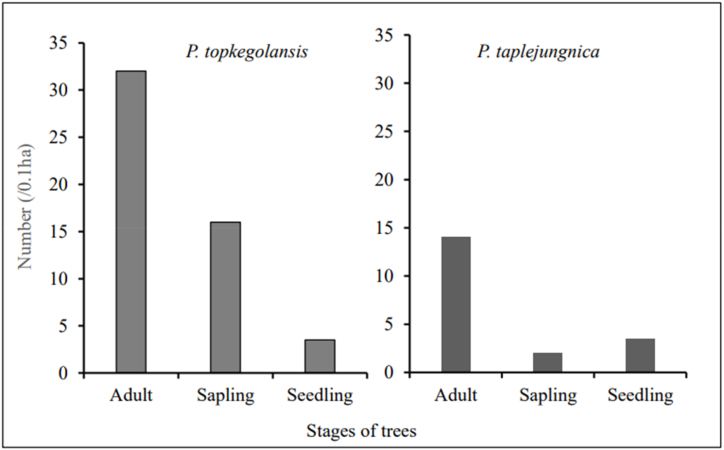
Prunus species play an important role in preserving the Nepal's unique identity; such as three endemic species of Prunus, , , and , represent the country's local area. An ecological and social survey of . and . was conducted. To analyze these species' regeneration status and population structures, the density of seedlings, saplings, and adult trees were compared, and created a diameter size class diagram. The Wilcoxon signed-rank test was used to compare the average values of seedlings, saplings, and adult trees between two species. To determine the ethnobotanical importance of a species, the relative frequency of citation (RFC) was calculated for various use categories. We classified both species as trees as the average diameter at breast height (DBH) of . was 19.55 ± 14.66 cm with an average height 5.05 ± 2.28 m, while that of . was 14.5 ± 7.93 cm with an average height of 4.89 ± 1.66 m. . had an average 32 ± 31 adult trees, 16 ± 15 saplings, and 21 ± 18 seedlings per 0.1 ha, while . had 12 ± 5 adult trees, 2 saplings, and 6 ± 4 seedlings per 0.1 ha. The number of seedlings and saplings at the plot level differed significantly between species (W = 75.5, p- = 0.05, and W = 84, p = 0.01, respectively). Both had humped-shaped diameter at breast height size class distribution. However, . had a more apparent hump-shaped diameter at breast height distribution than . , indicating that . has more unsustainable regeneration issues. . was locally recognized as a separate species from . , whereas . was not. . have seven different use categories, with wood and fuel wood being the most frequently cited, with RFC value 1. Rapid vulnerability assessment (RVA) showed both species are having high conservation threats. In situ conservation measures are suggested to address the issue of poor regeneration and disturbances.
李属物种在维护尼泊尔的独特特性方面发挥着重要作用;例如李属的三种特有物种,[此处缺失物种名称]、[此处缺失物种名称]和[此处缺失物种名称],代表了该国的当地地区。对[此处缺失物种名称]和[此处缺失物种名称]进行了生态和社会调查。为了分析这些物种的更新状况和种群结构,比较了幼苗、幼树和成年树的密度,并绘制了直径大小分级图。采用威尔科克森符号秩检验来比较两个物种之间幼苗、幼树和成年树的平均值。为了确定一个物种的民族植物学重要性,计算了各种用途类别的相对引用频率(RFC)。我们将这两个物种都归类为树木,因为[此处缺失物种名称]的平均胸径(DBH)为19.55±14.66厘米,平均高度为5.05±2.28米,而[此处缺失物种名称]的平均胸径为14.5±7.93厘米,平均高度为4.89±1.66米。[此处缺失物种名称]每0.1公顷平均有32±31棵成年树、16±15棵幼树和21±18棵幼苗,而[此处缺失物种名称]每0.1公顷有12±5棵成年树、2棵幼树和6±4棵幼苗。不同物种之间样地水平上的幼苗和幼树数量存在显著差异(分别为W = 75.5,p = 0.05,以及W = 84,p = 0.01)。两者的胸径大小分级分布均呈驼峰状。然而,[此处缺失物种名称]的胸径分布比[此处缺失物种名称]更明显地呈驼峰状,这表明[此处缺失物种名称]存在更多不可持续的更新问题。[此处缺失物种名称]在当地被认为是与[此处缺失物种名称]不同的物种,而[此处缺失物种名称]则不是。[此处缺失物种名称]有七种不同的用途类别,其中木材和薪材被引用的频率最高,RFC值为1。快速脆弱性评估(RVA)表明这两个物种都面临着很高的保护威胁。建议采取原地保护措施来解决更新不良和干扰的问题。