Su Rui, Li Hong-Liang, Wang Yu-Mei, Zhang Linlin, Zhou Jian-Xin
Department of Critical Care Medicine, Beijing Tiantan Hospital, Capital Medical University, Beijing, China.
Department of Critical Care Medicine, Beijing Shijitan Hospital, Capital Medical University, Beijing, China.
Heliyon. 2024 Oct 10;10(20):e39197. doi: 10.1016/j.heliyon.2024.e39197. eCollection 2024 Oct 30.
Cerebral blood flow (CBF) is closely regulated by carbon dioxide (CO). In patients with aneurysmal subarachnoid hemorrhage (aSAH), abnormal arterial partial pressure of CO (PaCO) might deteriorate brain injuries. Nevertheless, the impact of dynamic PaCO fluctuations on neurological outcomes in aSAH patients has not been extensively studied. Our study aimed to investigate the association between dynamic PaCO levels and unfavorable neurological outcomes in aSAH patients.
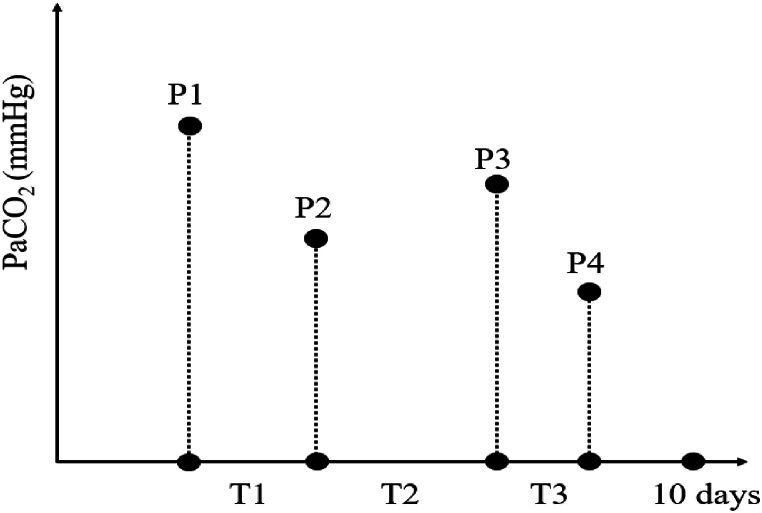
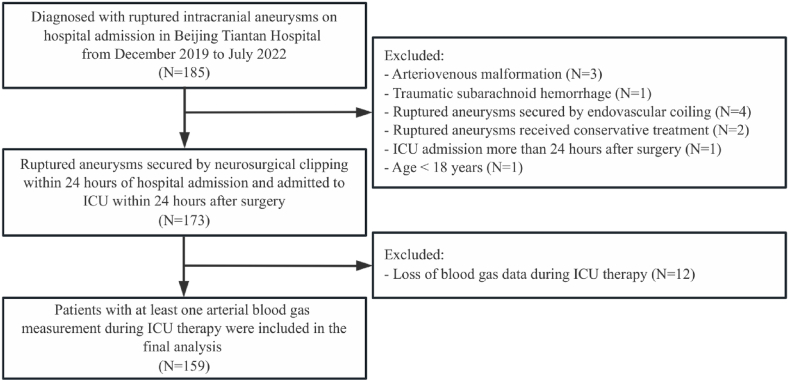
In this retrospective observational study, we consecutively enrolled 159 aSAH patients from December 2019 to July 2021. Arterial blood gas measurements within 10 days after intensive care unit (ICU) admission for each patient were recorded to calculate the time-weighted average (TWA)-PaCO, an indicator representing the dynamic changes in PaCO levels. For the association between TWA-PaCO levels and unfavorable neurological outcomes in aSAH patients, multivariable logistic analysis was used to explore TWA-PaCO levels as categorical variables, and restricted cubic spline (RCS) was used to explore TWA-PaCO levels as continuous variables.
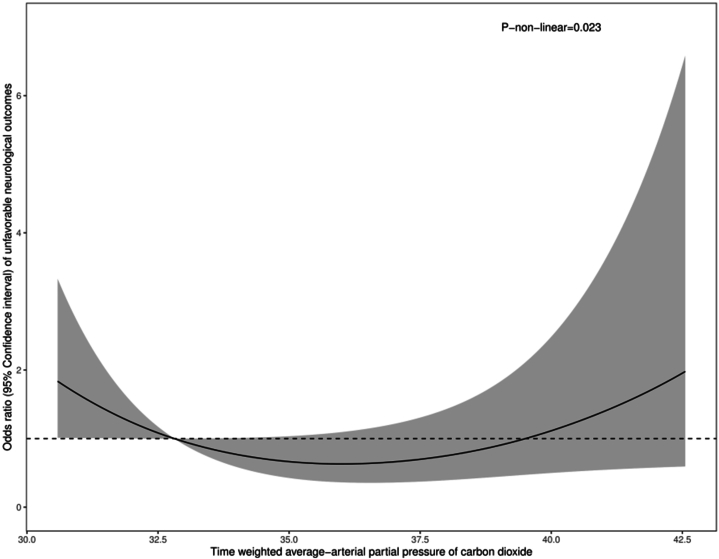
In multivariable logistic analysis, after adjusting confounders, when TWA-PaCO 35-45 mmHg was as a reference, TWA-PaCO < 35 mmHg (odds ratio [OR] 2.15, 95 % confidence interval [CI] 0.83-5.55, P = 0.113) and TWA-PaCO > 45 mmHg (OR 8.31, 95 % CI 0.72-96.14, P = 0.090) were not independently associated with unfavorable neurological outcomes (modified Rankin score of 3-6). The RCS shows a "U" shape curve between TWA-PaCO levels and unfavorable neurological outcomes, with a nonlinear Pvalue of 0.023. The lowest ORs of unfavorable neurological outcomes were within PaCO 32.8-38.1 mmHg.
Both lower and higher PaCO levels are harmful to aSAH patients. PaCO in the range of 32.8-38.1 mmHg is associated with lowest unfavorable neurological outcomes.
脑血流量(CBF)受二氧化碳(CO₂)的严格调节。在动脉瘤性蛛网膜下腔出血(aSAH)患者中,动脉血二氧化碳分压(PaCO₂)异常可能会加重脑损伤。然而,动态PaCO₂波动对aSAH患者神经功能结局的影响尚未得到广泛研究。我们的研究旨在探讨aSAH患者动态PaCO₂水平与不良神经功能结局之间的关联。
在这项回顾性观察研究中,我们连续纳入了2019年12月至2021年7月期间的159例aSAH患者。记录每位患者入住重症监护病房(ICU)后10天内的动脉血气测量结果,以计算时间加权平均值(TWA)-PaCO₂,这是一个代表PaCO₂水平动态变化的指标。对于aSAH患者TWA-PaCO₂水平与不良神经功能结局之间的关联,采用多变量逻辑分析将TWA-PaCO₂水平作为分类变量进行探索,并使用受限立方样条(RCS)将TWA-PaCO₂水平作为连续变量进行探索。
在多变量逻辑分析中,调整混杂因素后,以TWA-PaCO₂ 35 - 45 mmHg为参照,TWA-PaCO₂ < 35 mmHg(比值比[OR] 2.15,95%置信区间[CI] 0.83 - 5.55,P = 0.113)和TWA-PaCO₂ > 45 mmHg(OR 8.31,95% CI 0.72 - 96.14,P = 0.090)与不良神经功能结局(改良Rankin量表评分3 - 6分)无独立关联。RCS显示TWA-PaCO₂水平与不良神经功能结局之间呈“U”形曲线,非线性P值为0.023。不良神经功能结局的最低OR值出现在PaCO₂ 32.8 - 38.1 mmHg范围内。
较低和较高的PaCO₂水平对aSAH患者均有害。PaCO₂在32.8 - 38.1 mmHg范围内与最低的不良神经功能结局相关。