Hooi James K Y, Low Marshall C H, To Jonathan C L, Mak Hugo W F, Choi Mandy M, Tam Chris C P, Mak Raymond W M, Wong Vincent K C, Chan Timo C C, Li Andrew W T, Mak Charlie C Y, Chiang Valerie, Chu Gordon K H, Wong Jane C Y, Li Philip H
Division of Rheumatology and Clinical Immunology, Department of Medicine, Queen Mary Hospital, The University of Hong Kong, Hong Kong SAR, China.
Department of Pharmacy and Pharmacology, The University of Hong Kong, Hong Kong SAR, China.
World Allergy Organ J. 2024 Nov 21;17(12):101003. doi: 10.1016/j.waojou.2024.101003. eCollection 2024 Dec.
Mislabelled penicillin allergies are associated with a myriad of adverse outcomes and development of anti-microbial resistance. With the overwhelming need for specialist allergy services, pharmacist initiatives such as the Hong Kong Penicillin Allergy Pharmacist Initiative (HK-PAPI) have been advocated. However, evidence of their effectiveness, safety and impact on health-related quality-of-life (HR-QoL) are lacking.To assess and compare the effectiveness, safety and improvements on HR-QoL of pharmacists vs allergists in a pilot low-risk penicillin allergy delabelling initiative.
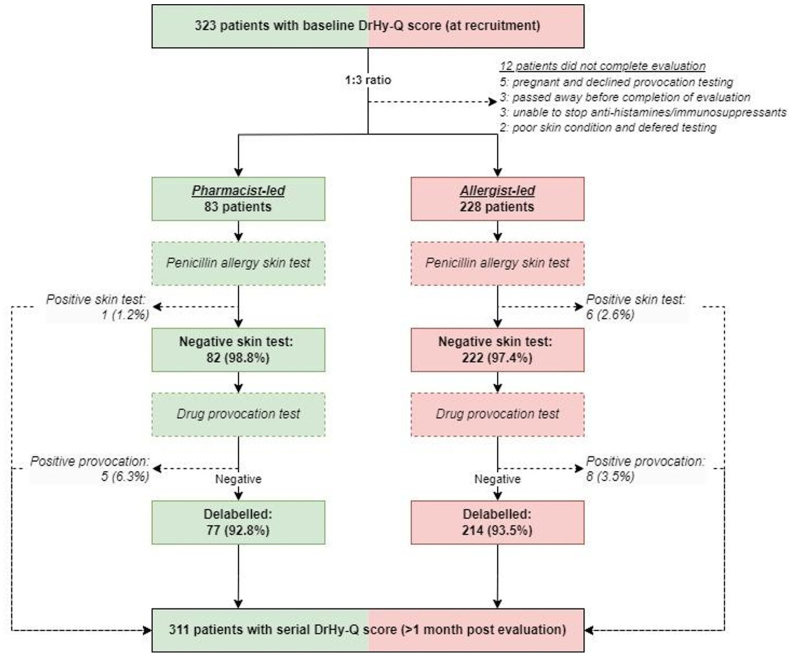
All adult patients referred for low-risk penicillin allergy were randomized and evaluated by either pharmacists or allergists in a 1:3 ratio. Outcomes and changes in Drug Hypersensitivity Quality of Life Questionnaire (DrHy-Q) scores were compared.
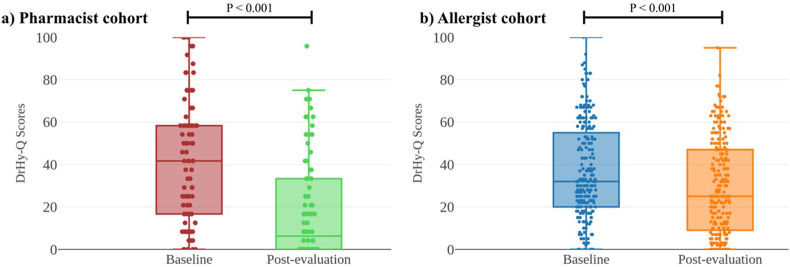
Of 323 patients referred, 96.3% (311/323) completed penicillin allergy evaluation (pharmacists: 83 [24.3%] vs allergists: 228 [66.7%]). Overall, 93.6% (291/311) were delabelled with no difference between evaluations by pharmacists and allergists (92.8% vs 93.9%, p = 0.729). There were no severe or systemic reactions in either cohort. Patients evaluated by either pharmacists (43.4 [SD:29.1] to 10.5 [SD:5.93], p < 0.001) or allergists (37.2 [SD:22.2] to 29.1 [SD:22.4], p < 0.001) reported improved HR-QoL as reflected by DrHy-Q scores. However, absolute changes in DrHy-Q scores were significantly greater among patients evaluated by pharmacists compared to those by allergists (-24.6 [SD:25.1] vs -9.19 [SD:13.7], p < 0.001).
Evaluations and delabelling by pharmacists (vs allergists) were comparably effective and safe among patients with low-risk penicillin allergy. Moreover, patients evaluated by pharmacists even reported significantly greater improvements in HR-QoL, highlighting the potential of multidisciplinary allergy initiatives.
青霉素过敏标签错误与众多不良后果及抗菌药物耐药性的产生相关。鉴于对抗过敏专科服务的迫切需求,已提倡开展药剂师主导的举措,如香港青霉素过敏药剂师倡议(HK - PAPI)。然而,缺乏关于其有效性、安全性以及对健康相关生活质量(HR - QoL)影响的证据。为评估并比较在一项低风险青霉素过敏标签去除试点倡议中,药剂师与过敏专科医生在有效性、安全性及对HR - QoL改善方面的情况。
所有因低风险青霉素过敏而被转诊的成年患者按1:3的比例随机分配,由药剂师或过敏专科医生进行评估。比较药物过敏生活质量问卷(DrHy - Q)评分的结果及变化。
在323名被转诊的患者中,96.3%(311/323)完成了青霉素过敏评估(药剂师:83例[24.3%],过敏专科医生:228例[66.7%])。总体而言,93.6%(291/311)的患者过敏标签被去除,药剂师和过敏专科医生的评估结果无差异(92.8%对93.9%,p = 0.729)。两个队列中均未出现严重或全身性反应。经药剂师(从43.4[标准差:29.1]降至10.5[标准差:5.93],p < 0.001)或过敏专科医生(从37.2[标准差:22.2]降至29.1[标准差:22.4],p < 0.001)评估的患者报告称,DrHy - Q评分反映出HR - QoL有所改善。然而,与经过敏专科医生评估的患者相比,经药剂师评估的患者DrHy - Q评分的绝对变化显著更大(-24.6[标准差:25.1]对-9.19[标准差:13.7],p < 0.001)。
在低风险青霉素过敏患者中,药剂师(与过敏专科医生相比)进行的评估及标签去除同样有效且安全。此外,经药剂师评估的患者报告称HR - QoL有显著更大的改善,凸显了多学科过敏倡议的潜力。