Burggraaf-van Delft J Louise I, Wiggins Kerri L, van Rein Nienke, le Cessie Saskia, Smith Nicholas L, Cannegieter Suzanne C
Department of Clinical Epidemiology, Leiden University Medical Center, Leiden, the Netherlands.
Department of Medicine, University of Washington, Seattle, Washington, USA.
Res Pract Thromb Haemost. 2024 Oct 29;8(8):102610. doi: 10.1016/j.rpth.2024.102610. eCollection 2024 Nov.
Long-term outcome after a first venous thromboembolism (VTE) might be optimized by tailoring anticoagulant treatment duration on individual risks of recurrence and major bleeding. The L-TRRiP models (A-D) were previously developed in data from the Dutch Multiple Environment and Genetic Assessment of Risk Factors for Venous thrombosis study to predict VTE recurrence.
We aimed to externally validate models C and D using data from the United States Heart and Vascular Health (HVH) study.
Data from participants with a first VTE who discontinued initial anticoagulant therapy were used to determine model performance. Missing data were imputed, and results were pooled according to Rubin's rules. To determine discrimination, Harrell's C-statistic was calculated. To assess calibration, the observed/expected (O/E) ratio was estimated, and calibration plots were created, in which we accounted for the competing risk of death. A stratified analysis based on age <70 or >70 years was performed.
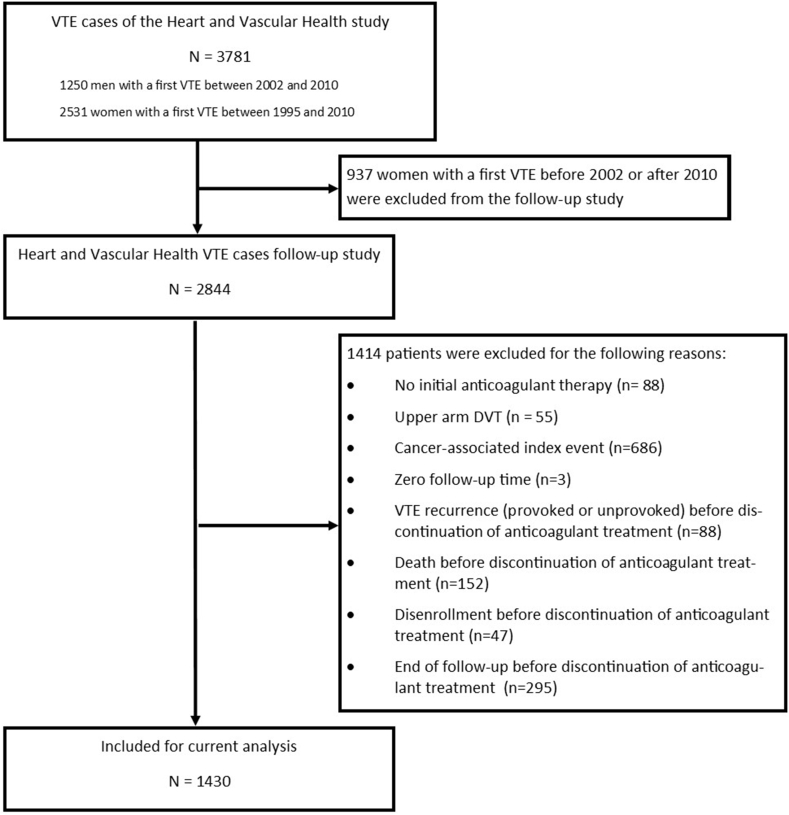
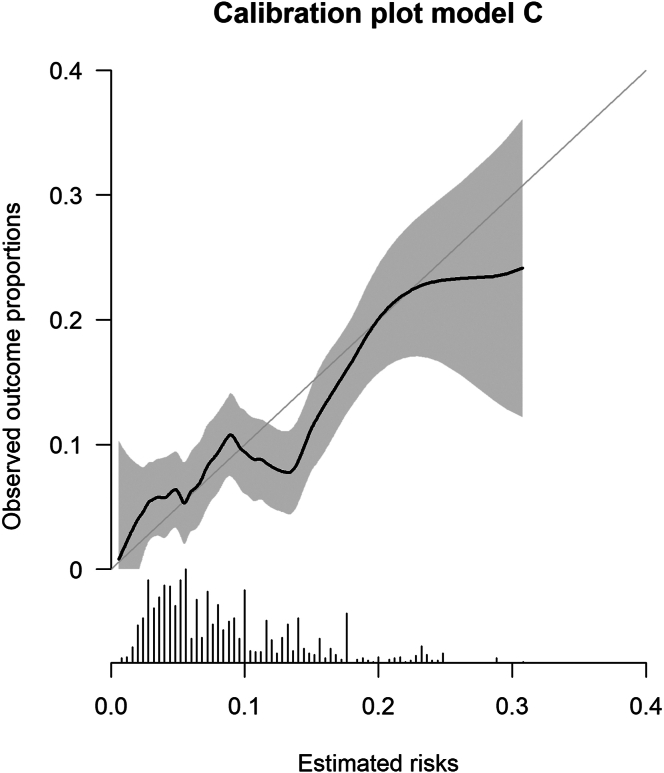
Of 1430 participants from the HVH study, 187 experienced an unprovoked VTE recurrence during follow-up. The C-statistics of L-TRRIP models C and D were 0.62 (95% CI, 0.56-0.67) and 0.61 (95% CI, 0.55-0.67), respectively. The O/E ratio (1.00; 95% CI, 0.84-1.17 and 1.09; 95% CI, 0.91-1.27, respectively) and calibration plots indicated good calibration. The discrimination was similar between participants <70 or >70 years, whereas overall calibration was lower in participants <70 years.
The L-TRRiP models showed moderate discrimination and good calibration in a different population and can be used to guide clinical decision making. To assess the added value in daily clinical practice, a management study is needed.
首次静脉血栓栓塞(VTE)后的长期预后可通过根据个体复发风险和大出血风险调整抗凝治疗时长来优化。L-TRRiP模型(A - D)先前是在荷兰静脉血栓形成多环境与遗传风险因素评估研究的数据中开发的,用于预测VTE复发。
我们旨在使用美国心脏与血管健康(HVH)研究的数据对模型C和D进行外部验证。
来自首次发生VTE且停止初始抗凝治疗的参与者的数据用于确定模型性能。对缺失数据进行插补,并根据鲁宾法则汇总结果。为确定区分度,计算了哈雷尔C统计量。为评估校准情况,估计了观察值/预期值(O/E)比率,并绘制了校准图,其中我们考虑了死亡的竞争风险。进行了基于年龄<70岁或>70岁的分层分析。
在HVH研究的1430名参与者中,187人在随访期间发生了不明原因的VTE复发。L-TRRIP模型C和D的C统计量分别为0.62(95%CI,0.56 - 0.67)和0.61(95%CI,0.55 - 0.67)。O/E比率(分别为1.00;95%CI,0.84 - 1.17和1.09;95%CI,0.91 - 1.27)和校准图表明校准良好。<70岁或>70岁的参与者之间区分度相似,而<70岁的参与者总体校准较低。
L-TRRiP模型在不同人群中显示出中等区分度和良好校准,可用于指导临床决策。为评估在日常临床实践中的附加价值,需要进行一项管理研究。