Espadinha Diana, Roycroft Emma, Flanagan Peter R, Mok Simone, McNamara Eleanor, Rogers Thomas R, Fitzgibbon Margaret M
European Public Health Microbiology Training Programme (EUPHEM), European Center for Disease Prevention and Control (ECDC), Solna, Sweden.
Public Health Laboratory HSE Dublin, Cherry Orchard Hospital, Dublin, Ireland.
Heliyon. 2024 Nov 8;10(22):e40279. doi: 10.1016/j.heliyon.2024.e40279. eCollection 2024 Nov 30.
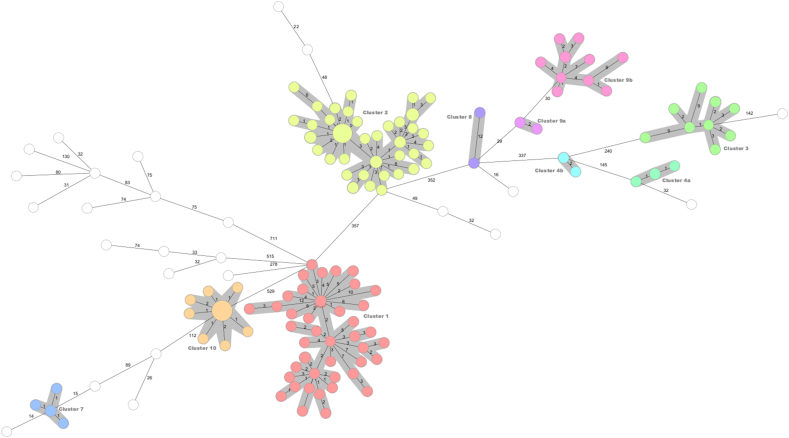
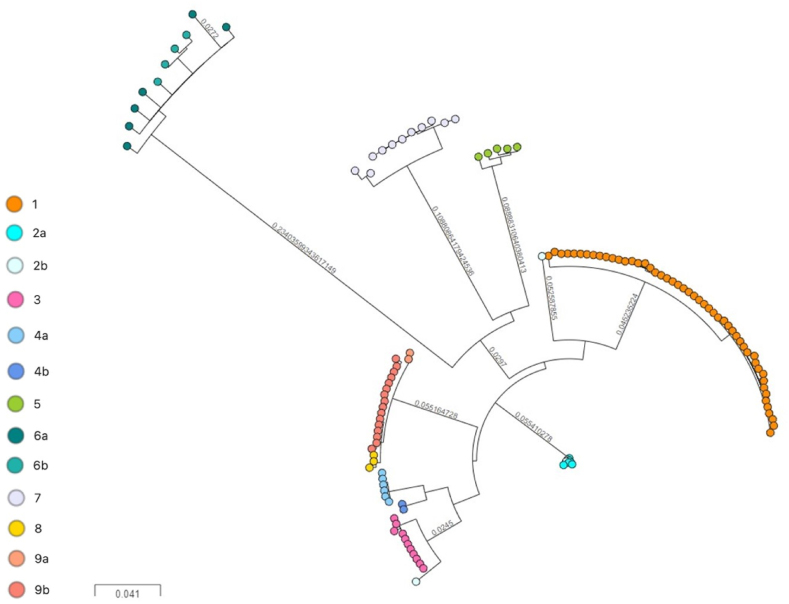
Whole genome sequencing-based methodologies have become extremely relevant for the molecular surveillance of human pathogens and are being increasingly introduced into national reference laboratory services. In this study, we describe the validation and implementation of core-genome Multi-Locus Sequence Typing (cgMLST) and whole genome single-nucleotide polymorphism (wgSNP) analysis at the Irish Mycobacteria Reference Laboratory, as a replacement for Mycobacterial Interspersed Repetitive Unit-Variable Number Tandem Repeat (MIRU-VNTR) typing. Concordance of clustering, discriminatory power, and ease-of-use of both WGS analytical methods were evaluated. Although wgSNP analysis (MTBseq) was the most discriminatory method ( < 0,001), we recommend cgMLST (SeqSphere), as the first-line approach for molecular typing of isolates in the context of routine surveillance work due to its ease of use and decreased turnaround time, while reserving wgSNP-analysis for a more in-depth cluster analysis of new isolates that show a distance of ≤12 alleles to any other isolate(s) in the cgMLST database.
基于全基因组测序的方法对于人类病原体的分子监测已变得极为重要,并且正越来越多地被引入国家参考实验室服务中。在本研究中,我们描述了爱尔兰分枝杆菌参考实验室对核心基因组多位点序列分型(cgMLST)和全基因组单核苷酸多态性(wgSNP)分析的验证与实施,以取代分枝杆菌散布重复单元可变数目串联重复序列(MIRU-VNTR)分型。评估了两种全基因组测序分析方法在聚类一致性、鉴别力和易用性方面的表现。尽管wgSNP分析(MTBseq)是鉴别力最强的方法(<0.001),但由于其易用性和缩短的周转时间,我们推荐将cgMLST(SeqSphere)作为常规监测工作中分离株分子分型的一线方法,而将wgSNP分析保留用于对在cgMLST数据库中与任何其他分离株等位基因距离≤12的新分离株进行更深入的聚类分析。