Pandey Sapna Kumari, Roy Kunal
Drug Theoretics and Cheminformatics Laboratory, Department of Pharmaceutical Technology, Jadavpur University, Kolkata 700032, India.
Toxicol Rep. 2024 Nov 19;13:101822. doi: 10.1016/j.toxrep.2024.101822. eCollection 2024 Dec.
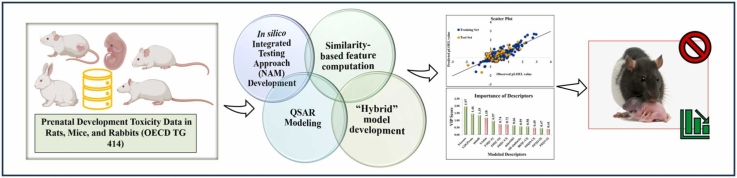
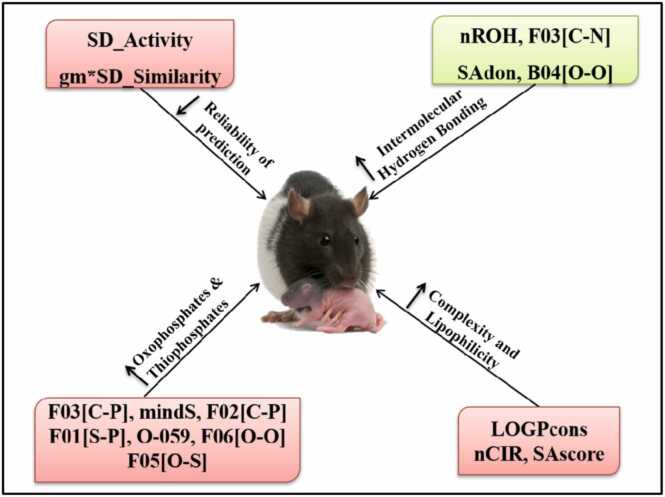
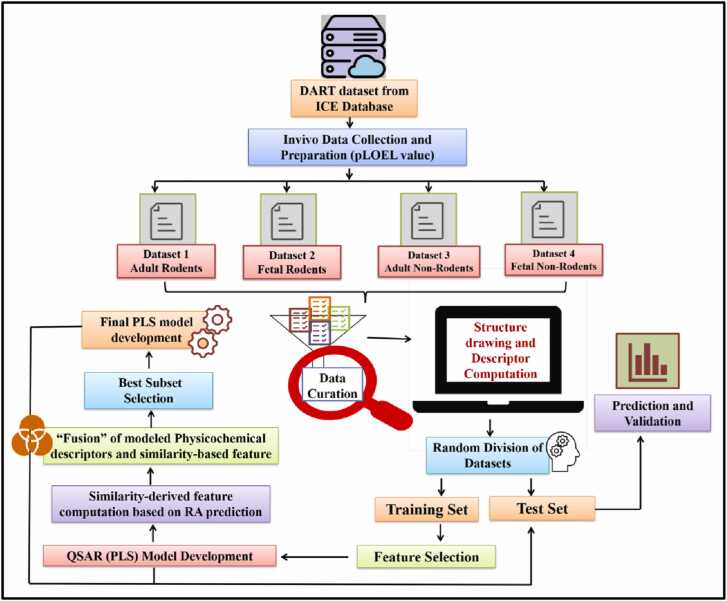
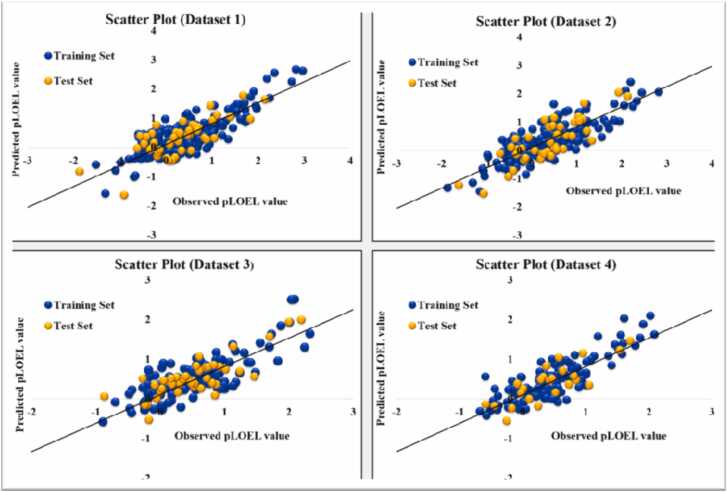
The governing laws mandate animal testing guidelines (TG) to assess the developmental and reproductive toxicity (DART) potential of new and current chemical compounds for the categorization, hazard identification, and labeling. modeling has evolved as a promising, economical, and animal-friendly technique for assessing a chemical's potential for DART testing. The complexity of the endpoint has presented a problem for Quantitative Structure-Activity Relationship (QSAR) model developers as various facets of the chemical have to be appropriately analyzed to predict the DART. For the next-generation risk assessment (NGRA) studies, researchers and governing bodies are exploring various new approach methodologies (NAMs) integrated to address complex endpoints like repeated dose toxicity and DART. We have developed four hybrid computational models for DART studies of rodents and rabbits for their adult and fetal life stages separately. The hybrid models were created by integrating QSAR features with similarities-derived features (obtained from read-across hypotheses). This analysis has identified that this integrated method gives a better statistical quality compared to the traditional QSAR models, and the predictivity and transferability of the model are also enhanced in this new approach.
管理法规规定了动物试验指南(TG),以评估新的和现有的化合物的发育和生殖毒性(DART)潜力,用于分类、危害识别和标签标注。建模已发展成为一种有前景、经济且对动物友好的技术,用于评估化学品进行DART测试的潜力。该终点的复杂性给定量构效关系(QSAR)模型开发者带来了一个问题,因为必须对化学品的各个方面进行适当分析以预测DART。对于下一代风险评估(NGRA)研究,研究人员和管理机构正在探索各种新方法学(NAMs),以综合解决像重复剂量毒性和DART这样的复杂终点。我们分别为啮齿动物和兔子的成年和胎儿生命阶段的DART研究开发了四种混合计算模型。这些混合模型是通过将QSAR特征与相似性衍生特征(从跨读假设中获得)相结合而创建的。该分析表明,与传统的QSAR模型相比,这种综合方法具有更好的统计质量,并且在这种新方法中模型的预测性和可转移性也得到了增强。